
Michelin has just unveiled not one but two exciting new additions to their all-season tyre lineup: the CrossClimate 3 and the all-new CrossClimate 3 Sport. While the CrossClimate 3 represents an evolution of the much loved CrossClimate 2, the CrossClimate 3 Sport is a completely new offering aimed at drivers of sportier vehicles who still want all-season versatility.
Having spent a week testing both new tyres alongside the CrossClimate 2, I can explain how these new models perform, and what improvements Michelin has made to their already impressive all-season range.
Michelin CrossClimate 3: Evolutionary Improvement
The CrossClimate 3 was developed as an evolution rather than a revolution of the CrossClimate 2. Michelin's primary goals for this new version were to improve two specific areas where the CrossClimate 2 had lost performance compared to its rivals:
- Improved Wear Performance: Enhancing longevity to lead the segment
- Enhanced Wet Grip: Better wet handling and braking performance
These improvements needed to be achieved without compromising the CrossClimate 2's existing strengths, particularly its class-leading snow performance and excellent rolling resistance.
Performance Improvements
The below graphs show the improvements made when comparing the CrossClimate 3 to the CrossClimate 2 in 205/55 R16 using a VW Golf.
Dry
Subjective dry handling: Noticeably improved steering response and predictability
Wet
Snow
Despite improving wet performance, Michelin actually enhanced snow capability as well, according to TÜV testing:
This is particularly impressive considering the CrossClimate 2 was already the benchmark for snow performance in the all-season category, with capabilities that match or exceed many dedicated winter tyres.
Comfort and Refinement
The subjective improvements in comfort and noise were among the most noticeable changes. The CrossClimate 3 features:
- Lower pitch of road noise (less intrusive)
- Improved impact absorption
- More mature, predictable steering feel
- Smoother response over rough surfaces
Rolling Resistance
The CrossClimate 3 maintains very low rolling resistance: 7.2 kg/t compared to 7.1 kg/t for the CrossClimate 2. This is lightly due to the higher starting tread depth of the CrossClimate 3.
In wear testing by Dekra, the CrossClimate 3 managed to regain segment leadership, albeit by a small margin over its strongest competitors.
Michelin CrossClimate 3 Sport: The New Contender
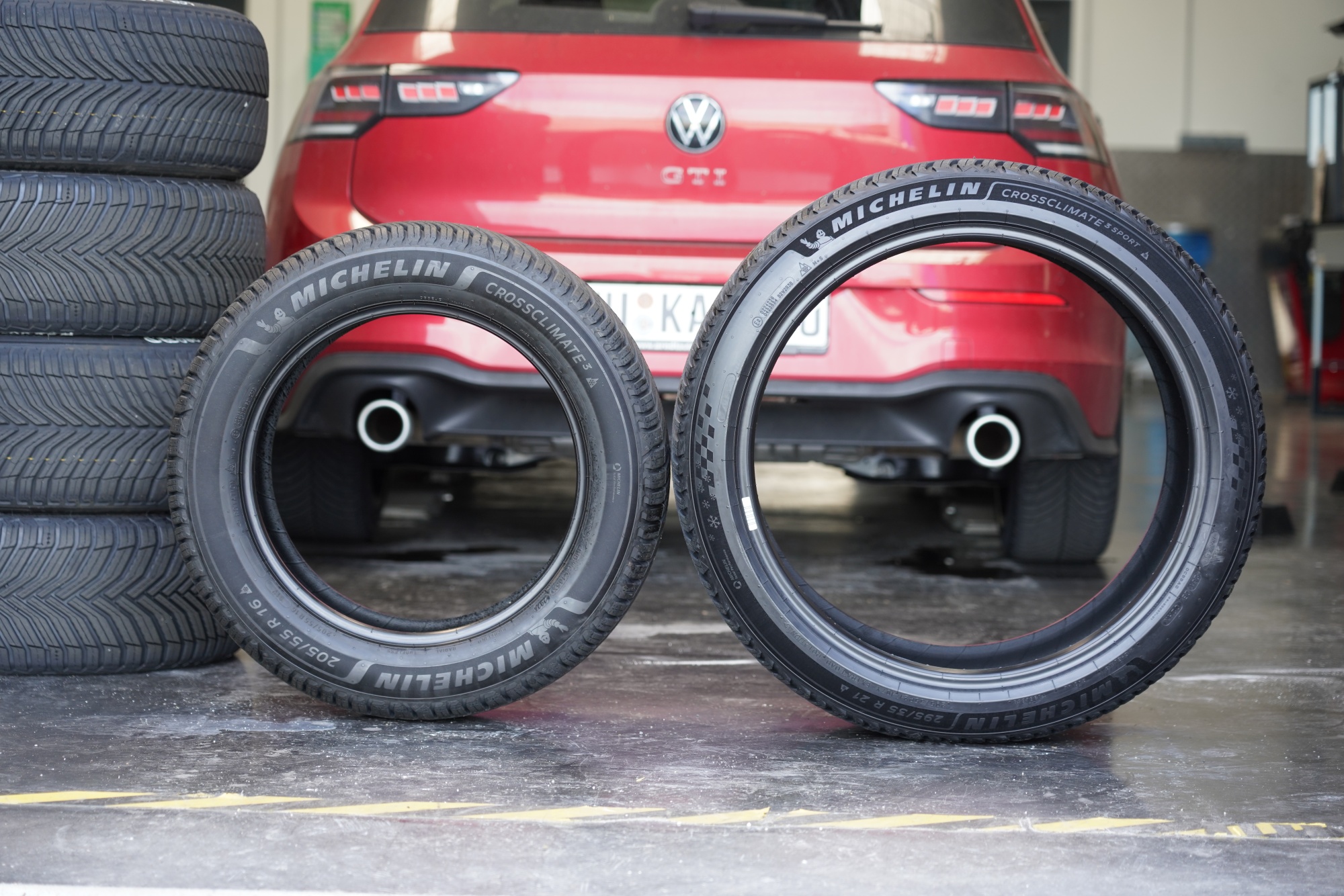
The CrossClimate 3 Sport represents Michelin's response to a specific consumer need: drivers of sportier vehicles who want the convenience of all-season tyres without sacrificing the dynamic handling characteristics they expect.
According to Laurent Pascal, the project manager for the new CrossClimate tyres, the key goal was to "provide sport performance in the summer while having also some snow capabilities."
Technology and Design
- Hybrid Belt with Aramid and Nylon: This technology, borrowed from Michelin's motorsport heritage and Pilot Sport 5 tyre, ensures optimal transmission of steering inputs to the road for precision handling.
- New Generation Tread Compound: Specifically engineered to deliver excellent wet grip while maintaining EU label efficiency certification.
Performance Comparison
The full test including the CrossClimate 3 and CrossClimate 3 Sport will be published at the start of July, but here are some of the data points.
- Dry braking: Small improvement over CrossClimate 3
- Handling lap time: 2.2% faster than CrossClimate 3
- Subjective feel: Much more direct, responsive steering with sportier characteristics
- Wet handling: 4.6% better lap time than CrossClimate 3
- Wet braking: Impressive 10% improvement over CrossClimate 3
- Aquaplaning: Slight reduction in resistance compared to CrossClimate 3, but still competitive
- Snow braking: Only 0.4% behind CrossClimate 3
- Snow traction: Just 0.2% lower than CrossClimate 3
- Snow handling: 1.3% difference
- Snow circle: 4.2% behind (the largest difference, but still excellent overall)
This means the CrossClimate 3 Sport will also be one of the best all-season tyres for snow performance, outperforming many existing all-season options.
Wear Performance
The wear target for the CrossClimate 3 Sport was different than the standard CrossClimate 3. Rather than targeting segment leadership, Michelin aimed to match the combined wear performance of using a summer Pilot Sport 5 and winter Pilot Alpin 5 when using two sets of the CrossClimate 3 Sport.
Looks
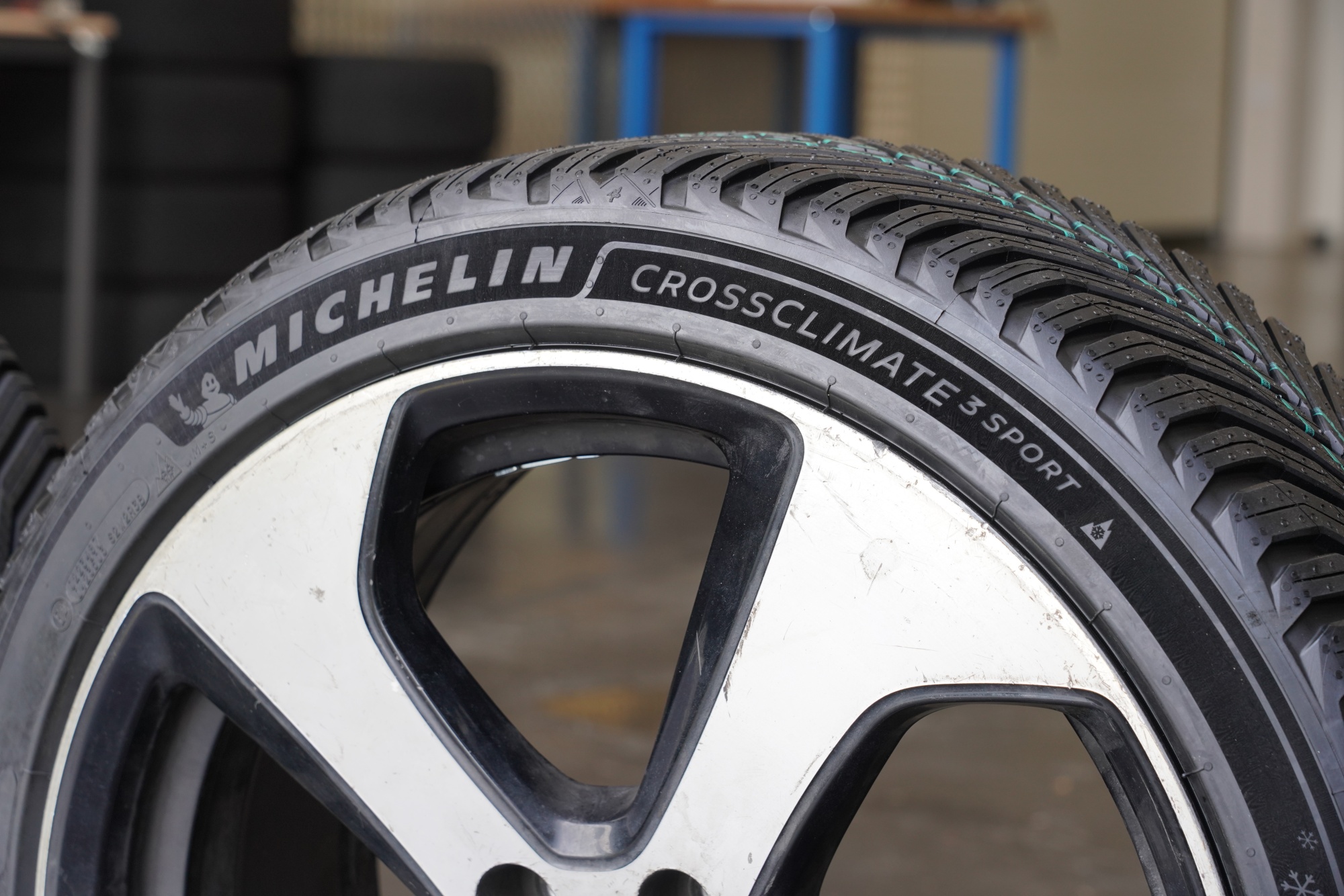
Both new tyres feature attractive sidewall designs:
- CrossClimate 3 Sport: Premium touch velvet ring with a distinctive checkered flag and snowflake design on all sizes
- CrossClimate 3: Thinner velvet ring on 18" and larger sizes, with smaller sizes getting a more basic sidewall design
Size Range and Availability
CrossClimate 3: 130 sizes from 16" to 22" by the end of 2026
CrossClimate 3 Sport: 60 sizes from 18" to 23"
There are only four overlapping sizes between the two tyre lines, so most consumers won't face a difficult choice between models.
The SUV-specific variant of the CrossClimate 2 has been discontinued, with the CrossClimate 3 designed to accommodate both passenger cars and SUVs/CUVs.
I will update the site once I have a full list of sizes.
Conclusion
Michelin has successfully improved on the CrossClimate 2, turning it into an even more capable CrossClimate 3, addressing its few weaknesses while maintaining or improving its many strengths. The introduction of the CrossClimate 3 Sport adds an interesting option for drivers who want both sporty handling and all-season versatility.
The CrossClimate 3 represents a complete upgrade over its predecessor in every performance category, while the CrossClimate 3 Sport delivers impressive dry and wet performance without significant compromises in snow capability - a remarkable engineering achievement that further expands Michelin's strong position in the all-season tyre market.
Thanks for all the great reviews and comparisons.
I've recently bought an Audi Q6 Launch Edition (in the UK here). Although it comes with 21" Pirelli P-Zeros's, I intend to change to 20's and can't decide between the CC3's or CC3 Sports.
The car has air suspensions having a number os settings from Comfort to Sport, and I'm in a semi rural location, not doing high miles, probably less than 8k a year. I like the occasional 'spirited' drive, with mostly commuting the rest of the time.
I realise it's no sports car having owned a Porsche Boxster.
With the above in mind, Which of the CC's do you think would best suit? Would the difference be noticeable?
Thank you for this very helpful information! Curious if you have or have seen any data on ice performance? That seemed like the biggest weakness of the CC2s, I wonder if the CC3s have improved much on that
Nope. Michelin don't even test the CC range on ice, it's not a priority in development for this segment.
I'm wondering how the Cross Climate 3 Sport compare to the Pirelli Cinturato WeatherActive, which won in all the previous All Weather tire comparisons for dry handling. Wish those had been included in the comparison rather than the Pirelli AS 3, I'm trying to decide which one to get for a trade-off of spirited summer driving and occasional mountain weekend trips in the winter ?
Sadly there's no region you can currently buy both in :(
Hi guys,
I drive a Renault Megane 3 Hatchback (2011) on 205/55 R16 tyres, annual mileage ~15,000 km, mostly city driving in Veliko Tarnovo, Bulgaria.
Climate here: very hot summers (up to 42-43°C, ~4 months) and short winters (~2 months, mostly wet roads and slush, with occasional snow/ice).
I’m hesitating between:
Michelin CrossClimate 3
Continental AllSeasonContact 2
Hankook Kinergy 4S²
Main priorities: durability in hot summers, wet grip/safety, and low noise/comfort.
Which one would be the best long-term choice?
We don't know how the CC3 performs longterm yet so I can't answer that.
A shame that the CC3 no longer is supporting 15in wheel sizes, given how popular the 195/65 R15 tyre has been, and how many 15in tyres are still the standard size for most superminis other than upper trim/Sport versions.
It's been quite noticeable that for newer cars (built since the late 2010s and especially those from the last 5 years), fitting 'standard' sized tyres (like 195/65 R15, 205/55 R16, etc) on cars is getting rare, with all manner of variants used, meaning tyre manufacturers have far less economies of scale, and thus the cost to the consumer (especially replacement tyres) will be a good deal higher.
I've also noticed that many tyre manufacturers are cutting back on what tyres they sell for 'older' cars with smaller wheels/higher sidewalls, despite there still being many of them still on the roads and high in popularity, because of the high (new) purchase price, complexity and maintenance of newer cars.
When I last bought a set of 195/65 R15s for my 2005 Mazda3 back in 2018, BlackCircles (for example) had nearly 100 tyres for me to choose from across a wide band of makes and price/quality points, including all the latest ones. I checked again recent and the number had dropped to just 20, and where prices had gone up by 50%. It was a similar experience looking at competitor websites.
The 'new' tyre sizes (e.g. OEMs using 205/60 R16 instead of 205/55 R16) car use have meant changing tyres adds on another 1/3rd to the price, sometimes as much as 50% from the late 2010s for higher trim 'standard (non-sporty) cars that used to be fitted with 17in rims that now get 18in ones.
The example of Michelin dropping their SUV range of tyres could also indicate that they've just made most of their tyres for 'non-SUV cars' just XL in order to take the extra weight and cornering forces of SUVs, thus everyone pays the higher prices, not just SUV owners.
Replacing a set of tyres can these days easily cost well in excess of £600 + fitting even for 'bog standard' (non-sporty) Focus sized cars, and where they last a lot less because the tyres are low profile and thus much more susceptible to damage from kerbing, potholes, etc.
Got the CC3 Sports on my 2022 Corolla TS this week, full set, racked up a few hundred miles already, and I love em, they look fab and feel great...
I initially ordered some of the Pirelli SF3's, but the fitters could only get three tires for this week, so offered me CC3/CC3 Sports as an alternative, and upon looking into them on Google, I decided I wanted the CC3 Sport, they are very close to the SF3's anyway, so I am very very happy that fate pushed them my way...
Highly recommend them...
Awesome, glad you like them. Once you have a good idea of their performance please leave a review on the site (review your tyres top right of navigation) as it will really help others.
https://youtu.be/1bVyClJDiuA?si=HVVuSwiygrb3Yii8 Someone has done the comparison. You could do a better one.
working on it. the laptimes in that comparison are interesting, much slower than expected using same car / tire
Will there be more sizes for cc3? Theres only 2 or 3 sizes for 19in wheels.
Yes there are more sizes coming, however I think the big sizes like 19" an above will mostly be served by the CC3S.
Thank you for giving the temperature of the wet braking tests!!!
Looks like CC3 Sport are the perfect tyre choice for Tesla Model 3. I'm happy overall with CC2, but grip in the wet is not very good and the car balance is too understeery. I'm willing to switch to CC3 Sport ASAP!
The test results are very interesting, however, the graphs are a bit unscientific, if not even misleading. When you arbitrarily choose that a graph starts at 100 seconds and goes to 101 seconds for example, then that miniscule difference - which is well within the margin of error and could thus be dismissed - is blown out of proportion, quite literally.
The graphs completely exaggerate the relatively minor generational improvements (and let's be honest, we can't expect a quantum leap anymore, they already did their homework on the CC2). If we were to see the graphs in their entirety, it would make it very clear that these improvements, while nice, are not as revolutionary as they seem on the graphs.
Whenever i see graphs that are zoomed into the very tip of them, i know that it's usually a marketing trick by someone like NVIDIA, when they don't want to make it so obvious that the improvements are rather pedestrian. If i see it on a (presumably mostly independent) website, it's just bad practice. Yes, you can't really show the difference all that well when we see the entire graphs, but that's the point of it then, the difference simply isn't very big. Maybe just leave out the graphs and give us the numbers in that case.
Sorry, had to get this off my chest.
Misleading would be a better description than unscientific.
You can press the charts tab and see the graphs zero starting. For the majority of people on mobile this is not good UI which is why the graphs aren't zero started in the main article. The X axis is clearly labelled and you can click the bars for the data so nothing is trying to be hidden.
Thank you for that hint, i haven't even noticed that "Test Charts" leads to a different subpage with the graphs properly scaled. Honestly, this is the way that it should be done in the main article, with the option of zooming in for people on mobile, perhaps. Or if you have found that the space is too tight for people on mobile, serve them a different layout, lots of websites can do that. For me on PC, i never want to see graphs zoomed in like this, because it distorts the results.
Yes, you clearly label the graphs, and i wasn't insinuating that you are trying to hide anything. But we humans are such visual animals that, with a bunch of graphs showing a clear advantage for one product, the main takeaway will still be the bigger difference that the graphs suggest at first glance. There is a reason this trick is regularly being used in marketing materials for new products.
Another minor gripe i have with the graphs on the subpage is that, in two instances, the order is reversed, because the CC2 was better than the CC3. It would probably be better to always keep the same order (CC3 top, CC2 bottom graph), because after the 7th or 8th graph, people might not bother to look at the labelling anymore and just assume that CC3 is top and CC2 bottom on the graph.
Anyway, thanks again for the hint about the graphs, i feel like these are much more informative, and should probably be more prominently linked somehow (as i said, i missed them initially, not being a regular user of this website).
P.S. New all-season tyre test from German "ADAC" is out (2025 test).
Hey!
I need your advice on something. Im considering buying the CC3S for my Winther rims which goes on my Tesla model 3 performance, and then still keep a dedicated summer tyre like the PS4S for my summer rims. Because it seems like the CC3S beats UHP Winther tyres in everything, except snow and ice, while still maintaining overall safety in that catergory. My main priority is to keep overall performance to a Max at All times. Dont Care that much for snow performance since its only 2 weeks at Max we have snow where I live.
Would this be a good idea, or should I just keep the CC3S on all year?
The idea of the CC3S is to be on all year. I can't make that choice for you, especially as I don't have any experience comparing it to a summer tyre, sorry.
Hello,
I’m considering purchasing a set of all-season tires and would appreciate your expert recommendation. I’m currently choosing between the Michelin CrossClimate 3 and the Pirelli Cinturato All Season SF3.
I live in Eastern Europe, where winter conditions usually last for about two weeks per year with some light to moderate snowfall. My annual mileage is low, so tread life and durability are not major priorities for me.
What matters most in my case are:
Safety in all weather conditions (especially in wet and light snow),
Low noise levels,
Comfortable ride quality.
Based on these criteria, which of the two tires would you recommend?
Thank you in advance for your advice.
Best regards,
Robert
In the all season tyre test 24/25 the CC2 was 4th with disappointing wet performance compared to the front runners and the dry performance wasn't as sharp either. Do these changes for the CC3 do enough to push it up the ranking? How does the wear compare to the Pirelli, Bridgestone and Conti?
Hi! Would you choose CC3/CC3 Sport (when they are released) for a Tesla Model 3 Long Range or the Pirelli Cinturato SF3 instead? The rim size is 235/40 R19. There isn't much snow in Hungary in the winter anymore, only dry, freezing temperatures down to -10°C. However, summers can be very hot, reaching about 40°C.
The car currently has Cinturato SF2s, but I'm not entirely satisfied with them. I find them a bit noisy, and I've noticed a brief loss of grip when crossing tram lines, which never happened before with other Teslas and tires.
I'm not sure what sizes the CC3S will be released in yet, assuming you can get it I would go with that. Then the SF3 over the CC3.
Hey Jon!
Would you still recommend SF3 over the CC3, if the car is a 1350 kg Honda Civic (1.8 petrol) ? My concern is that the SF3 here only comes in 94V, but for my car, it may be overkill and CC3 in 91H would be more adequate, but probably the difference it makes is not that big. Also, I heard that CC3 will have a new compound that can better adapt to temperature changes, so shouldn't it be better than the SF3 in extreme heat? What do you think?
PS.: Love your reviews!
Yes. Often 94V and 91H are the same tyre now.
Could you please mention rim protection in future AS tests? CC2 was horrible (235/35 R19), now I am on Bridgestone AS6, much better. It's a better tire as well (Cupra Leon ST 245 kW) for Northern Germany.
I try to in all tests where possible, it can be found in the results section under the tyre picture. It will be included in the next test in 18", in this case in 16" there was no protection, and there usually isn't on 16" models.
Thanks, sadly you didn't in The Best All Season Tyres for 2024 / 2025.
Well that was silly of me. I checked as I Should have taken the data but I can't find it at the moment, I'll check again later.
TBDR Bridgestone and Pirelli usually do the best.
Don't know what TBDR means (google doesn't know either), but Pirelli SF3 seems to have nearly nothing when it comes to rim protection.
Any news here?
The small improvements on the cc3 over the cc2 are fine - but - the wet handling should have been their priority. I’m disappointed they didn’t manage to improve more in this segment. I would have traded some minor snow performance and some more mileage to avoid the mediocre grip and heavy understeering in the rain.
The cc3sport compound without the sporty less comfort would make the perfect tire for me. I drive 10k km a year - I don’t need tires that last 5-6 Years. I’m fine with 3-4 Years.
Maybe I have to wait for the next generation Goodyear all season. My cc2 looks like new after 20000km. So I have some time left.
I guess that's what the CC3 Sport is.
How much has the comfort increased? Is it on the level of the touring summer tyres? What's the difference in comfort between cc3 and the sport version?
It's a small change but the CC2 was on the level of summer touring in terms of comfort so yes
Please do a squish test like you used to do at the end of the videos.
I sadly didn't have any unmounted in the same size for this test, but I'll incorporate it more in the future, especially for high performance stuff where possible
Can't wait for more videos, wish you could upload more often. Really appreciate all your effort.
Have you thought of doing a leaderboard for all tyres, in terms of dry/wet braking distance, rolling resistance, comfort and all measurable metrics. Top 100 tyres chart, like the dxo mark for phones?
Sadly it is not possible to compare braking distances between tests as surface has a huge effect.
Its the continental all season 2 more comfortable than the cc3 sport?
No one has tested this yet. I'd GUESS that yes the ASC2 would be a little more comfortable.
not for 15" :(
Hi. I think same. I have small city car with 15'' wheels. We must wait, maybe Michelin fix this mistake. Have a nice Day.
Interesting that the CC3 Sport has such a massive improvement in wet braking on the standard CC3. 10% is huge. Why couldn't Michelin get some of that additional improvement with the standard CC3 given that the Sport has done it with minimal effect on snow performance. They've improved the CC3 wet performance but it's still behind the Pirelli in dry and wet if we take your last AS test and apply the CC3s percentage improvements to the CC2
Sounds like the dry and wet performance improvement on CC3S is at expense of comfort and wear. If I’m reading correctly, CC3S will only last half as long as CC3.
I think it might be more than half as long, but yes it seems CC3S traded some wear for some wet grip
Wear is important to Michelin for the CC3, so yes it's still behind the Pirelli but lasts probably twice as long.
The CC3 Sport does not have the tread life of the CC3 which is why it can offer better wet performance.
The CC2 we mounted on our family hatchback have worn beautifully, but they developed cracks within one or two years. 4 years and 41k km later, the remaining tread is about 3-4mm front and 4-5mm rear (and about to be rotated), but the grooves are all cracked along the V-shaped tread.
In the past P7 and Primacy lasted about the same 3-4 years of driving and about 30-40k km. I don't expect Pirellis to last as long, but the tyre wear test seem to suggest the difference will be dramatic, when in our experience was only marginal.
This is quite exciting! Would you say the CC3S comes close to a North American UHP all season or it still firmly a touring tyre, just a bit sportier? Really looking forward to seeing both of these being tested against the competition!
Would you consider both of these tyres to be the same class?
Do you think this move might induce other companies to introduce sportier all season choices in Europe?
I'm assuming it will be somewhere in-between the two, but I need to test that when it comes to the USA.