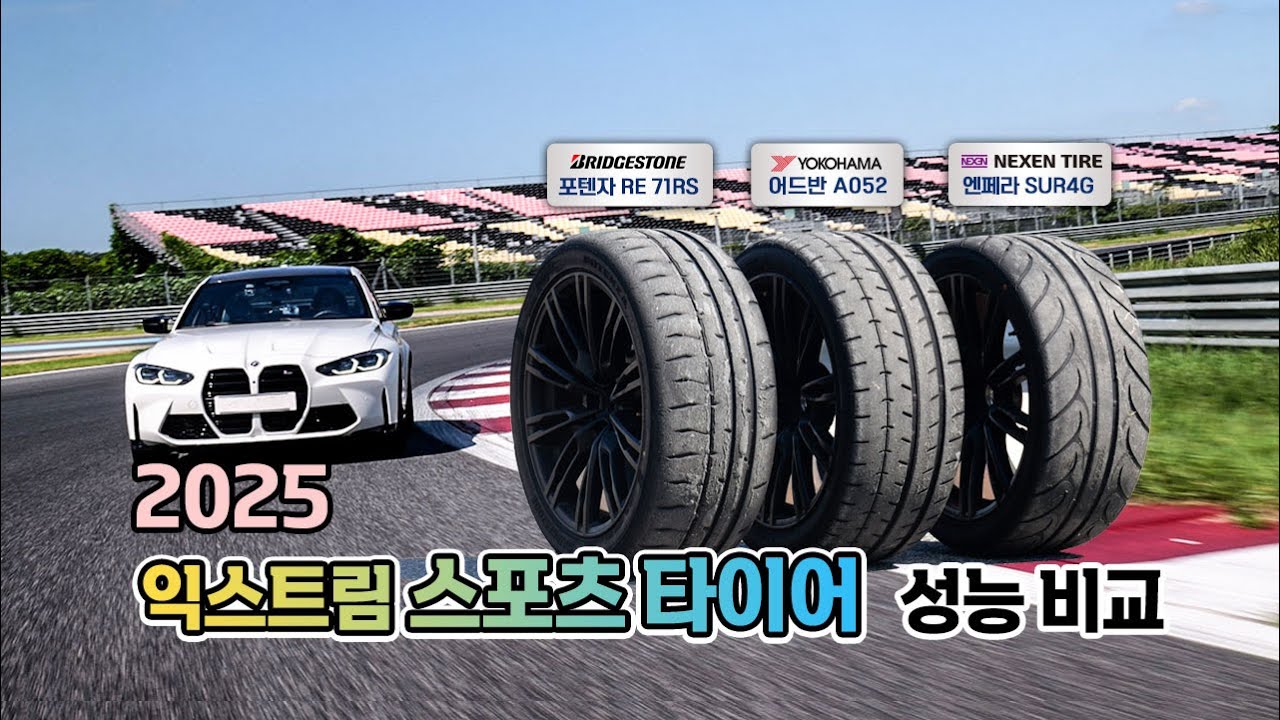
AutoView's 2025 extreme-performance shootout takes three of the most aggressive R-compound-flavoured summer tyres available in the Korean market - the Nexen N'Fera SUR4G, the Bridgestone Potenza RE71RS and the Yokohama Advan A052 - and runs them on a BMW M3 (G80) in 275/35R19. The SUR4G is the staple of Korean sprint racing and goes in as the domestic benchmark; the RE71RS and A052 are the imported reference tyres against which it has to defend that reputation. Michelin declined to send a Pilot Sport Cup 2 / 2R for this round, citing a worry about being beaten by tyres with prior test wins overseas - so the obvious fourth contender is missing, but the three that did show up cover the price/performance spectrum cleanly.
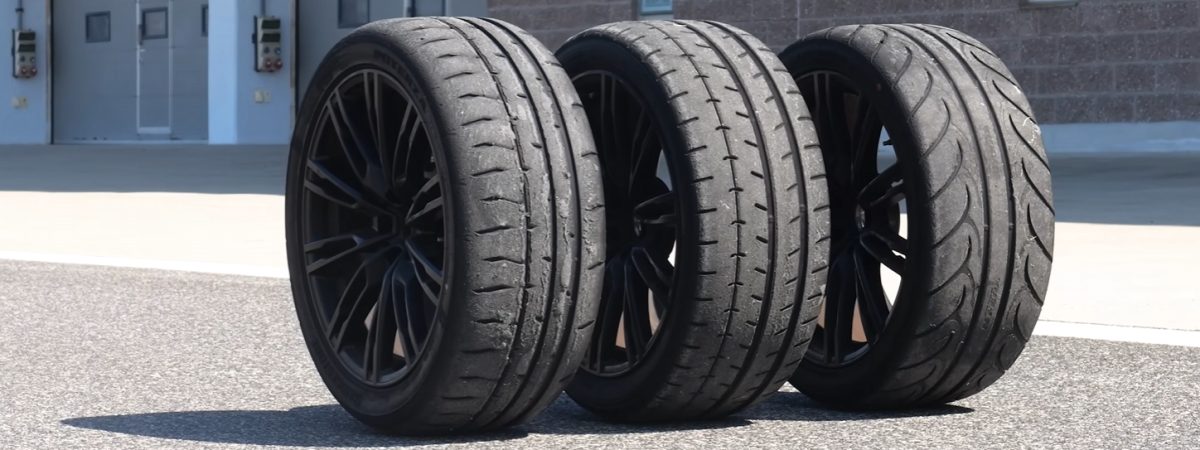
The headline result is a narrow win for the Bridgestone Potenza RE71RS: shortest dry stop, shortest wet stop, and the fastest single lap of Korea International Circuit at Yeongam - 1:25.15, just 0.01 s clear of the Yokohama Advan A052. That gap is well inside AutoView's 0.03 s dead-heat threshold, so on outright pace those two tyres are effectively tied; the RE71RS earns the overall by carrying its advantage into the braking columns as well. The Nexen N'Fera SUR4G is 1.25 s adrift on lap time, has the longest dry stop, and lacks the steering directness of the imports - but it also stays consistent across all three laps where both rivals fade, is the quietest of the three on highway pavement, and remains the obvious value pick for repeated track-day use.
Test Publication:
AutoView
275/35R19
3 tyres
2 categories
AutoView is not affiliated with, and does not endorse, Tyre Reviews. This is independent editorial coverage of their published test.
Objective braking and skidpad work was done at KATRI on the M3 at factory cold pressures; the circuit session was run separately at Yeongam with AutoView's Jeon In-ho driving on a hot day with track surface temperatures over 50 °C. AutoView also captured tyre weight, tread thickness, weight-to-weight deviation across the set, and a 40 km/h coast-down rolling-resistance proxy in the video, none of which convert cleanly into our breakdown units - the relevant observations from those are folded into the per-tyre commentary below.
Dry braking
The RE71RS pulls up roughly two metres shorter than the SUR4G - a wider margin than expected on what is supposed to be the home-market tyre's strongest test.
- Bridgestone Potenza RE 71RS
- Yokohama Advan A052
- Nexen N Fera SUR4G
Wet braking
Wet braking from 80 km/h on a depth-controlled flooded surface. The order reshuffles in the lower placings: the Bridgestone holds its lead, but the SUR4G beats the A052 by nearly two metres here. The thin, narrow-grooved A052 tread shows its limits in standing water.
- Bridgestone Potenza RE 71RS
- Nexen N Fera SUR4G
- Yokohama Advan A052
Dry handling - Yeongam circuit
Three flying laps on the full 3.045 km Korea International Circuit at Yeongam, with the best lap from each tyre recorded below. The RE71RS and A052 both peaked on their opening flying lap and fell off about a second on lap two; the SUR4G held its time consistently across all three laps but ~1.25 s slower than the imports. AutoView also ran a 30 m skidpad to find the lateral-grip limit on each tyre - all three carried essentially the same ~68 km/h before sliding, so steady-state lateral grip on its own doesn't separate them; the difference is what they do around the limit.
- Bridgestone Potenza RE 71RS
- Yokohama Advan A052
- Nexen N Fera SUR4G
Results
The Bridgestone Potenza RE71RS takes the overall on combined braking and one-lap pace, the Yokohama Advan A052 ties on lap time but loses both braking columns and degrades hardest, and the Nexen N'Fera SUR4G is the value and durability pick - slower, but the only tyre on the test you would happily lap on all afternoon.
2025 AutoView Extreme Performance Tyre TestWatch the full video of this test on YouTube Watch on YouTube
The Bridgestone Potenza RE71RS posts the shortest stop of the test in both dry (30.8 m from 100 km/h) and wet (27.6 m from 80 km/h), with the lowest tyre-to-tyre weight deviation of the three. Its front-to-rear grip balance is the most even on corner exit, so understeer is well suppressed and the M3 can pick up the throttle earlier than on the Yokohama. The tread blocks are softer than the A052's, which gives it noticeably better curb and bump compliance - the suspension stays composed where the Yokohama gets unsettled. The steer character is a stable progression from light understeer toward neutral and never surprises the driver.
Steering pointing precision is a step behind the A052; small inputs translate into grip with a slight time lag because the soft tread block sits on a stiff carcass. The tyre is intolerant of slip - push past its narrow slip-angle window and it scrubs off speed sharply, so a clean, planned line is mandatory. Longitudinal grip falls off noticeably after the opening hot lap, more than the A052's. And of the three tyres on test it is the loudest on highway pavement.
The Bridgestone Potenza RE71RS is AutoView's narrow winner: best in both braking columns, fastest single-lap pace at Yeongam (1:25.15 - 0.01 s ahead of the A052 and inside AutoView's 0.03 s dead-heat threshold, so the two are effectively tied for outright pace), and the most balanced steer character of the three. A demanding tyre that punishes overdriving, but the most rewarding when driven cleanly.
| Test |
# |
Result |
Best |
Diff |
% |
| Dry Braking |
1st |
30.8 M |
|
|
100% |
| Dry Handling |
1st |
85.15 s |
|
|
100% |
| Test |
# |
Result |
Best |
Diff |
% |
| Wet Braking |
1st |
27.6 M |
|
|
100% |
The Yokohama Advan A052 is the lightest tyre on test and the one that talks loudest to the driver: feedback is rigid, direct and consistent across loads, which is exactly the character a track driver looks for. It needs the smallest steering angle to hit a given line, responds fastest to small inputs, and holds grip at higher slip angles than either rival - overcooked entries come back without much speed loss. Its single best lap (1:25.16) is essentially tied with the RE71RS and 1.25 s clear of the SUR4G.
Wet braking is the weakest of the three at 30.7 m from 80 km/h - nearly two metres longer than the Bridgestone - and the thin tread that helps in the dry is the obvious culprit; expected service life will also be shorter as a result. On corner exits with long throttle phases (Yeongam's T8 for example) the front gives up before the rear and understeer pulls speed out of the run. The carcass is stiff, so kerbs and bumps unsettle the chassis more than they do on the Bridgestone. Performance falls off after the opening lap, with about 1.4 s lost on lap two - lateral grip in particular drops away.
The Yokohama Advan A052 is a one-flying-lap qualifier tyre: superb feedback, tiniest steering effort, ties the RE71RS for fastest lap. Pay for it with the worst wet braking on test and a clear pace drop after the first lap. If your weekend is timed-attack singles, take this one; if it's stints, take the Bridgestone.
| Test |
# |
Result |
Best |
Diff |
% |
| Dry Braking |
2nd |
32 M |
30.8 M |
+1.2 M |
96.25% |
| Dry Handling |
2nd |
85.16 s |
85.15 s |
+0.01 s |
99.99% |
| Test |
# |
Result |
Best |
Diff |
% |
| Wet Braking |
3rd |
30.7 M |
27.6 M |
+3.1 M |
89.9% |
The Nexen N'Fera SUR4G's signature strength is thermal stability - across the three flying laps at Yeongam its times barely move, where both rivals shed pace after the opening lap, so the SUR4G is the most forgiving tyre on the test for a driver who misses the optimum window. It is also the quietest of the three on highway pavement (both on ISO certification road at 80 km/h and on general road at 110 km/h), the cheapest by some margin, and clearly the most appropriate of the three for repeated lapping practice.
Steering feedback is the softest and slowest of the three, with the lightest wheel weight and the least linear response. Under load the rear breaks away ahead of the driver's prediction, turning a neutral entry into a mild oversteer on exit - and recovery from an evasive input takes more steering and more time than on either rival. Both braking columns are the longest of the three (32.7 m dry, 28.9 m wet), the structure feels soft enough that the line has to be 'steered into' rather than aimed, and the Yeongam best lap (1:26.41) is 1.25 s off the front pair.
The Nexen N'Fera SUR4G finishes third, but the model is now overdue for replacement and AutoView frames it as still credibly competing with much more expensive imported rivals. As an endurance / sprint-race tyre for Korean domestic series it remains the obvious value pick - predictable, durable, repeatable, and meaningfully cheaper to consume than the Bridgestone or Yokohama.
| Test |
# |
Result |
Best |
Diff |
% |
| Dry Braking |
3rd |
32.7 M |
30.8 M |
+1.9 M |
94.19% |
| Dry Handling |
3rd |
86.41 s |
85.15 s |
+1.26 s |
98.54% |
| Test |
# |
Result |
Best |
Diff |
% |
| Wet Braking |
2nd |
28.9 M |
27.6 M |
+1.3 M |
95.5% |

Discussion