Auto Bild Klassik magazine recently conducted a test of seven classic-style summer tyres in the 205/70 VR 15 size, aiming to improve safety and performance for vintage sports cars. The testers used a Jaguar E-Type Lightweight replica, an iconic 1960s sports car renowned for its powerful 270 PS engine and impressive 240 km/h top speed. I'm very sad this isn't a Tyre Reviews test!
As usual with Auto Bild tests, they've done a proper job. On wet surfaces, the tyres were evaluated for their resistance to aquaplaning, cornering stability, overall handling, and braking efficiency. Dry condition tests focused on handling, braking performance, rolling comfort, and noise levels. Additionally, the tyres' rolling resistance was measured to gauge their efficiency.
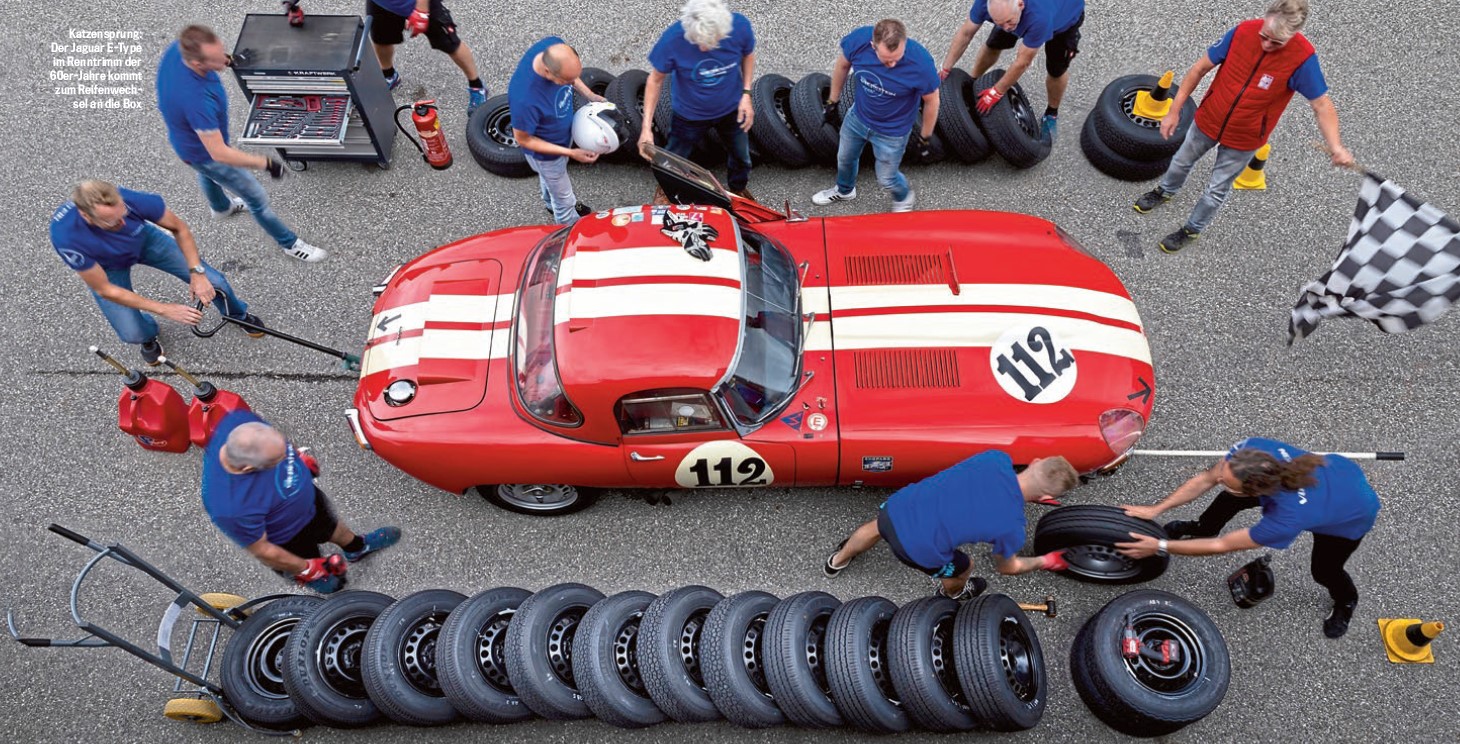
The test looked to find out what tyre could best enhance the driving dynamics and safety of a vintage vehicle while maintaining period-correct aesthetics. The test included offerings from major manufacturers like Pirelli, Dunlop, Michelin, and Vredestein, as well as lesser-known brands, providing a comprehensive view of the market for classic car enthusiasts seeking to upgrade their vehicles' performance without compromising their authentic look.
Test Publication:
Auto Bild
205/70 R15
7 tyres
4 categories
Test Size:
205/70 R15
Tyres Tested:
7 tyres
Auto Bild is not affiliated with, and does not endorse, Tyre Reviews. This is independent editorial coverage of their published test.
Dry
In dry conditions, the test revealed small differences among the tyres. The Pirelli Cinturato P5 and Pirelli Cinturato HS CN12 achieved the highest scores in handling tests, with both tyres allowing average speeds of 87.6 km/h and 87.5 km/h respectively. The Dunlop Sport Classic and Radar Dimax Classic followed closely, both reaching 86.8 km/h.
Braking performance from 100 km/h showed the Pirelli Cinturato HS CN12 stopping in the shortest distance at 37.2 meters. The Pirelli Cinturato P5 required 38.0 meters, while the Dunlop Sport Classic needed 38.7 meters to come to a full stop.
The Michelin XWX recorded the lowest average speed in dry handling at 85.5 km/h, indicating less responsive steering and reduced lateral grip compared to its competitors. However, it compensated with a quieter and more comfortable ride.
The Dunlop SP Sport Aquajet, despite its wet-weather oriented name, managed a respectable 86.3 km/h in dry handling. However, it required the longest braking distance of 41.4 meters from 100 km/h.
Comfort factors varied among the tyres. The Vredestein Sprint Classic and Michelin XWX produced the least road noise, measuring 72.6 dB(A) and 72.5 dB(A) respectively at 80 km/h. In contrast, the Pirelli models generated slightly more noise, with the Cinturato P5 measuring 78.0 dB(A).
The test highlighted that while all tyres performed adequately in dry conditions, measurable differences emerged in specific performance areas.
- Pirelli Cinturato HS CN12
- Pirelli Cinturato P5
- Dunlop Sport Classic
- Radar Dimax Classic
- Michelin XWX
- Vredestein Sprint Classic
- Dunlop SP Sport Aquajet
- Pirelli Cinturato P5
- Pirelli Cinturato HS CN12
- Dunlop Sport Classic
- Radar Dimax Classic
- Dunlop SP Sport Aquajet
- Vredestein Sprint Classic
- Michelin XWX
- Dunlop SP Sport Aquajet
- Radar Dimax Classic
- Michelin XWX
- Vredestein Sprint Classic
- Dunlop Sport Classic
- Pirelli Cinturato HS CN12
- Pirelli Cinturato P5
Wet
Wet conditions revealed more significant differences between the tyres. The Pirelli models again stood out, with the Cinturato HS CN12 and Cinturato P5 achieving the highest scores in most wet tests.
Wet braking from 100 km/h saw the Pirelli Cinturato P5 stop in the shortest distance of 49.5 meters. The Dunlop Sport Classic and Pirelli Cinturato HS CN12 followed closely at 50.3 and 50.5 meters. The Radar Dimax Classic required the longest distance at 71.9 meters.
- Pirelli Cinturato P5
- Dunlop Sport Classic
- Pirelli Cinturato HS CN12
- Vredestein Sprint Classic
- Michelin XWX
- Dunlop SP Sport Aquajet
- Radar Dimax Classic
In wet handling, the Pirelli Cinturato HS CN12 allowed the highest average speed of 78.8 km/h, closely followed by the Cinturato P5 at 78.4 km/h. The Dunlop Sport Classic and Vredestein Sprint Classic followed with 76.1 km/h and 75.2 km/h respectively. The Radar Dimax Classic struggled most in this test, managing only 66.2 km/h.
- Pirelli Cinturato HS CN12
- Pirelli Cinturato P5
- Dunlop Sport Classic
- Vredestein Sprint Classic
- Michelin XWX
- Dunlop SP Sport Aquajet
- Radar Dimax Classic
In the wet circular track test, both Pirelli models completed the circuit in 11.4 seconds, with the Dunlop Sport Classic and Vredestein Sprint Classic following at 11.8 and 11.9 seconds. The Radar Dimax Classic took significantly longer at 13.2 seconds.
- Pirelli Cinturato HS CN12
- Pirelli Cinturato P5
- Dunlop Sport Classic
- Vredestein Sprint Classic
- Michelin XWX
- Dunlop SP Sport Aquajet
- Radar Dimax Classic
Aquaplaning resistance tests showed the Pirelli Cinturato P5 maintaining traction up to 93.3 km/h, with the Vredestein Sprint Classic close behind at 91.5 km/h. The Michelin XWX and Dunlop SP Sport Aquajet lost traction earliest, at 73.6 km/h and 73.8 km/h respectively.
- Pirelli Cinturato P5
- Vredestein Sprint Classic
- Dunlop Sport Classic
- Pirelli Cinturato HS CN12
- Radar Dimax Classic
- Dunlop SP Sport Aquajet
- Michelin XWX
- Dunlop Sport Classic
- Pirelli Cinturato P5
- Vredestein Sprint Classic
- Pirelli Cinturato HS CN12
- Radar Dimax Classic
- Michelin XWX
- Dunlop SP Sport Aquajet
Value
The Dunlop Sport Classic demonstrated the lowest rolling resistance at 9.01 kg/t, suggesting it would be the most energy-efficient option among the tested tyres.
Following closely was the Radar Dimax Classic with a rolling resistance of 9.53 kg/t, and the Michelin XWX at 9.99 kg/t.
In the middle of the pack, the Pirelli Cinturato HS CN12 and Vredestein Sprint Classic showed similar results, with rolling resistances of 10.90 kg/t and 10.91 kg/t respectively.
The Dunlop SP Sport Aquajet had a higher rolling resistance at 11.54 kg/t, suggesting it may be less energy-efficient compared to most of its competitors in this test.
The Pirelli Cinturato P5 recorded the highest rolling resistance at 11.88 kg/t, indicating it might have the largest impact on fuel consumption among the tested tyres.
It's worth noting that while lower rolling resistance is generally beneficial for energy efficiency, it's just one factor in overall tyre performance. Tyres with higher rolling resistance often provide better grip, especially in wet conditions, as seen with the Pirelli models in this test.
Results
Excellent grip on wet roads, precise steering response, sporty-agile handling, short braking distances, good reserves in aquaplaning, good rolling comfort.
Increased rolling resistance.
| Test |
# |
Result |
Best |
Diff |
% |
| Dry Braking |
1st |
37.2 M |
|
|
100% |
| Dry Handling |
2nd |
87.5 Km/H |
87.6 Km/H |
-0.1 Km/H |
99.89% |
| Test |
# |
Result |
Best |
Diff |
% |
| Wet Braking |
3rd |
50.5 M |
49.5 M |
+1 M |
98.02% |
| Wet Handling |
1st |
78.8 Km/H |
|
|
100% |
| Wet Circle |
1st |
11.4 s |
|
|
100% |
| Straight Aqua |
4th |
86.1 Km/H |
93.3 Km/H |
-7.2 Km/H |
92.28% |
| Curved Aquaplaning |
4th |
3.21 m/sec2 |
3.92 m/sec2 |
-0.71 m/sec2 |
81.89% |
| Test |
# |
Result |
Best |
Diff |
% |
| Noise |
6th |
75.4 dB |
71.6 dB |
+3.8 dB |
94.96% |
| Test |
# |
Result |
Best |
Diff |
% |
| Rolling Resistance |
4th |
10.9 kg / t |
9.01 kg / t |
+1.89 kg / t |
82.66% |
Good grip on wet roads, crisp-direct steering behavior, sporty-balanced handling, short braking distances, good aquaplaning reserves.
Slight tendency to oversteer.
| Test |
# |
Result |
Best |
Diff |
% |
| Dry Braking |
3rd |
38.7 M |
37.2 M |
+1.5 M |
96.12% |
| Dry Handling |
3rd |
86.8 Km/H |
87.6 Km/H |
-0.8 Km/H |
99.09% |
| Test |
# |
Result |
Best |
Diff |
% |
| Wet Braking |
2nd |
50.3 M |
49.5 M |
+0.8 M |
98.41% |
| Wet Handling |
3rd |
76.1 Km/H |
78.8 Km/H |
-2.7 Km/H |
96.57% |
| Wet Circle |
3rd |
11.8 s |
11.4 s |
+0.4 s |
96.61% |
| Straight Aqua |
3rd |
87.1 Km/H |
93.3 Km/H |
-6.2 Km/H |
93.35% |
| Curved Aquaplaning |
1st |
3.92 m/sec2 |
|
|
100% |
| Test |
# |
Result |
Best |
Diff |
% |
| Noise |
5th |
74 dB |
71.6 dB |
+2.4 dB |
96.76% |
| Test |
# |
Result |
Best |
Diff |
% |
| Rolling Resistance |
1st |
9.01 kg / t |
|
|
100% |
Excellent grip on wet roads, precise steering response, sporty-crisp handling, short braking distances, very good reserves in aquaplaning.
Increased rolling noise, high rolling resistance.
| Test |
# |
Result |
Best |
Diff |
% |
| Dry Braking |
2nd |
38 M |
37.2 M |
+0.8 M |
97.89% |
| Dry Handling |
1st |
87.6 Km/H |
|
|
100% |
| Test |
# |
Result |
Best |
Diff |
% |
| Wet Braking |
1st |
49.5 M |
|
|
100% |
| Wet Handling |
2nd |
78.4 Km/H |
78.8 Km/H |
-0.4 Km/H |
99.49% |
| Wet Circle |
1st |
11.4 s |
|
|
100% |
| Straight Aqua |
1st |
93.3 Km/H |
|
|
100% |
| Curved Aquaplaning |
2nd |
3.53 m/sec2 |
3.92 m/sec2 |
-0.39 m/sec2 |
90.05% |
| Test |
# |
Result |
Best |
Diff |
% |
| Noise |
7th |
78 dB |
71.6 dB |
+6.4 dB |
91.79% |
| Test |
# |
Result |
Best |
Diff |
% |
| Rolling Resistance |
7th |
11.88 kg / t |
9.01 kg / t |
+2.87 kg / t |
75.84% |
Agile handling with very good lateral guidance in wet conditions, balanced handling on dry roads, short braking distances, good aquaplaning reserves, comparatively affordable price.
Slightly delayed steering response.
| Test |
# |
Result |
Best |
Diff |
% |
| Dry Braking |
6th |
39.5 M |
37.2 M |
+2.3 M |
94.18% |
| Dry Handling |
6th |
86.2 Km/H |
87.6 Km/H |
-1.4 Km/H |
98.4% |
| Test |
# |
Result |
Best |
Diff |
% |
| Wet Braking |
4th |
53.5 M |
49.5 M |
+4 M |
92.52% |
| Wet Handling |
4th |
75.2 Km/H |
78.8 Km/H |
-3.6 Km/H |
95.43% |
| Wet Circle |
4th |
11.9 s |
11.4 s |
+0.5 s |
95.8% |
| Straight Aqua |
2nd |
91.5 Km/H |
93.3 Km/H |
-1.8 Km/H |
98.07% |
| Curved Aquaplaning |
3rd |
3.37 m/sec2 |
3.92 m/sec2 |
-0.55 m/sec2 |
85.97% |
| Test |
# |
Result |
Best |
Diff |
% |
| Noise |
4th |
72.6 dB |
71.6 dB |
+1 dB |
98.62% |
| Test |
# |
Result |
Best |
Diff |
% |
| Rolling Resistance |
5th |
10.91 kg / t |
9.01 kg / t |
+1.9 kg / t |
82.58% |
Balanced driving behavior on wet roads, good rolling comfort, low pass-by noise.
Moderate reserves in aquaplaning, slightly delayed steering response, extended braking distances.
| Test |
# |
Result |
Best |
Diff |
% |
| Dry Braking |
5th |
39.3 M |
37.2 M |
+2.1 M |
94.66% |
| Dry Handling |
7th |
85.5 Km/H |
87.6 Km/H |
-2.1 Km/H |
97.6% |
| Test |
# |
Result |
Best |
Diff |
% |
| Wet Braking |
5th |
58.5 M |
49.5 M |
+9 M |
84.62% |
| Wet Handling |
5th |
72.9 Km/H |
78.8 Km/H |
-5.9 Km/H |
92.51% |
| Wet Circle |
5th |
12.6 s |
11.4 s |
+1.2 s |
90.48% |
| Straight Aqua |
7th |
73.6 Km/H |
93.3 Km/H |
-19.7 Km/H |
78.89% |
| Curved Aquaplaning |
6th |
2.35 m/sec2 |
3.92 m/sec2 |
-1.57 m/sec2 |
59.95% |
| Test |
# |
Result |
Best |
Diff |
% |
| Noise |
3rd |
72.5 dB |
71.6 dB |
+0.9 dB |
98.76% |
| Test |
# |
Result |
Best |
Diff |
% |
| Rolling Resistance |
3rd |
9.99 kg / t |
9.01 kg / t |
+0.98 kg / t |
90.19% |
Acceptable handling on dry roads, quiet rolling noise.
Low reserves in aquaplaning, delayed steering response, long braking distances on wet and dry roads, very high price level.
| Test |
# |
Result |
Best |
Diff |
% |
| Dry Braking |
7th |
41.4 M |
37.2 M |
+4.2 M |
89.86% |
| Dry Handling |
5th |
86.3 Km/H |
87.6 Km/H |
-1.3 Km/H |
98.52% |
| Test |
# |
Result |
Best |
Diff |
% |
| Wet Braking |
6th |
64.5 M |
49.5 M |
+15 M |
76.74% |
| Wet Handling |
6th |
71.2 Km/H |
78.8 Km/H |
-7.6 Km/H |
90.36% |
| Wet Circle |
6th |
12.9 s |
11.4 s |
+1.5 s |
88.37% |
| Straight Aqua |
6th |
73.8 Km/H |
93.3 Km/H |
-19.5 Km/H |
79.1% |
| Curved Aquaplaning |
7th |
2.13 m/sec2 |
3.92 m/sec2 |
-1.79 m/sec2 |
54.34% |
| Test |
# |
Result |
Best |
Diff |
% |
| Noise |
1st |
71.6 dB |
|
|
100% |
| Test |
# |
Result |
Best |
Diff |
% |
| Rolling Resistance |
6th |
11.54 kg / t |
9.01 kg / t |
+2.53 kg / t |
78.08% |
Decent handling on dry roads.
Poor grip and strongly understeering, unbalanced driving behavior in wet conditions, dangerously long braking distances on wet and dry roads, moderate aquaplaning reserves.
| Test |
# |
Result |
Best |
Diff |
% |
| Dry Braking |
4th |
39.1 M |
37.2 M |
+1.9 M |
95.14% |
| Dry Handling |
3rd |
86.8 Km/H |
87.6 Km/H |
-0.8 Km/H |
99.09% |
| Test |
# |
Result |
Best |
Diff |
% |
| Wet Braking |
7th |
71.9 M |
49.5 M |
+22.4 M |
68.85% |
| Wet Handling |
7th |
66.2 Km/H |
78.8 Km/H |
-12.6 Km/H |
84.01% |
| Wet Circle |
7th |
13.2 s |
11.4 s |
+1.8 s |
86.36% |
| Straight Aqua |
5th |
80 Km/H |
93.3 Km/H |
-13.3 Km/H |
85.74% |
| Curved Aquaplaning |
5th |
2.73 m/sec2 |
3.92 m/sec2 |
-1.19 m/sec2 |
69.64% |
| Test |
# |
Result |
Best |
Diff |
% |
| Noise |
2nd |
71.9 dB |
71.6 dB |
+0.3 dB |
99.58% |
| Test |
# |
Result |
Best |
Diff |
% |
| Rolling Resistance |
2nd |
9.53 kg / t |
9.01 kg / t |
+0.52 kg / t |
94.54% |
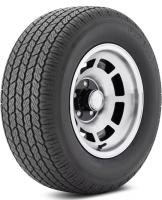
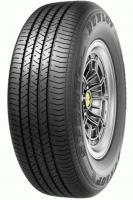
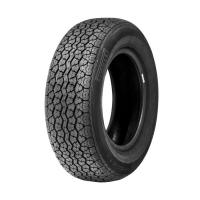
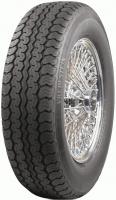
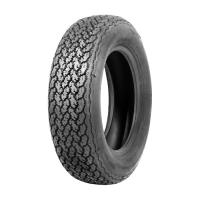

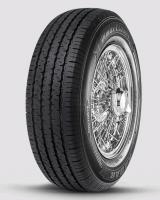
The Tire Rack has just done a "classic" tyre test. Compared to ABK thoroughness, it's a disappointingly limited effort but, given the paucity of "classic" tyre tests, it would be nice for you to give it a forum.
I'll put it on the list.
ta!
Jonathan, I don't know if you are in conversation with the good folk at ABK, but if so, perhaps you could suggest to them that a future test of interest would be in 155/80-15. I mention it because it is a size of interest as it is available in the FF compound formulation of the Xas. The regular compound Xas generally tests poorly in the wet but the FF should do better in merely slick conditions which don't make demands on the pattern's poor water clearance.
Adding interest would be to also test some 145/80 (XZX for example) &, if it is available still, the TB15 in 170/65 against the 155/80 field.
Vehicle? Superbeetle maybe (5" rims) or R8 Gordini or R8S (with 4.5" standard wheels)
Oh, and perhaps 175/70-15 as it allows the CN36 to feature.
Sadly I have almost no contact with AB, other than our paths crossing sometimes when testing. Dirk is a great guy, maybe write in?
Would it breach confidentiality to share his email (or whatnot) here?
Unfortunately I don't have it!
I've requested via the generic ABK contact email but no response yet.
Thanks so much for this Jonathan. The ABK tests are otherwise very hard to access. (Spoken as someone whose youngest car is 45 years old & all of them take unfashionably small sizes.) I'll spread the word that it's up here.
Sounds like you have quite the interesting garage!