Hankook Ventus Evo vs Yokohama Advan Sport V107
The headline theme is balance and efficiency versus dry-edge sharpness. The Ventus Evo is consistently the safer, more rounded performer-especially in the wet, where it wins wet braking in all five shared tests-while also showing clear advantages in rolling resistance, wear and overall running costs. The Advan Sport V107's main counterpunch is dry stopping power (it wins dry braking in 3/5 shared results), plus one standout result for straight-line aquaplaning resistance in the 2026 AutoBild test (93.0 km/h vs 90.4 km/h).
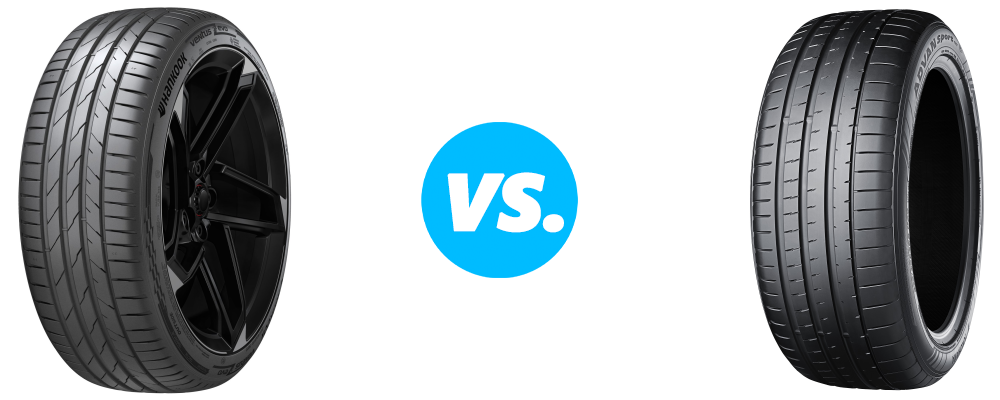
Test Results
Independent comparison tyre tests are the best source of data to get tyre information from, and the good news is there have been five tests which compare both tyres directly!
| Tyre | Test Wins | Performance |
|---|---|---|
| Hankook Ventus Evo | five |
While it might look like the Hankook Ventus Evo is better than the Yokohama Advan Sport V107 purely based on the higher number of test wins, tyres are very complicated objects which means where one tyre is better than the other can be more important in real world use.
Let's look at how the two tyres compare across multiple tyre test categories.
Key Strengths
- Class-leading wet braking across all shared tests (5/5 wins), often by large margins (e.g., 42.1 m vs 47.9 m in 2026 AutoBild)
- Very strong overall dynamics with top-tier handling results (e.g., best dry handling speed 101.5 vs 100.8 km/h in 2026 AutoBild; strong wet handling wins in multiple tests)
- Lower running costs: consistently lower rolling resistance (e.g., 7.69 vs 10.1 kg/t in 2026 AutoBild) and better value metrics
- Better longevity and wear efficiency (e.g., 56,310 vs 45,630 km and lower abrasion 1470 g vs 1794 g in 2026 AutoBild)
- Strong dry braking performance with multiple wins (3/5 shared dry-braking results), including small but repeatable edges in 225/40 R18 tests
- Competitive dry handling capability when conditions suit (e.g., slight handling win in 2025 Auto Express: 82.8 s vs 83.1 s)
- Best straight-line aquaplaning result in the 2026 AutoBild test (93.0 vs 90.4 km/h)
- Sporty, grippy dry-road character noted in professional commentary, albeit more demanding near the limit
Dry Braking
Looking at data from five tyre tests, the Yokohama Advan Sport V107 was better during three dry braking tests. On average the Yokohama Advan Sport V107 stopped the vehicle in 0.12% less distance than the Hankook Ventus Evo.
Best In Dry Braking: Yokohama Advan Sport V107
See how the Dry Braking winner was calculated >>
Dry Handling [s]
Looking at data from one tyre tests, the Yokohama Advan Sport V107 was better during one dry handling [s] tests. On average the Yokohama Advan Sport V107 was 0.36% faster around a lap than the Hankook Ventus Evo.
Best In Dry Handling [s]: Yokohama Advan Sport V107
See how the Dry Handling winner was calculated >>
Dry Handling [Km/H]
Looking at data from two tyre tests, the Hankook Ventus Evo was better during two dry handling [km/h] tests. On average the Hankook Ventus Evo was 0.85% faster around a lap than the Yokohama Advan Sport V107.
Best In Dry Handling [Km/H]: Hankook Ventus Evo
See how the Dry Handling winner was calculated >>
Subj. Dry Handling
Looking at data from one tyre tests, the Hankook Ventus Evo was better during one subj. dry handling tests. On average the Hankook Ventus Evo scored 13% more points than the Yokohama Advan Sport V107.
Best In Subj. Dry Handling: Hankook Ventus Evo
See how the Subj. Dry Handling winner was calculated >>
Wet Braking
Looking at data from five tyre tests, the Hankook Ventus Evo was better during five wet braking tests. On average the Hankook Ventus Evo stopped the vehicle in 11.13% less distance than the Yokohama Advan Sport V107.
Best In Wet Braking: Hankook Ventus Evo
See how the Wet Braking winner was calculated >>
Wet Handling [s]
Looking at data from one tyre tests, the Hankook Ventus Evo was better during one wet handling [s] tests. On average the Hankook Ventus Evo was 1.74% faster around a wet lap than the Yokohama Advan Sport V107.
Best In Wet Handling [s]: Hankook Ventus Evo
See how the Wet Handling winner was calculated >>
Wet Handling [Km/H]
Looking at data from two tyre tests, the Hankook Ventus Evo was better during two wet handling [km/h] tests. On average the Hankook Ventus Evo was 2.36% faster around a wet lap than the Yokohama Advan Sport V107.
Best In Wet Handling [Km/H]: Hankook Ventus Evo
See how the Wet Handling winner was calculated >>
Subj. Wet Handling
Looking at data from one tyre tests, the Hankook Ventus Evo was better during one subj. wet handling tests. On average the Hankook Ventus Evo scored 16.09% more points than the Yokohama Advan Sport V107.
Best In Subj. Wet Handling: Hankook Ventus Evo
See how the Subj. Wet Handling winner was calculated >>
Wet Circle
Looking at data from three tyre tests, the Hankook Ventus Evo was better during two wet circle tests. On average the Hankook Ventus Evo was 1.74% faster around a wet circle than the Yokohama Advan Sport V107.
Best In Wet Circle: Hankook Ventus Evo
See how the Wet Circle winner was calculated >>
Straight Aqua
Looking at data from three tyre tests, the Hankook Ventus Evo was better during two straight aqua tests. On average the Hankook Ventus Evo floated at a 0.78% higher speed than the Yokohama Advan Sport V107.
Best In Straight Aqua: Hankook Ventus Evo
See how the Straight Aqua winner was calculated >>
Curved Aquaplaning
Looking at data from three tyre tests, the Yokohama Advan Sport V107 was better during one curved aquaplaning tests. On average the Yokohama Advan Sport V107 slipped out at a 0.4% higher speed than the Hankook Ventus Evo.
Best In Curved Aquaplaning: Yokohama Advan Sport V107
See how the Curved Aquaplaning winner was calculated >>
Subj. Comfort
Looking at data from two tyre tests, the Hankook Ventus Evo was better during two subj. comfort tests. On average the Hankook Ventus Evo scored 13.85% more points than the Yokohama Advan Sport V107.
Best In Subj. Comfort: Hankook Ventus Evo
See how the Subj. Comfort winner was calculated >>
Subj. Noise
Looking at data from one tyre tests, the Hankook Ventus Evo was better during one subj. noise tests. On average the Hankook Ventus Evo scored 8.33% more points than the Yokohama Advan Sport V107.
Best In Subj. Noise: Hankook Ventus Evo
See how the Subj. Noise winner was calculated >>
Noise
Looking at data from two tyre tests, the Hankook Ventus Evo was better during two noise tests. On average the Hankook Ventus Evo measured 2.03% quieter than the Yokohama Advan Sport V107.
Best In Noise: Hankook Ventus Evo
See how the Noise winner was calculated >>
Wear
Looking at data from two tyre tests, the Hankook Ventus Evo was better during two wear tests. On average the Hankook Ventus Evo is predicted to cover 16.6% miles before reaching 1.6mm than the Yokohama Advan Sport V107.
Best In Wear: Hankook Ventus Evo
See how the Wear winner was calculated >>
Value
Looking at data from two tyre tests, the Hankook Ventus Evo was better during two value tests. On average the Hankook Ventus Evo proved to have a 15.78% better value based on price/1000km than the Yokohama Advan Sport V107.
Best In Value: Hankook Ventus Evo
See how the Value winner was calculated >>
Rolling Resistance
Looking at data from three tyre tests, the Hankook Ventus Evo was better during three rolling resistance tests. On average the Hankook Ventus Evo had a 18.28% lower rolling resistance than the Yokohama Advan Sport V107.
Best In Rolling Resistance: Hankook Ventus Evo
See how the Rolling Resistance winner was calculated >>
Abrasion
Looking at data from one tyre tests, the Hankook Ventus Evo was better during one abrasion tests. On average the Hankook Ventus Evo lost 18.06% less particle wear matter than the Yokohama Advan Sport V107.
Best In Abrasion: Hankook Ventus Evo
See how the Abrasion winner was calculated >>
Real World Driver Reviews
Hankook Ventus Evo Driver Reviews
Overall sentiment toward the Hankook Ventus Evo is strongly positive. Most drivers praise its high mechanical grip in dry and especially wet conditions, confident braking, stability, low noise, and good comfort-often comparing it favorably to Michelin PS4, Goodyear Asymmetric, and Bridgestone. A minority mention softer steering feel/feedback and one mid-scoring review reports faster wear on a high-performance Tesla. For most users, it delivers excellent everyday sporty performance at a good price.
Based on 11 reviews with an average rating of 83%
Yokohama Advan Sport V107 Driver Reviews
Drivers generally describe the Yokohama Advan Sport V107 as a very sporty max-performance summer tyre with strong dry grip, sharp steering, and confident handling/feedback that can hold up surprisingly well for occasional track use. Many also report good wet traction, though several note reduced confidence in colder conditions and some aquaplaning as the tyre wears. The most consistent drawbacks are short tread life for a “premium” tyre and higher road noise/roar on coarse pavement, especially at highway speeds.
Based on 20 reviews with an average rating of 73%
The size is a bit of an unusual one, and therefore the price of this set, compared to a set of... Continue reading this review using the link below
Conclusion
The Yokohama Advan Sport V107 is not a “bad” tyre-its dry braking is frequently excellent (e.g., it edges Hankook in both 2025 Auto Express and 2025 AutoBild dry braking, and it's strong in dry handling feel in some write-ups). But its recurring weak point is wet capability relative to the leaders, and its consistently high rolling resistance (described as the highest in multiple tests) undermines both economy and overall scoring. Practical takeaway: if you want the most complete fast-road summer tyre that doesn't punish you in the wet or at the pump/charger, the Ventus Evo is the smarter buy; if you're prioritizing dry stopping and occasional standout hydroplaning stability in a straight line-and can accept higher running costs-the V107 can still appeal.
Key Differences
- Wet braking is the decisive separator: Hankook wins 5/5 tests, with gaps that can be several metres (e.g., 27.0 vs 30.6 m; 42.7 vs 49.6 m), translating to a meaningful safety advantage.
- Overall rankings heavily favor Hankook (e.g., 1/20 vs 13/20 in 2026 AutoBild; 4/21 vs 19/21 in 2025 AutoBild), indicating the Hankook's broader competence beyond one standout metric.
- Dry braking often favors Yokohama (3/5 wins), but the margins are generally small (e.g., 34.0 vs 33.8 m in 2025 AutoBild), and don't offset its wet deficits.
- Efficiency/running costs strongly favor Hankook: Yokohama repeatedly posts very high rolling resistance (e.g., 10.1 vs 7.69 kg/t in 2026 AutoBild), which hurts fuel/energy use and overall scoring.
- Wear and durability favor Hankook (e.g., 56,310 vs 45,630 km in 2026 AutoBild; 41,440 vs 35,890 km in 2025 AutoBild), improving cost-per-km and long-term value.
- Aquaplaning is mixed: Yokohama can excel in straight-line aquaplaning (notably 2026 AutoBild), but Hankook is more consistently strong across wet handling/braking and often competitive in aquaplaning too.
Overall Winner: Hankook Ventus Evo
Based on the tyre test data and user reviews we have in our database, the Hankook Ventus Evo has demonstrated better overall performance in this comparison. However, as you can see from the spider diagram above, each tyre has its own strengths which should be considered in your final tyre buying choice.Similar Comparisons
Looking for more tyre comparisons? Here are other direct comparisons involving these tyres:

Footnote
This page has been developed using tyre industry testing best practices. This means we are only comparing tests which have had both tyres in the same test.
Why is this important? Tyre testing is heavily affected by things like surface grip levels and surface temperature, which means you can only compare values from the same day. During a tyre test external condition changes are calculated into the overall results, but it is not possible to calculate this between tyre tests performed on different days or at different locations.
As a result you will see other tests on Tyre Reviews which feature both the %s and %s, but as they weren't conducted on the same day, the results are not comparable.
Lots of other websites do this sort of tyre comparison, Tyre Reviews doesn't.
Discussion
- No comments yet — be the first.