
Everyone knows tyre performance changes with wear, with the biggest change in tyre performance coming from all season and winter tyres in snowy and icy conditions.
The drop in performance can be so vast after 4mm that certain countries where "three peak mountain and snowflake" tyres are a legal requirement for winter driving, they can lose their legality after 4mm, meaning you only get to use half of your tyres tread.
Should this be the case? Michelin have been making alot of noise recently regarding the negative impact of having to scrap a tyre with half its tread life remaining, and their arguments are compelling. Not only are you costing the customer more, but you're also causing a much higher negative environmental impact by doubling natural resourse usage and doubling waste.

Europe's leading tyre testers at the German publication Auto Bild have decided to find out exactly who's right. On test are six of the best all season tyres, a set of summer tyres and a set of winter tyres. Each set of tyres was tested at new, 4mm remaining tread depth, and 2mm remaining tread depth.
First, the negative. To reduce the tyres tread depth Auto Bild milled the tyres down to just above the target tread depth, then ran the tyres on the road for 1,000km to re-bed them in. This isn't the ideal way of wearing the tyres, in the real world the longer duration of use and more extreme environment has an effect of the chemical composition of the rubber, but it's realistically the only way of doing it for this type of test, as wearing hundreds of tyres on the road is a very long and expensive process.
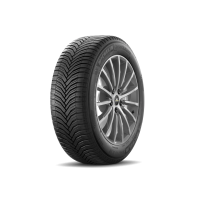
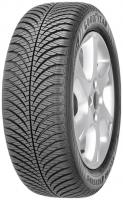
As for the results? It's certainly worth heading over to Auto Bild for the full picture as there's way too much data for us to summarise efficiently, so instead we'll concentrate on the popular Michelin CrossClimate, Goodyear Vector 4Season Gen-2, winter and summer tyres in the test.
Snow
During snow braking, the Goodyear all season tyre started the best, stopping the car in 27.6 meters, with the winter tyre and Michelin CrossClimate close behind. At 4mm the order was the same, but the gaps between the tyres closer, and by 2mm the Goodyear end as the worst of the three tyres, with the Michelin just beating the full winter tyre to being the best in the snow.
Snow handling saw a similar trend, but this time with the winter starting just ahead of the Goodyear. By 4mm the Michelin had taken the lead, which it further improved on at 2mm, proving to be the most consistent tyre on test. The summer tyre performed badly in both snow braking, and failed the snow handling test at 4 and 2mm tread depth.
Wet
The wet and the dry tests bring the summer tyre back into contention. Wet braking sees the order of tyre consistent, whatever the tread depth, with the Michelin proving best at all three levels of wear. The summer started ahead of the Goodyear all season, but the performance dropped off more at 2mm wear which means it finished tied, and the winter started the worst on test, and showed the largest drop in performance by 2mm.
Wet handling again showed the Michelin to be consistently the best tyre, and again the winter had the largest drop in performance as the milimeters decreased.
Dry
Dry braking proved to be an interesting test. While the winter tyre started extremely far behind the summer tyre and Michelin CrossClimate, at 4mm it was performing the best, and by 2mm it had once again dropped behind the Michelin, but remained ahead of the summer tyre.
The trend was broadly similar during dry handling, only with the winter tyre finishing the best. Sadly we do not know what winter tyre was used, or what temperature the wet and dry tests were conducted at, but it does highlight that once the "dry sipe disadvantage" of a winter tyre has worn away, the softer, more elastic compound of the winer tyre does have some benefits.
Conclusion
As this was primarily an all season tyre test, the testers at Auto Bild only considered the all season tyres in the final result, which are noted below. We recommend visiting the Auto Bild website to see the full data from all six all season tyres on test.
Do you know how the new Vredestein Quatrac compares when worn?
I've not seen that tested, sorry
I'm really curious which winter and summer tyres they used as reference. Certainly not class leading because with these numbers why you would ever buy anything else than a CroosClimate+ or Vector 4 S2 seeing that they beat the specialist tyres on their home turf?
We would also love to know what reference tyres were used. In the past, Auto Bild have chosen premium tyres, and I can't see why they would have chosen differently this time.
Really nice real world test. We don't see many tests like this. Also, I would like to point something that's been bothering me for a while. Why isn't there a snow performance category when reviewing all season and snow tyres. I think it would be very useful as it's one of the most important factors when considering snow or all season tyres.
Could you define "snow performance"? Nearly all the tests include snow braking, traction and handling, which is a fairly rounded performance view of the tyres :)
Sorry for not being clearer, I meant when users rate their tyres :). There are the same categories for all the tyres from dry petformance to would you buy again and I think that a snow performance category would be useful for snow and all season tyres.
Ah, sorry for the misunderstanding :)
You are correct, but keep in mind Tyre Reviews is a UK based site, where we only really get 2 days of snow every 5 years. This means many of our reviewers don't get the consistent snow running to make a judgement on how good the tyres are in the snow, so at the time of development I thought it would be best to leave snow performance out.
It's something I'll consider for the new site in 2018 :)
Thanks, I hope you do include it because it would be useful for people outside the UK that use this site like me. Also, good luck working on the new site, looking forward to seeing it.
And people in UK never go abroad for winter/ski holidays ? ! Snow performance is interesting even if it is only very few days a year.
Then you can make it optional or like - not enough data to rate. Whoever has it - rate it, whoever does not feel it can rate it - leave it aside unrated.
Ranking table from test
http://www.testpneumatik.eu...
http://www.testpneumatik.eu...
Great to see tests like this being conducted, there was so much based on marketing and hearsay in the past, now we're starting to get really scientific, useful tests. Long may it continue!
Any chance of a link to autobild? Ill find it but sometimes they can be difficult to find...
It's not yet on the Auto Bild website, I'll link it as soon as it is :)
http://www.autobild.de/arti...
Thank you for linking :)
Cheers Kolemjdouci :-)
http://www.autobild.de/arti...
Thanks for importing and translating this German article with great graphs. Just to add this test was done with tyre size 185/65 R 15 on Opel Corsa...and the new all seasons Contis couldn't make it to the test from timing reasons (not available at the beginning of the test).
Thanks for the added information :) It took a while to workout the best way to graph them!