
Performance Overview
This radar chart shows relative performance across all test categories, with 100% representing the best performance in each category. Reference tires may have gaps where data is not available.
Dry Performance Overview
Dry Braking (M)
Dry braking in meters (Lower is better)
Dry Handling (Km/H)
Dry Handling Average Speed (Higher is better)
Wet Performance Overview
Wet Braking (M)
Wet braking in meters (Lower is better)
Wet Handling (Km/H)
Wet Handling Average Speed (Higher is better)
Wet Circle (m/s)
Lateral wet grip in m/s squared (Higher is better)
Straight Aqua (Km/H)
Float Speed in Km/H (Higher is better)
Curved Aquaplaning (m/sec2)
Remaining lateral acceleration (Higher is better)
Comfort Performance Overview
Noise (dB)
External noise in dB (Lower is better)
Value Performance Overview
Price
Price in local currency (Lower is better)
Rolling Resistance (kg / t)
Rolling resistance in kg t (Lower is better)
Energy Consumption (kWh/100km)
Energy consumption in kW hours per 100 km (Lower is better)
Overall Findings
Based on the weighted scoring from all tests, here are the overall results:
| Position | Tyre | Score |
|---|---|---|
| Falken e.Ziex | 98.4% | |
| 2 | Michelin e.Primacy | 97.8% |
| 3 | Pirelli Scorpion Elect | 95.8% |
| 4 | Continental SportContact 7 | 95.8% |
| 5 | Continental Premium Contact 6 | 94.7% |
| 6 | Falken Azenis FK520 | 94.6% |
| 7 | Michelin Pilot Sport 4 SUV | 94.2% |
| 8 | Maxxis Victra Sport VS5 SUV | 92.7% |
| 9 | GT-Radial SportActive 2 SUV | 92.4% |
| 10 | Bridgestone Potenza Sport | 92% |
Test Winner
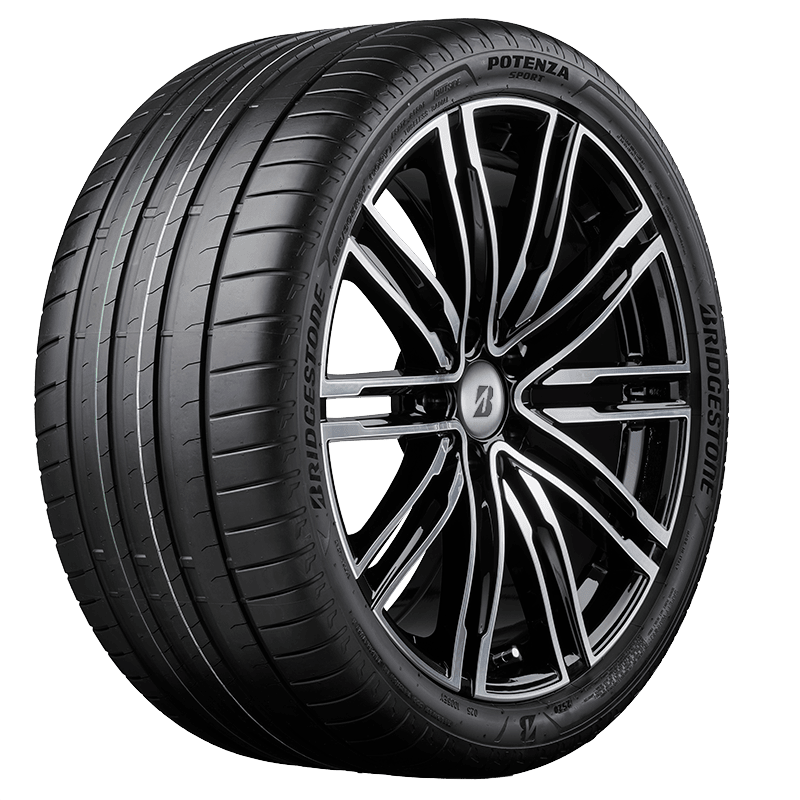
Bridgestone Potenza Sport
92%
Now I am wondering if I should get the e.Primacy as a dedicated summer tire for my 500e and replace the Falken AS210 All Season Tire. Wouldn’t this result in 20-30% more mileage per charge? This would be a huge difference. How would this compare to a more efficient all season tire like the Continental All Season Contact 2 or the excellent Michelin?
On an EV a tyre accounts for approx 25% of rolling resistance, though some of that comes from the aero of the tyre profile that we don't test on our machines. 20-30% more range per charge seems optimistic but you should notice an increase.
Good day,
I need advice on suitable tires for sporty driving on the edge, especially on dry alpine roads. I know there isn't much to choose from in my size 215/45 R16. I am considering the Hankook Prime 3 or Prime 4. Can you please advise which tire is better for my driving style?
Thank you for answer. Sincerely, Albl
I've just looked through the list here https://www.tyrereviews.com... and there's not many great options, apart from the AD08RS but that might be a bit extreme!
I do also know a lot of the Clio boys love the Pilot Sport 3 for sporty driving.
Thanks for the answer, I was thinking about the AD08RS, but they say it is not suitable for use at temperatures below 7 degrees and in the Alps it is often cold in the morning. Also, according to the reviews, it is much worse than the previous model AD08R. If only PS 4 was made in my size, or PS 5, so I would decide easily. I would also like to ask you, if I decide to try Hankook, should I choose Prime 3 or 4. Thank you for your answer and have a nice day. Albl
I really couldn't tell you from experience, while I've driven on both tyres it was years apart.
My GUESS would be test the 3. The Prime 4 is the better tyre overall, but as with all modern tyres, the quest for rolling resistance and comfort improvements means handling can suffer.
Thank you, I will try Prime 3 and then Pilot sport 3. Regards Albl
Those prices - ouch! I just looked at (just for comparison - used on similar sized [but not wieght - EVs are much heavier] cars) the all-season test and the most expensive tyre in that group, the Michelin CC2 was 104.99, whereas the cheapest tyre here is 177, most being between 200-300 and both Michelins well over 350!
No wonder EV ownership (even on 'standard' sized cars like this) is for the well-off. Not sure what 'local currency' is used for both (hopefully the same, otherwise you can't compare them), but if they were either £, $ or Euros (all within 20% of one-another in worth), that is a horrendous price to pay for just one tyre.
For comparison, albeit in 2018, my 195/65 R15H Michelin CC+ tyres cost about £55 each (today the cost for the CC2 [better product] is about £75, including 'pandemic' era inflation) shod on a similar sized car and which probably handles nearly as well (or as well as) the KIA test vehicle. Not as quick, but you can only do up to the speed limit of 70 (or whatever it is locally)!
What sizes are you comparing?
The ones in the EV test were admitedly large, at 255/45 R20 vs the all-season test ones at 225/45 R17 vs my car's at 195/65 R15, but the all-important factor is the first group were tested on a KIA EV6, the second on a current VW Golf and mine are fitted to a (yes, 17yo) Mazda3 saloon, cars all similar in size and passenger capacity. Admitedly the EV6 has the biggest boot at 480L, mine is 420L and the Golf at 380L, but that's not too dissimilar overall, apart from the 0-60 performance and mpg. They all take 5 people and can only drive at or below the UK speed limit.
My issue was that cars nowadays, and especially EVs, cost a fortune not just to buy but to run (replacement tyres will cost [by these metrics] nearly 7x that of my current ones and won't last as long as they are lower profile), partly perhaps because of extra safety features, but those EV tyres presumably have to be that large because they need to support all that extra weight of the car (batteries), which still don't get you the same average range as my 17yo petrol Mazda.
As such, and because governments are legislating ICE cars out of existence, no-one apart from the very wealthy can afford to get a new car. Even if they were more affordable, many of us live in flats or terraced houses, which means we cannot charge an EV overnight/at weekends at home, and would have to rely on the poor / time-consuming 'public' chargers, and that's if we can afford to buy the car in the first place, which we can't.
You raise a lot of points.
First, I'd argue the difference going from 225/45R17 to 255/45R20 is significant. The difference between 255/45R20 and 195/65R15 is huge. I agree that a common, high profile 16/17inch tyre across many common passenger cars would be an intelligent move in the interest of reducing waste and expenses. Tyre cost is due to intended application, production volume, and finally size. I am happy every time I can fit 185/65R15 or 205/55R16 to a daily. I think R17 offers a good compromise between cost, performance, and looks.
A similar argument can be made about the cars you described.
As per your second point, tyres are the best they have ever been and the mileage they can be run is so high that tyre cost is minimal in car ownership. I can see people paying more on car wash than tyres. Fuel of course being one of the major costs. You can drive any EV sensibly and tyres should last just about the same distance per weight class. Granted ev are generally heavier, but people don't complain about tyre wear on SUV so it is not a concern to the general public, it seems.
I would add that often times, the unaware will go to the dealership for a tyre change. As an anecdote, a friend of mine payed around 6-700 euros on her Audi A1 tyre change. You can hardly buy smaller car than that. Once again, tyre size and vehicle have little to do with cost when it comes to the mainstream user.
I would also point out that why everyone wants their cake and eat it too, if EVs are to be considered the green alternative then one should expect there is a compromise. Personally I don't think the focus should be on extending the range at the expense of price and the environment as the main goal of the EV should be to power emissions. I disagree with the over-engineering that's taking place, primarily to make the EV into a cool status symbol, and to please the masses all while removing the element of range anxiety. I dailied a Zoe, living in flat in Edinburgh and the price to pay was time, time I would spend on longer journeys. What I saved was a lot of petrol, and hopefully the Zoe was just about right sized for ending up green in the long run (which is not the case with the leased hydrogen cars that get binned after a couple of years).
I will conclude by saying thay why I think small-sized EV are smarter, I also think that other sources of CO2 emission should be tackled well before the passenger car. Heating (again, looking at you single glazed Scotland), agriculture, industry, shipping. I see little benefit in forcing the bill on people, sell EVs, and convincing them they saved the planet. They just bought a new car. Small electric run-around cars are great 90% of the time as far as city use goes. At least in Europe. A tesla model S is extra weight most of the time, which defies the purpose in the first place.
Tyre pollution (pm) beats tailpipe pollution these days.. perhaps instead of enforcing Euro 7, they should start looking at tyres.
A while back it was direct injection petrol engines which weren't being properly assessed. Today it's tyres and EV.
Got carried away, long rant.
The problem is that the 'solutions' being forced upon us are a 'one-size fits all' approach. I live in a small town in the countryisde in England, where a car is essential, and I live in a flat, where EV charging is impossible at the moment and will likely not be for decades to due logistical and cost issues. I agree that small cars are a sensible option for the city-dweller or people just doing a shortish commute to other urban areas (I used to own a Nissan Micra before my current Mazda3), but I needed a larger car for work purposes and that rode the God-awful roads better than a small car (even on 60 profile tyres as my Micra was shod on).
I would gladly buy a smaller car next time out, but none can be shod on reasonable tyres and all cost 2x and more than I paid for my car. Soon, none will be ICE and I'll be expected to pay £30k for an EV one, and then hire a bigger car when I need more capacity. I deliberately use my car sparingly (walk a lot, even for grocery shopping), so it has a relatively small carbon footprint or tyre-based pollution. It certainly helps being educated as an engineer as well - you know the truths / realities that many scientists and politicians / journalists ignore (often deliberately) or miss.
The problem with many EVs as I see it is that most are big, heavy cars or tiny ones, and both very expensive to buy /lease for what use they can provide. That many come shod on bling huge alloys and (often) low profile tyres just makes the ride quality worse, lifespan a lot shorter and chance of serious damage to both from kerbing/potholes/speed humps etc. There's just no way in my rural town and living in a flat that I could viably run and EV (of any size), given the lack of nearby / secure / fast charging points and no way of getting them on my housing development, even though that's only 20 or so years old - there's not the room or the money.
I agree on the heating side (my engineering speciality is mechanical building services, incl. heating systems), though our stupid governments (often who are in thrall to / in the pocket of the globalists and WEF as well as ill-informed activists) insist on ill-thought-out, unworkable laws / schemes such as heat pumps etc when, as you say, most of the UK's building stock is incapable of taking such tech because they are very old and either not insulated at all (and many cannot be) or not enough to be able take advantage of the lower system temperatures of heat pumps. And they want us all to bankrupt and starve ourselves through paying for this new tech and putting up the cost of agriculture to pretend to 'save the planet', when in reality they are just saving themselves (the rich and powerful) at everyone else's expense.
The problem is that the proverbial 'great and good' are just allowed by the normies to do as they please. Until we fight back to take control via the ballot box, rather like the Ducth and their farmers party is now doing, nobody with sensible policies that provide workable solutions to genuine problems will take control as needed. Sadly, common sense is in short supply these days.
(you encouraged me to rant myself!)
I agree that EVs are not the answer for everyone. In fact, at the moment they are mostly the answer for the city dwellers. It makes a lot of sense for the few that can benefit from the highly urbanized and well-served areas. I had a job where I could recharge daily, that said I only had to do so only weekly.
I don't it's right to impose the switch for reasons like the ones you pointed out.
I would probably stick to an old hatchback with uprated suspensions goot AT tyres if I was in a country setting. My next shitbox is in fact a Focus mk I. For the new, I always liked the Crosstrek, wasn't for the engine.
As per the houses or flats, I can't believe German cars have double glazed mirrors and British houses often are single glazed. Especially incomprehensible up north where the cold is palpable. I am told old "authentic" windows can't be changed because of some plan, I think it's horses**t.
Rant away, I don't mind :)
Our 'British way' is sometimes undertsndable - but only up to a point. For example, properly 'old' houses and flats (including some that are converted from large stately homes or suchlike) are excellent examples of the architecture of their time and good looking when well-maintained. Many of them - 17th Century cottages, art-deco flats, etc obviously have single-glazed windows but the entire property (including the windows) are often covered by 'listed building status' and cannot be materially altered, including adding double glazing.
Some lower classes of listed status might be able to have secondary glazing (not as good as double but better than single alone), but almost none will be able to install any sort of insulation for the reason I gave before. We have a LOT of those sort of buildings, the former in the countryside (mainly villages and small towns like mine), the latter mainly in large, long-established towns and cities.
The big problem is that many terrible 1920s - 1970s homes are thermally very poor (no cavity insulation) but if you install double glazing, they sweat like mad and need to be dehumidified, which requires electricity-hungry equipment similar to A/C units. My parents have one in their 1960s built house that was only needed after they had the windows upgraded in the 1980s. Most of these properties have cavity walls, but no insulation, and it's not cheap to have it installed and there's little to no tax/government incentives to do so, plus it makes the 'sweating problem' worse. As we saw with the Grenfell fire disaster, externally cladding buildings, especially flats, isn't the cheap and easy solution certain 'experts' thought it was.
The daft thing is that most people are far more willing to spend big on a car they don't need (or can afford - because they pay monthly via a loan / PCP / leasing deal) when they could save themselves a fortune over the longer term by helping to improve their home's thermal properties, including the heating and ventilation systems. Local authorities and government let bad new build housing developments go ahead that are in no way future-proofed / easy to maintain or upgrade (it can be done without much extra expense) and mostly VERY poorly built.
My own flat block (built only 20 years ago) had issues where part of the communal areas were not insulated at all (they should've been) and was so buildly built the water was getting in and cuasing a lot of damage. House warranties are not worth the paper they're written on - at least with cars, you have SOME chance in recompense because problems are normally quite obvious and happen more quickly.
With cars, I finding that its often best to stick with a car you know does the job well, even if it's a bit older, as long as it's reliable and not falling to bits. Like with replacing an older heating boiler, you'll likely never recoup the cost of purchasing a new one via its greater efficiency in operation, unless you use a heck of a lot. I agree that EVs should just be a useful option for the urban dweller amongst many - those on the outer edge of a big city may find that an ICE car is far better because they need to use it to drive further and more often, especially people living in flats.
In such areas, public transport is far more sparse than in city centres because the areas covered are much larger. Less people have driveways and thus EVs aren't always a useful option, at least unless and until vandal-proof, reliable charging points are installed on every lamp-post. Out in the sticks, both are a waste of time unless you are very well off and have the space/money at home for a decent EV charger. Most UK workplaces have far less car parking spaces than staff who drive to work, often with no space or a landlord willing / able to install charging points.
The only employers who do tend to be large coprorates who can afford to virtue-signal and have the facilities. Most other (smaller size firms) don't. Even the largest employer in my town - with a very large site and probably over 1000 staff have only about a total of 4-5 EV charging points in their car parks (only for them). The council has one installed next to the town hall (a slow 7.5kWh charger) and there's two at the local supermarket (which has about 300- 500 spaces total). None of the filling stations in and around the town has an EV charger yet. Thus unless you have one at home, then EVs are a non-starter. Politicians either don't get that or don't care.
Don't forget to compare apples to apples, this test was on a rather large size compared to most!
Oh I wasn't comparing them directly, more for Jacopo illustrating that the more modern a car is, the more expensive its tyres (and other components) are to replace. £400 a tyre would cost me more than my car is worth! the same would go for example, replacing a front (LED) light cluster, etc. There's something to be said for the K.I.S.S. principle - simple is often cheap, and can also be long lasting, which saves even more money and often pollutes less.