
Following on from last years on-road and off-road test of nine all terrain tyres, we've taken seven of them through to a full snow test, and tested them against the one of the best rated US all season tyres, the Michelin Defender LTX and our favourite winter tyre, the Michelin X-Ice Snow (SUV variant).
As the group of all terrain tyres is a mix of snow rated and non snow rated all terrain tyres, it means we'll not only know what the best all terrain tyre is on snow, but we can also answer whether a snow rating is worth purely basing your purchase decision on, AND we'll be able to find out if a very good snow rated all terrain tyre is a safe replacement for a winter tyre in the snow.
Testing Methodology

- Test Driver
- Jonathan Benson
- Tyre Size
- 275/65 R18
- Test Location
- Professional Proving Ground
- Test Year
- 2023
- Tyres Tested
- 7
Snow
During snow handling, three groups of tyres emerged. It would be fair to assume the non-snow rated tyres were in the slowest group, but if you have assumed that, you are wrong. The slowest two tyres of the group were the Goodyear, which is not snow rated, and the Pirelli, which is snow rated!
The Goodyear was actually great to drive, communicated nicely, slid progressively, it was just down a little on grip compared to the best, which made it about 12% slower around the lap. The Pirelli was a less easy tyre to drive, the rear especially would break away laterally fairly quickly and then it would be difficult to recover.
The next group of tyres was the other non-winter rated tyre, the Continental, almost matching the winter rated Toyo and Yokohama, all less than a 1% apart and 5% off the best.
To me the Continental and Yokohama felt fairly similar to drive, with the Yokohama having a VERY small advantage when turning. Traction and braking felt very similar which is is interesting given the lack of three peak on the Conti.
The Toyo was pretty unremarkable to drive, it wasn't quite as progressive as the previous two but the grip was there and it felt fine. Perhaps not the tyre to enjoy snow handling but as a day to day all terrain tyre in the snow, perfectly adequate.
The final pair of tyres was the Firestone and BFGoodrich. These were so close I ran them a second time and had other drivers run them, and everything backs up the result. The BFGoodrich had the slight edge in pace for all of us, however the Firestone was mighty impressive.
They did feel quite different tyres to drive, the BFGoodrich felt like it had been developed with safety in mind. It felt like it had the best traction and straight braking of the group, it was monstrous when braking in a straight line, I'll confirm this in the traction and braking testing next, and it broke into understeer by default. All very safe qualities.
While the Firestone couldn't quite match the BFGoodrich in raw traction, I found it more fun as while it broke into oversteer early and the first part of the slide was pretty quick, you could easily hold the truck at large yaw angles and feel like a hero. This probably helped the laptime, and made me smile. This obviously isn't a useful quality for the road, so the BFGoodrich definitely wins overall in terms of laptime and subjective safety, but the Firestone is very close and a really capable tyre.
What about the all season and winter?
I ran the all season, the Michelin Defender LTX, back to back with the BFGoodrich to see how big a difference there was between the best winter rated all terrain and a very good all season.
There was a difference, but it was less of a difference than between the good and the bad all terrain tyres as the defender finished between the Firestone and the Toyo! Lets not forget the Defender LTX is not snow rated, so in the grand scheme of things I think it did extremely well. No nasty handling characteristics, you just had to be a little slower with all your inputs. It even felt good on the brakes. Will be interesting to see how it does in traction and braking.
Lastly, can a snow rated all terrain tyre be a replacement for a winter tyre? The answer is, and I'm sorry to say, absolutely not. I may have given the winter tyre an unfair advantage by using one of the very best in the segment, the Michelin X-Ice Snow SUV, but the grip was on a different planet. The braking was the most impressive thing, but the amount of extra grip you had in all directions was simply indescribable.
In snow traction it's worth noting there was a 6.5% difference between the winter tyre and the best all terrain tyre, but a 32% difference between the best all terrain tyre, which was again the BFGoodrich, and the worst all terrain tyre. The BFGoodrich might have been a standout for an all terrain tyre in snow, but the second placed Firestone and third placed non-three peak rated all season were still 23% ahead of the worst all terrain, so there's quite a variance.
This variance continued in snow braking. The BFGoodrich was again the best rounding it out as a triple winner in the snow, but this time nearly 15% behind the winter tyre. That was still 20% better than the worst all-terrain tyre confirming that there's a bigger variance in snow performance between a good and a bad all terrain tyre than there is between a good all terrain tyre and one of the worlds best winter tyres.
Again, the michelin all season, the Defender LTX proved to be extremely strong. Very impressive tyre and I don't want you to think this is how all the all season tyres are in the snow, this is a standout product.
Three Peak VS Non-Three Peak
The obvious elephant in the room is how some of the three peak marked tyres were beaten by non-three peak marked tyres. I could make an entyre video on this topic, if you're interested in that level of geekery be sure let me know in the comments.
The short version is that to gain the 3 peak mark your tyre has to be 10% better in traction than a standardized reference all season tyre.
In this test, the three peak marked Pirelli and Yokohama had worse snow traction than the none three peak marked Continental and all season tyres, and the three peak marked Toyo had worse braking than both. Does this mean Pirelli and Yokohama cheated the test? Absolutely not, I am confident that they legitimately passed the test.
I think what we're seeing here is more down to how brands operate. I know Continental will only put the three peak rating on a tyre if they have a large margin over the standard, whereas other brands might be fine with being a bit closer to the line. In the case of the all season tyre, this might simply be a marketing decision, as just because a tyre is three peak capable doesn't mean it has to be marked as so. The CrossClimate 2 is certainly a better tyre in the snow than the Defender LTX, so perhaps that's why the LTX has been omitted. Or perhaps it was just having a really good day in the Michigan snow.
In the end, the BFGoodrich is the best mild all terrain tyre in the snow, by quite a margin, and the Firestone is also a very impressive product. Be sure to cross reference this with the dry, wet and offroad part of this test to find the best tyre for you.
Results
- UTQG: 660 A B
- 3PMSF: yes
- Weight: 20.07 kgs
- Tread: 10 mm
| Test | # | Result | % |
|---|---|---|---|
| Snow Braking | 1st | 39.08 M | 100% |
| Snow Traction | 1st | 4.57 s | 100% |
| Snow Handling | 1st | 97.4 s | 100% |
- UTQG: 540 A B
- 3PMSF: yes
- Weight: 18.9 kgs
- Tread: 9.4 mm
| Test | # | Result | % |
|---|---|---|---|
| Snow Braking | 2nd | 45.5 M | 85.89% |
| Snow Traction | 2nd | 5.07 s | 90.14% |
| Snow Handling | 2nd | 97.73 s | 99.66% |
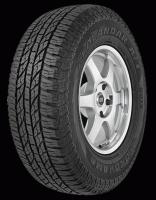
- UTQG: 600 A B
- 3PMSF: yes
- Weight: 19.29 kgs
- Tread: 9.5 mm
| Test | # | Result | % |
|---|---|---|---|
| Snow Braking | 7th | 51.55 M | 75.81% |
| Snow Traction | 5th | 6.07 s | 75.29% |
| Snow Handling | 3rd | 101.77 s | 95.71% |
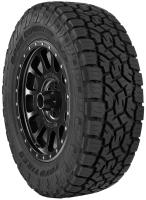
- UTQG: 600 A B
- 3PMSF: yes
- Weight: 19.74 kgs
- Tread: 10.9 mm
| Test | # | Result | % |
|---|---|---|---|
| Snow Braking | 5th | 50.59 M | 77.25% |
| Snow Traction | 3rd | 5.61 s | 81.46% |
| Snow Handling | 4th | 102.45 s | 95.07% |
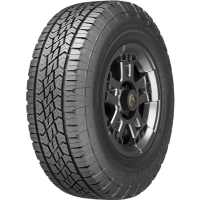
- UTQG: 680 A B
- Weight: 19.95 kgs
- Tread: 9.1 mm
| Test | # | Result | % |
|---|---|---|---|
| Snow Braking | 3rd | 47.84 M | 81.69% |
| Snow Traction | 4th | 5.66 s | 80.74% |
| Snow Handling | 5th | 102.56 s | 94.97% |
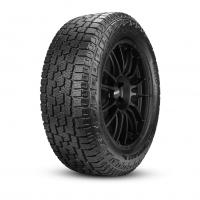
- UTQG: 640 A B
- 3PMSF: yes
- Weight: 19.47 kgs
- Tread: 10 mm
| Test | # | Result | % |
|---|---|---|---|
| Snow Braking | 6th | 51.11 M | 76.46% |
| Snow Traction | 6th | 6.26 s | 73% |
| Snow Handling | 6th | 111.18 s | 87.61% |
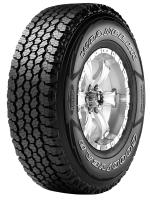
- UTQG: 640 A B
- Weight: 19.58 kgs
- Tread: 9.4 mm
| Test | # | Result | % |
|---|---|---|---|
| Snow Braking | 4th | 49.97 M | 78.21% |
| Snow Traction | 7th | 6.93 s | 65.95% |
| Snow Handling | 7th | 111.23 s | 87.57% |
A friend of mine who is stationed in Alaska, he gave me a glowing review of the Nittos Terra Grabbler G3's. Said it's great in snow, rain and it's quiet. But based on the performance of the G2's. I just don't believe it.
I just feel like buying a second set of destination. At2s, is so boring. Granted they were great in every way, but will we not see an at3 or new king? Perhaps a terrain contact with a 3 peak?
I really appreciate your reviews. Actual objective testing. I'm trying to decide between the Falken Wildpeak A/T Trail and the Michelin Defender LTX. Most interested in how they compare on snow. Do you have any insight on how they compare? Appreciate that you included the Michelin LTX in your A/T review as a reference! Would be great to see the Wildpeak A/T Trail in a future snow comparison. Thanks!
I guess they would be close, though I've not seen much snow data of the Wildpeak Trail, sorry
I'm trying to decide between the firestones and the Continentals. My priorities in order are wet performance, snow performance, efficiency, nvh. I understand the opposing nature of my priorities. One thing I noticed is that in your test the firestones dominate the Continentals in the snow. But in tire racks test, it was the opposite. The the Continentals beat the firestones definitively in the snow. Both tests had the Continentals better in the wet. I wonder if this is because of different tire sizes, test methods, or the nature of snow testing not always being repeatable.
Interesting! Can you link me the tirerack test you're looking at?
https://www.tirerack.com/tires/tests/testDisplay.jsp?ttid=292
here is the test I was talking about.
That is curious. I don't really have an answer, it could be down to temperature or due to the size. IT's worth noting the Conti is not snow rated (3peak), and if it was that much further ahead of the Firestone (which is) Conti would have almost certainly certified it for snow.
I remember you mentioned that, continental does not put the three peak Mark unless it far surpasses the requirements. If it really dominated the firestones, I'd imagine that to be the case.
Consumer reports review on the Firestone compared to the Continentals muddy's the water even more. It ranked them about the same in the snow and ice. But gave the firestones a really poor score in wet breaking, and a much lower score overall.
tires are complicated.
however, since tire rack and consumer reports tested the 265 width, and, Tyre reviews tested 275, which is closer to my 285 size. I'm guessing your data is more relevant to me.
subjectively, I believe you said you wear cc2s in the winter. How do the CC2s compare in the winter versus an all-terrain with good snow performance. I would imagine it's better. But are we talking a little bit or night and day.
Tires are complicated, and the answer to the CC2 vs a good snow AT is also hard.
I ran the Nokian Outpost nATs in a test against the all weather WRG4 and they weren't too far off. I also had the nAT on my personal car and the CC2 on my wifes car and in a totally non scientific test they felt pretty close, however I'm sure the CC2 would have the advantage in nearly all types of snow and ice (maybe deep snow an AT tire would have the edge)
Thanks for the insight, I could talk tires all day. I think I'll try out the firestones, and see how it does on my mountain pass runs. I'll make sure to leave a review either way. Please keep up the tire gospel, there aren't that many sources in the US.
Look forward to hearing your feedback!
HI
Loved vidio thanks I have Pirelli Scorpion Zero 285/45/r22 M&S, Spending 12 weeks in Fench Alps and I can oly get hold of Yokohama Geolander with moutin 3 peak symbel. Just want best grip safest tyer is it worth buying these or are they as much as much and stay with My Pirelli M&S
Do not need by law in France and Yokohame only tyre available in UK at present, thanks in adavance
3peak should give you better winter performance. Pack chains or socks whatever you do.
Is the Nokian Outpost nAT a better all terrain tire in the snow than this test winning BF Goodrich Trail Terrain?
I can't find a head to head comparison of these 2 tires. I'm leaning towards the Outpost nAT but this comparison test has me wondering if the the Trail Terrain is superior in the snow? Snow traction is my highest priority but I can't go with a pure snow tire because i don't want to run 2 sets of tires here in New
England
I don't know, no one has tested it. FWIW the nAT is a different category, it would square up to the K02. I do know both are excellent in the snow, just not which is better.
Would love to see the Cooper Discoverer AT3 4S make it into these snow and on/off-road tests!
I'll try my best to include it in the future test
Also the Cooper Discoverer AT3 Sport 2 as a comparison, as that is also 3 Peak rated.
A comparison between a companies different tyres with regards to how they categorise their 3PMSF tyres would be interesting
I would be very interested in a similar test for the LT-rated tires, including the popular aggressive ones (BFG K02, Falken Wildpeak AT3W, etc). There would be some crossover with this one with the G015 and Open Country AT3, but they have substantially more tread depth in the LT sizes.
Almost everyone I know with a pickup runs an LT-rated aggressive AT tire. Many run them year round because they think snow performance is “fine” but a few of us run Hakka LT3 or similar studded LT tires. (And some stud out hybrid tires like Duratracs for better deep snow performance.)
I hope to do this next year!