
Performance Overview
This radar chart shows relative performance across all test categories, with 100% representing the best performance in each category. Reference tires may have gaps where data is not available.
Dry Performance Overview
Dry Braking (M)
Dry braking in meters (Lower is better)
Dry Handling (s)
Dry handling time in seconds (Lower is better)
Subj. Dry Handling ( Points)
Subjective Dry Handling Score (Higher is better)
Wet Performance Overview
Wet Braking (M)
Wet braking in meters (Lower is better)
Wet Handling (s)
Wet handling time in seconds (Lower is better)
Subj. Wet Handling ( Points)
Subjective Wet Handling Score (Higher is better)
Straight Aqua (Km/H)
Float Speed in Km/H (Higher is better)
Curved Aquaplaning (m/sec2)
Remaining lateral acceleration (Higher is better)
Snow Performance Overview
Snow Braking (M)
Snow braking in meters (Lower is better)
Snow Traction (s)
Snow acceleration time (Lower is better)
Snow Handling (s)
Snow handling time in seconds (Lower is better)
Subj. Snow Handling ( Points)
Subjective Snow Handling Score (Higher is better)
Snow Circle (S)
Snow Circle Time in Seconds (Lower is better)
Ice Performance Overview
Ice Braking (M)
Ice braking in meters (Lower is better)
Ice Traction (s)
Ice acceleration time (Lower is better)
Ice Handling (s)
Ice handling time in seconds (Lower is better)
Subj. Ice Handling ( Points)
Subjective Ice Handling Score (Higher is better)
Comfort Performance Overview
Subj. Comfort ( Points)
Subjective Comfort Score (Higher is better)
Noise (dB)
Internal noise in dB (Lower is better)
Value Performance Overview
Rolling Resistance (kg / t)
Rolling resistance in kg t (Lower is better)
Overall Findings
Based on the weighted scoring from all tests, here are the overall results:
| Position | Tyre | Score |
|---|---|---|
| Michelin X Ice Snow | 83.5% | |
| 2 | Nokian Hakkapeliitta R5 | 83.5% |
| 3 | Continental VikingContact 7 | 83.4% |
| 4 | Continental WinterContact TS 870 | 81.1% |
| 5 | Pirelli Ice Zero FR | 81% |
| 6 | Yokohama iceGUARD iG53 | 80.8% |
| 7 | Cooper Weathermaster S100 | 77.6% |
| 8 | Federal Himalaya ICEO | 75.7% |
| 9 | Nokian Hakkapeliitta 10 | 63.6% |
Test Winner
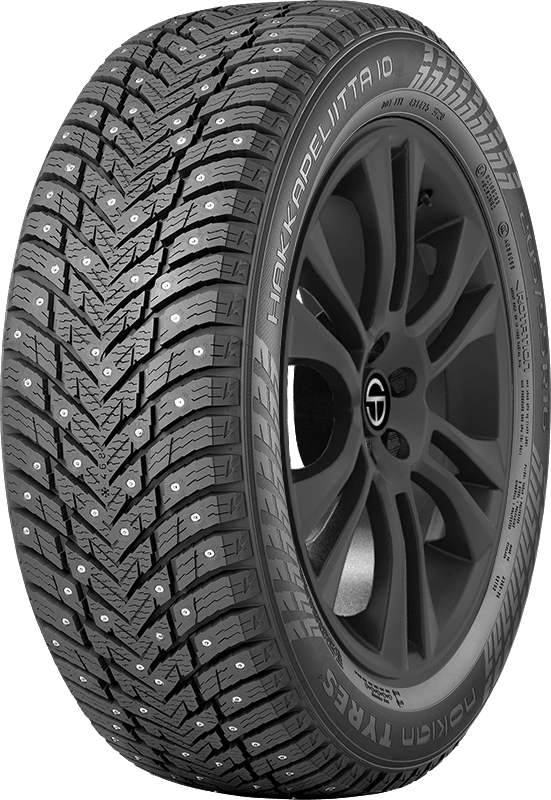
Nokian Hakkapeliitta 10
63.6%
When can we see test done on minivans? I’m curious to see how these winter tires handle in a minivan or similar size vehicles (FWD). Something bigger that isn’t AWD.
Thanks for the review. Very educational! Cheers!
In theory it should translate across vehicle types
-- Performances of studded tires but without studs.--
I did saw a lot of review of winter tires but never saw any that is reviewing the Nokian Hakkapeliitta 10 that are not set with any studs. I do understands that studs clearly help for gripping on ice, but what's if there are no studs on these tires? Are they as good as the Hakkapeliitta R5, acceptable or simply not good at all?
Location Montreal
Vehicle: all wheel drive SUV
Winter Tire size: 255/55 R19
Driving under unpredictable slushy conditions is kind of my main concern during winter driving. The Hakka R5 didn't look to be a king under such conditions. Also dont want want to drive on studs.
Why wouldn't you buy the R5 if that's what you want?
Studded tyres usually have a slightly harder compound so an unstudded Hakka 10 would be worse than the R5.
I live in the Northeast, and the snow we get is much wetter than what they get in the Midwest or the Pacific Northwest. Quick to become slush, studless winters are way overkill.
I am however quite curious about how these tires would perform in slushy conditions. I know you've mentioned it is difficult to test. But what would you guess?
My suspicion is that the lack of hydro performance would be detrimental. And the michelins x ice would probably beat the rest because of hydroplaning. I also suspect that an all-weather tire like the cross climate twos would dominate in slushy snow, Even better than a central European all season I would guess.
i tend to agree, but the biggest factor is what's below the snow. If you're getting through to the road surface then yet, if you're only getting to another layer of snow, then no.
Hi. What about the Nokian R5 EV compared to these non EV tires? I am struggling to find any good data on the web and would be nice to have it into this test.
Hello.
First off: thanks for the huge amount of effort required to create all this data. :-)
Second: I'd like to make a suggestion. Would it be possible to get the option of showing the graphs going down all the way to 0?
It would make it a lot easier to compare actual results. For example, in the "Dry Handling", as the graphs are now, the Continental Winter Contacts seem *infinitely* better than the worse ones (Federal Himalaya). But when we check the actual values, we find that there is only a 4% difference in performance between the best and worse. In other words, for this test, the actual difference in performance is very small.
I'm not saying that you should replace the actual graphs with graphs that go to 0, but an option to toggle between the two would be nice.
Thanks!
I like that idea :) I'm not sure it's possible with google charts which the site currently uses, but maybe it's possible with another javascript library such as chart.js or similar.
Great video. I have a set of Nokian Hakkapeliitta R2's for my GX470 but I live in North Carolina. I am thinking Central European winter tires would be more appropriate. The tough part is trying to filter through all the winter tires when they are all lumped together in most retailer websites, it would be nice with filter through them with a CE or Nordic Winter filter.
Some retailers call them "performance winter tires" but I'm afraid you might struggle to find something that fits. Maybe a good snow bias all season or all weather would be smart, something like the CC2 is great as a winter tire.
Good video, thank you, I’m always interested to see a good unbiased review. I like how you did it.
I live in Northern Ontario, Canada. I’ve run a wide range/type and brands of tires and snow tires over the years. I typically run summer and winter tires. Tire technology has changed quite a lot over the past 30-40 years in my experience.
I have become a big fan of Nokian winter tires over the past 8 years on cars and light duty SUV’s and have bought 3 sets, and will continue to do so in the future. Non studded. The traction is incredible in all conditions. And they seem to be very durable, long lasting. Work well on the highway, city and gravel roads.
As well, I know they are not covered here in this review, but I have also become a big fan of Toyo tires. The new ATIII are supposed to work well in the snow/winter and I have just installed a set on a GMC Yukon (10ply E rated) which is used on and off road, to run year round. I’ll be testing those this winter. I am interested to see how well they work in cold temps -30/40.
I actually tested the AT3s and wasn't overly impressed, though I didn't do any winter running.
https://www.tire-reviews.co...
I live in Latvia.
During winter we have both CE climate and Northern winter. Usually half and half of the winter season. So for my SUV I use AT tire with M+S thread = CE tire for the summer and I drive it untill I see, that this is safe and reasonable to use. Usually November and sometimes part or even whole December is still OK for CE tire. For the rest of the winter I change for the Friction tires. I've tried Nokian HKPL R1, Dunlop SJ6, Continental VikingContact 6 and 7. All are good, but Nokian, I think had little bit longer braking distance.
Nice little combination! Is your AT tire 3 peak rated? M+S doesn't really mean anything for snow these days!
Some of the tyre performance descriptions are for the incorrect tyres
Thanks, fixed.