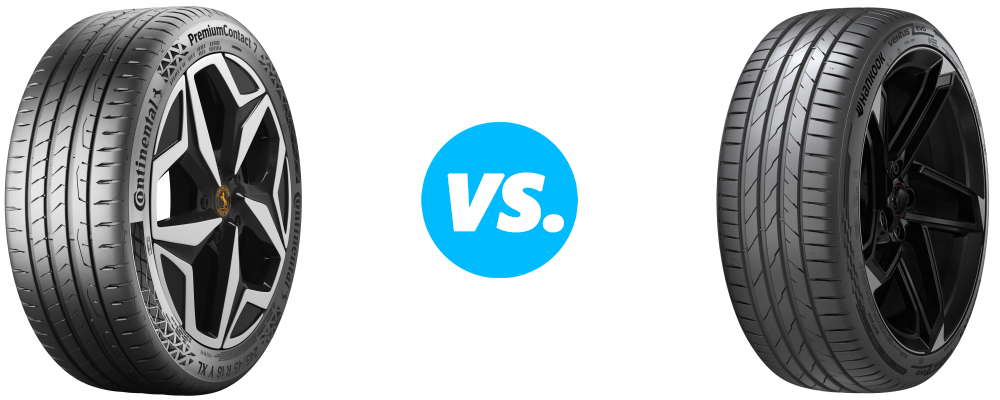
Continental PremiumContact 7 vs Hankook Ventus Evo
The interesting part is how they arrive at their results. The Hankook more often posts the headline braking numbers-especially in the wet-while the Continental tends to score with stability, aquaplaning reserves (particularly in corners), and long-haul ownership metrics like wear and rolling resistance. If you're choosing between them, it's less about which is “safe enough” (both are), and more about whether you prioritise wet stopping/driver feel or balanced touring competence and longevity.
Test Results
Independent comparison tyre tests are the best source of data to get tyre information from, and the good news is there have been six tests which compare both tyres directly!
| Tyre | Test Wins | Performance |
|---|---|---|
| Continental PremiumContact 7 | two | |
| Hankook Ventus Evo | three | |
| one draws in one tests | ||
While it might look like the Hankook Ventus Evo is better than the Continental PremiumContact 7 purely based on the higher number of test wins, tyres are very complicated objects which means where one tyre is better than the other can be more important in real world use.
Let's look at how the two tyres compare across multiple tyre test categories.
Key Strengths
- Class-leading curved aquaplaning resistance across shared tests (4-0), translating to strong cornering stability in heavy rain
- Very strong wet handling balance in multiple tests (e.g., 69.4 s vs 70.9 s in Motor 2026; 67.7 s vs 68.69 s in 225/45 R17 group test)
- Better wear/longevity results in shared data (e.g., 46,250 km vs 41,440 km in Auto Bild 2025; slightly ahead again in Autobild 2026)
- More often lower rolling resistance than Hankook (wins 3-1), supporting better efficiency/EV range potential
- Dominant wet braking across all shared comparisons (6-0), including big-test validation (e.g., 27.0 m vs 27.3 m; 42.1 m vs 42.7 m; 42.7 m vs 44.2 m)
- Frequent dry braking advantage (wins 4-2), including standout 32.8 m vs 34.3 m in 245/45 R19 testing
- Sportier, more confidence-inspiring subjective scores (wins subjective dry handling 3-0; also leads subjective wet handling where measured)
- Strong value proposition in some tests: notably lower cost-per-distance in Autobild 2026 (11.01 vs 17.39 price/1000) while still taking 1st overall
Dry Braking
Looking at data from six tyre tests, the Hankook Ventus Evo was better during four dry braking tests. On average the Hankook Ventus Evo stopped the vehicle in 0.74% less distance than the Continental PremiumContact 7.
Best In Dry Braking: Hankook Ventus Evo
See how the Dry Braking winner was calculated >>
Dry Handling [s]
Looking at data from two tyre tests, the Continental PremiumContact 7 was better during two dry handling [s] tests. On average the Continental PremiumContact 7 was 0.66% faster around a lap than the Hankook Ventus Evo.
Best In Dry Handling [s]: Continental PremiumContact 7
See how the Dry Handling winner was calculated >>
Dry Handling [Km/H]
Looking at data from two tyre tests, the Hankook Ventus Evo was better during two dry handling [km/h] tests. On average the Hankook Ventus Evo was 1.39% faster around a lap than the Continental PremiumContact 7.
Best In Dry Handling [Km/H]: Hankook Ventus Evo
See how the Dry Handling winner was calculated >>
Subj. Dry Handling
Looking at data from three tyre tests, the Hankook Ventus Evo was better during three subj. dry handling tests. On average the Hankook Ventus Evo scored 14.3% more points than the Continental PremiumContact 7.
Best In Subj. Dry Handling: Hankook Ventus Evo
See how the Subj. Dry Handling winner was calculated >>
Wet Braking
Looking at data from six tyre tests, the Hankook Ventus Evo was better during six wet braking tests. On average the Hankook Ventus Evo stopped the vehicle in 1.63% less distance than the Continental PremiumContact 7.
Best In Wet Braking: Hankook Ventus Evo
See how the Wet Braking winner was calculated >>
Wet Handling [s]
Looking at data from two tyre tests, the Continental PremiumContact 7 was better during two wet handling [s] tests. On average the Continental PremiumContact 7 was 1.79% faster around a wet lap than the Hankook Ventus Evo.
Best In Wet Handling [s]: Continental PremiumContact 7
See how the Wet Handling winner was calculated >>
Wet Handling [Km/H]
Looking at data from two tyre tests, the Hankook Ventus Evo was better during two wet handling [km/h] tests. On average the Hankook Ventus Evo was 1.02% faster around a wet lap than the Continental PremiumContact 7.
Best In Wet Handling [Km/H]: Hankook Ventus Evo
See how the Wet Handling winner was calculated >>
Subj. Wet Handling
Looking at data from two tyre tests, the Hankook Ventus Evo was better during two subj. wet handling tests. On average the Hankook Ventus Evo scored 4.6% more points than the Continental PremiumContact 7.
Best In Subj. Wet Handling: Hankook Ventus Evo
See how the Subj. Wet Handling winner was calculated >>
Wet Circle
Looking at data from one tyre tests, the Continental PremiumContact 7 was better during one wet circle tests. On average the Continental PremiumContact 7 had 3.75% higher lateral wet grip than the Hankook Ventus Evo.
Best In Wet Circle: Continental PremiumContact 7
See how the Wet Circle winner was calculated >>
Straight Aqua
Looking at data from four tyre tests, the Hankook Ventus Evo was better during two straight aqua tests. On average the Hankook Ventus Evo floated at a 1.92% higher speed than the Continental PremiumContact 7.
Best In Straight Aqua: Hankook Ventus Evo
See how the Straight Aqua winner was calculated >>
Curved Aquaplaning
Looking at data from four tyre tests, the Continental PremiumContact 7 was better during four curved aquaplaning tests. On average the Continental PremiumContact 7 slipped out at a 1.93% higher speed than the Hankook Ventus Evo.
Best In Curved Aquaplaning: Continental PremiumContact 7
See how the Curved Aquaplaning winner was calculated >>
Subj. Comfort
Looking at data from four tyre tests, the Continental PremiumContact 7 was better during two subj. comfort tests. On average the Continental PremiumContact 7 scored 0.46% more points than the Hankook Ventus Evo.
Best In Subj. Comfort: Continental PremiumContact 7
See how the Subj. Comfort winner was calculated >>
Noise
Looking at data from four tyre tests, the Hankook Ventus Evo was better during three noise tests. On average the Hankook Ventus Evo measured 1.59% quieter than the Continental PremiumContact 7.
Best In Noise: Hankook Ventus Evo
See how the Noise winner was calculated >>
Wear
Looking at data from two tyre tests, the Continental PremiumContact 7 was better during two wear tests. On average the Continental PremiumContact 7 is predicted to cover 4.73% miles before reaching 1.6mm than the Hankook Ventus Evo.
Best In Wear: Continental PremiumContact 7
See how the Wear winner was calculated >>
Value
Looking at data from two tyre tests, the Hankook Ventus Evo was better during one value tests. On average the Hankook Ventus Evo proved to have a 21.23% better value based on price/1000km than the Continental PremiumContact 7.
Best In Value: Hankook Ventus Evo
See how the Value winner was calculated >>
Rolling Resistance
Looking at data from four tyre tests, the Continental PremiumContact 7 was better during three rolling resistance tests. On average the Continental PremiumContact 7 had a 2.15% lower rolling resistance than the Hankook Ventus Evo.
Best In Rolling Resistance: Continental PremiumContact 7
See how the Rolling Resistance winner was calculated >>
Abrasion
Looking at data from one tyre tests, the Continental PremiumContact 7 was better during one abrasion tests. On average the Continental PremiumContact 7 lost 11.43% less particle wear matter than the Hankook Ventus Evo.
Best In Abrasion: Continental PremiumContact 7
See how the Abrasion winner was calculated >>
Real World Driver Reviews
Continental PremiumContact 7 Driver Reviews
Drivers generally rate the Continental PremiumContact 7 very highly for strong dry and especially wet grip, confident braking, and stable, planted handling that makes the car feel secure at speed. The most consistent drawbacks are higher-than-expected road noise (particularly on rough asphalt) and a softer sidewall feel that can reduce steering precision for some drivers. A meaningful minority also report faster wear than expected or a noticeable performance drop (especially in the wet) once tread depth gets lower, suggesting it prioritizes grip over ultimate longevity.
Based on 54 reviews with an average rating of 82%
Hankook Ventus Evo Driver Reviews
Overall sentiment toward the Hankook Ventus Evo is strongly positive. Most drivers praise its high mechanical grip in dry and especially wet conditions, confident braking, stability, low noise, and good comfort-often comparing it favorably to Michelin PS4, Goodyear Asymmetric, and Bridgestone. A minority mention softer steering feel/feedback and one mid-scoring review reports faster wear on a high-performance Tesla. For most users, it delivers excellent everyday sporty performance at a good price.
Based on 11 reviews with an average rating of 83%
The size is a bit of an unusual one, and therefore the price of this set, compared to a set of... Continue reading this review using the link below
Conclusion
Continental's PremiumContact 7 counters with a more rounded “always works” profile that shows up in curved aquaplaning and overall wet balance: it wins curved aquaplaning 4-0 across shared tests and is often quicker/more controlled in wet handling (e.g., 69.4 s vs 70.9 s in Motor 2026; 67.7 s vs 68.69 s in the 225/45 R17 group test). Where the Continental can make the biggest real-world difference is ownership: wear/mileage is consistently better (e.g., 46,250 km vs 41,440 km in Auto Bild 2025; and marginally higher again in Autobild 2026), and rolling resistance is more often lower-while Hankook is repeatedly flagged for higher rolling resistance in the narratives.
Practical takeaway: choose the Ventus evo if you want the more performance-leaning, braking-strong tyre with excellent wet stopping and a sportier steering/limit behaviour. Choose the PremiumContact 7 if you want a premium-touring summer tyre that's exceptionally secure in standing water and sweeping wet corners, with stronger longevity and a calmer, more balanced day-to-day character-accepting that it's often pricier and not always the “hero number” winner in braking tables.
Key Differences
- Wet braking is the clearest separator: Hankook wins 6/6, but margins are sometimes small (e.g., 43.2 m vs 43.3 m) and sometimes meaningful (e.g., 42.7 m vs 44.2 m).
- Aquaplaning character differs: Continental is consistently better in curved/lateral aquaplaning (wins 4-0), while Hankook more often leads straight-line aquaplaning in key datasets (e.g., 78.8 vs 74.9 km/h in Motor 2026; 78.81 vs 74.88 km/h in 225/45 R17 test).
- Dry performance emphasis: Hankook more often posts the best dry braking numbers, while dry handling is closer to a tie (2-2) depending on size/test format.
- Driver feel vs touring balance: Hankook dominates subjective handling metrics (especially dry), whereas Continental is more often described as safe, stable and balanced rather than the most “supported” or track-leaning.
- Efficiency trend: Continental more often has lower rolling resistance (3-1), while Hankook is repeatedly called out for high rolling resistance in test commentary despite occasional measured wins.
- Ownership economics vary by market/test: Continental tends to win on mileage/wear, but can be expensive upfront; Hankook can deliver exceptional cost-per-km in some tests (e.g., Autobild 2026) while still winning overall.
Overall Winner: Hankook Ventus Evo
Based on the tyre test data and user reviews we have in our database, the Hankook Ventus Evo has demonstrated better overall performance in this comparison. However, as you can see from the spider diagram above, each tyre has its own strengths which should be considered in your final tyre buying choice.Similar Comparisons
Looking for more tyre comparisons? Here are other direct comparisons involving these tyres:


Footnote
This page has been developed using tyre industry testing best practices. This means we are only comparing tests which have had both tyres in the same test.
Why is this important? Tyre testing is heavily affected by things like surface grip levels and surface temperature, which means you can only compare values from the same day. During a tyre test external condition changes are calculated into the overall results, but it is not possible to calculate this between tyre tests performed on different days or at different locations.
As a result you will see other tests on Tyre Reviews which feature both the %s and %s, but as they weren't conducted on the same day, the results are not comparable.
Lots of other websites do this sort of tyre comparison, Tyre Reviews doesn't.
Discussion
- No comments yet — be the first.