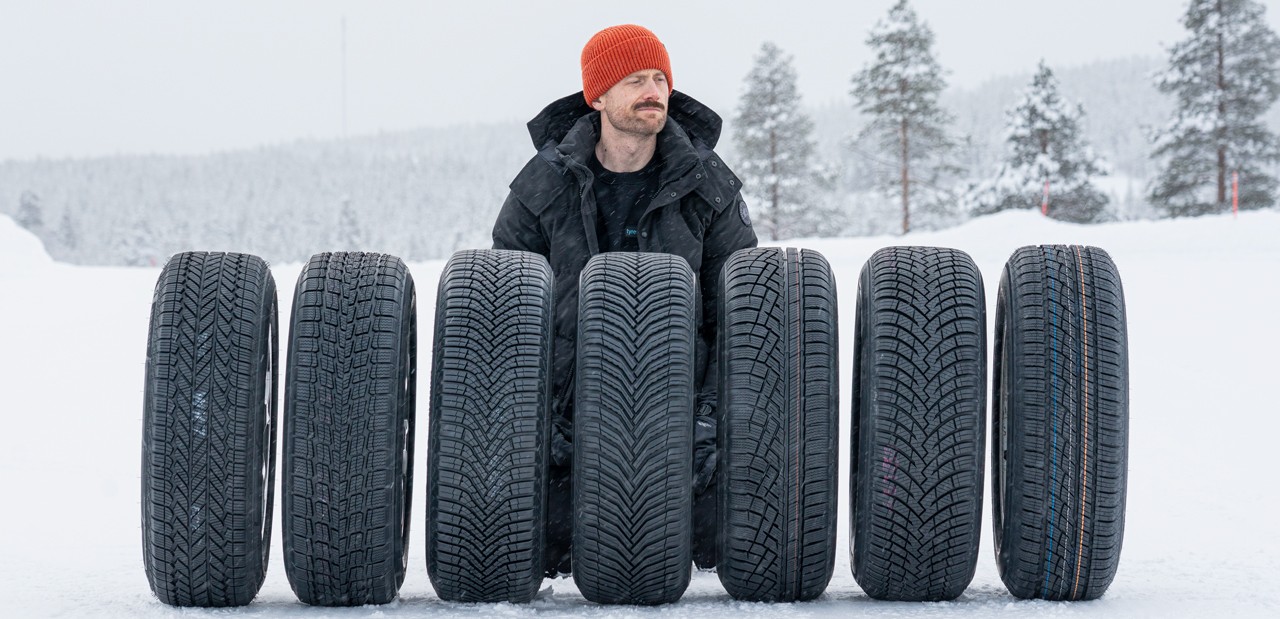
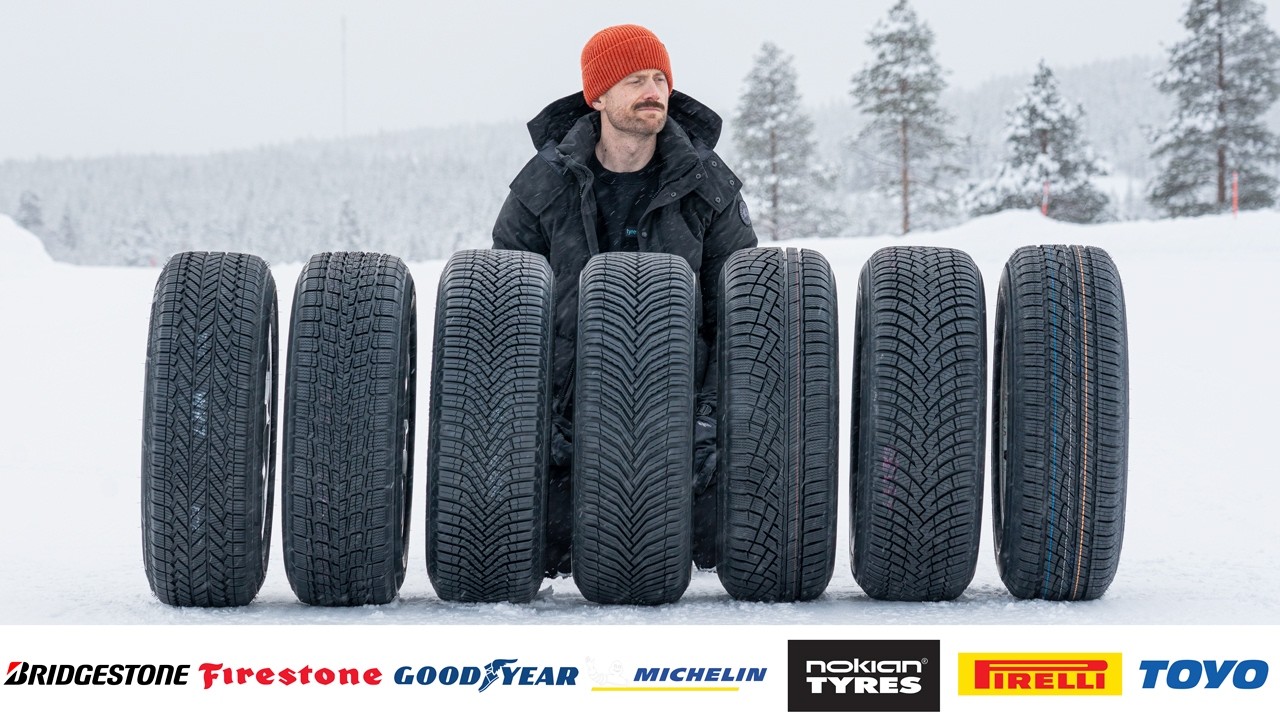
The all weather category of tyres is quickly growing in popularity, as a tyre that can be used in all weathers is a big advantage for people living in snowy climates, it saves changing tyres twice a year between an all season and a winter product.
To find out which of these new all weather category tyres is best, I have tested them in the dry, wet, snow and ice to give you a really good overview of their abilities, and also looked into the the rolling resistance, comfort, noise levels and value, to find out which tyre is best in all conditions.
Testing Methodology
Test Driver
Jonathan Benson
Tyre Size
225/65 R17
Test Location
Professional Proving Ground
Test Year
2025
Tyres Tested
7
Show full testing methodologyHide methodology
Every tyre is tested using calibrated instrumented measurement and structured subjective assessment. Reference tyres are retested throughout each session to correct for changing conditions, ensuring fair, repeatable comparisons. Multiple reference sets are used where needed so that control tyre wear does not affect accuracy.
We use professional-grade testing equipment including GPS data loggers, accelerometers, and calibrated microphones. All tyres are broken in and conditioned before testing begins. For full details on our equipment, preparation process, and calibration procedures, see our complete testing methodology.
Categories Tested
Dry Braking
For dry braking, I drive the test vehicle at an entry speed of 110 km/h and apply full braking effort to a standstill with ABS active on clean, dry asphalt. I typically use an 100–5 km/h measurement window. My standard programme is five runs per tyre set where possible, although the sequence can extend to as many as fifteen runs if conditions and tyre category justify it. I analyse the full set of runs and discard statistical outliers before averaging. Reference tyres are run repeatedly throughout the session to correct for changing conditions.
Dry Handling
For dry handling, I drive at the limit of adhesion around a dedicated handling circuit with ESC disabled where possible so I can assess the tyre's natural balance, transient response, and limit behaviour without electronic intervention masking the result. I usually complete between two and five timed laps per tyre set, depending on the circuit, tyre type, and consistency of conditions. I exclude laps affected by clear driver error or obvious environmental inconsistency. Control runs are carried out frequently throughout the session, and I often use multiple sets of control tyres so that wear on the references does not become a meaningful variable. For more track-focused products, I also do endurance testing, which is a set number of laps at race pace to determine tire wear patterns and heat resistance over longer driving.
Subj. Dry Handling
Objective data is only part of the picture, so I also carry out a structured subjective handling assessment at the limit of adhesion on a dedicated dry handling circuit. I score steering precision, steering response, turn-in behaviour, mid-corner balance, corner-exit traction, breakaway characteristics, and overall confidence using a standardised 1–10 scale used consistently across my testing. The final assessment combines numeric scoring with written technical commentary. I complete familiarisation laps on the control tyre before evaluating each candidate.
Wet Braking
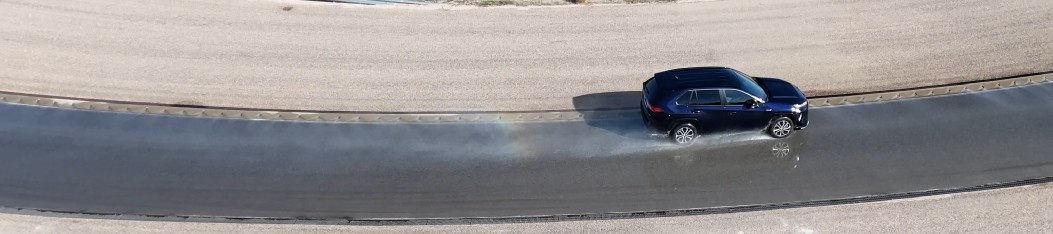
For wet braking, I drive the test vehicle at an entry speed of 88 km/h and apply full braking effort to a standstill with ABS active on an asphalt surface with a controlled water film. I typically use an 80–5 km/h measurement window to isolate tyre performance from variability in the initial brake application. My standard programme is eight runs per tyre set where possible, although the sequence can extend to as many as fifteen runs if conditions and tyre category justify it. I analyse the full set of runs and discard statistical outliers before averaging. To correct for changing conditions, I run reference tyres repeatedly throughout the session — in wet testing, typically every three candidate test sets.
Wet Handling
For wet handling, I drive at the limit of adhesion around a dedicated handling circuit. I generally use specialist wet circuits with kerb-watering systems designed to maintain a consistent surface condition. ESC is disabled where possible so I can assess the tyre's natural balance, transient response, and limit behaviour without electronic intervention masking the result. I usually complete between two and five timed laps per tyre set, depending on the circuit, tyre type, and consistency of conditions. I exclude laps affected by clear driver error or obvious environmental inconsistency. Control runs are carried out frequently throughout the session, and I often use multiple sets of control tyres so that wear on the references does not become a meaningful variable.
Subj. Wet Handling
Objective data is only part of the picture, so I also carry out a structured subjective handling assessment at the limit of adhesion on a dedicated wet handling circuit. I score steering precision, steering response, turn-in behaviour, mid-corner balance, aquaplaning resistance, breakaway characteristics, and overall confidence using a standardised 1–10 scale used consistently across my testing. The final assessment combines numeric scoring with written technical commentary. I complete familiarisation laps on the control tyre before evaluating each candidate.
Straight Aqua
To measure straight-line aquaplaning resistance, I drive one side of the vehicle through a water trough of controlled depth, typically around 7 mm, while the opposite side remains on dry pavement. I enter at a fixed speed and then accelerate progressively. I define aquaplaning onset as the point at which the wheel travelling through the water exceeds a specified slip threshold relative to the dry-side reference wheel. I usually perform four runs per tyre set and average the valid results.
Curved Aquaplaning
For curved aquaplaning, I use a circular track, typically around 100 metres in diameter, with a flooded arc of controlled water depth, usually about 7 mm. The vehicle is instrumented with GPS telemetry and a tri-axial accelerometer. I drive through the flooded section at progressively increasing speed, typically in 5 km/h increments, and record the minimum sustained lateral acceleration at each step. The test continues until lateral acceleration collapses, indicating complete aquaplaning. The result is expressed as remaining lateral acceleration in m/s² as speed rises.
Snow Braking
For snow braking, I drive the test vehicle at an entry speed of 50 km/h and apply full braking effort to a standstill with ABS active on a groomed, compacted snow surface, measuring 45-5 km/h. I generally use a wide VDA (vehicle dynamic area) and progressively move across the surface between runs so that no tyre ever brakes on the same piece of snow twice. My standard programme is twelve runs per tyre set, although the sequence can extend further if the data justify it. I analyse the full set of runs and discard statistical outliers before averaging. The surface is regularly groomed throughout the session. To correct for changing snow surface conditions, I run reference tyres repeatedly — typically every two candidate test sets.
Snow Traction
For snow traction, I accelerate the vehicle from rest on a groomed snow surface with traction control active and measure speed and time using GPS telemetry. I typically use a 5–35 km/h measurement window to reduce the influence of launch transients and powertrain irregularities. I use a wide VDA (vehicle dynamic area) and progressively move across the surface between runs so that no tyre ever accelerates on the same piece of snow twice. The surface is regularly groomed throughout the session. I complete multiple runs per tyre set and average the valid results. Reference tyres are run typically every two candidate test sets to correct for changing snow surface conditions.
Snow Handling
For snow handling, I drive at the limit of adhesion around a dedicated snow handling circuit with ESC disabled where possible. The circuit is groomed and prepared after every run while tyres are being changed, so each set runs on a consistently prepared surface. I usually complete between two and five timed laps per tyre set, excluding laps affected by clear driver error or obvious environmental inconsistency. Because snow surfaces degrade more rapidly than asphalt, control runs are carried out more frequently — typically every two candidate test sets.
Subj. Snow Handling
Objective data is only part of the picture, so I also carry out a structured subjective handling assessment at the limit of adhesion on a dedicated snow handling circuit. The circuit is groomed and prepared after every run while tyres are being changed, so each set runs on a consistently prepared surface. I score steering precision, turn-in behaviour, mid-corner balance, corner-exit traction, breakaway characteristics, and overall confidence on snow using a standardised 1–10 scale used consistently across my testing. The final assessment combines numeric scoring with written technical commentary. I complete familiarisation laps on the control tyre before evaluating each candidate.
Ice Braking
For ice braking, I drive the test vehicle at an entry speed of 35 km/h and apply full braking effort to a standstill with ABS active on a prepared ice surface. Surface temperature is continuously monitored as ice friction properties vary substantially with temperature. My standard programme is twelve runs per tyre set but with ice testing, you often do many more. I analyse the full set of runs and discard statistical outliers before averaging. Reference tyres are run typically every two candidate test sets to correct for changing surface conditions.
Ice Traction
For ice traction, I accelerate the vehicle from rest on a prepared ice surface with traction control active and measure speed and time using GPS telemetry. I typically use a 5–35 km/h measurement window to reduce the influence of launch transients. I use a wide VDA (vehicle dynamic area) and progressively move across the surface between runs so that no tyre ever accelerates on the same piece of ice twice. Surface temperature is continuously monitored. I complete multiple runs per tyre set and average the valid results, with reference tyres run typically every two candidate test sets.
Subj. Comfort
To assess comfort, I drive on a wide range of road surfaces (often dedicated comfort tracks at test facilities) at speeds from 50 to 120 km/h, including smooth motorway, coarse surfaces, expansion joints, broken pavement, and sharp-edged obstacles. I evaluate primary ride quality, secondary ride quality, impact harshness, seat-transmitted vibration, and the tyre's ability to absorb sharp inputs. Ratings are assigned on a 1–10 scale relative to the reference tyre.
Subj. Noise
For subjective noise assessment, I drive at constant speeds across multiple surface types with the windows closed, ventilation off, and audio system off. I assess overall noise level, tonal quality, cavity boom, pattern noise, broadband roar, and sensitivity to both speed and road texture. Each tyre is rated on a 1–10 scale and supported by written observations on noise character and annoyance.
Noise
I measure external pass-by noise in accordance with UNECE Regulation 117 and ISO 13325 using the coast-by method on a compliant test surface. Calibrated microphones are positioned beside the test lane, and the vehicle coasts through the measurement zone under controlled conditions. I record the maximum A-weighted sound pressure level in dB(A), complete multiple runs over the relevant speed range, and normalise the result to the reference speed required by the procedure.
Rolling Resistance
Rolling resistance is measured under controlled laboratory conditions in accordance with ISO 28580 and UNECE Regulation 117 Annex 6. The tyre is mounted on a test wheel and loaded against a large-diameter steel drum. After thermal stabilisation at the prescribed test speed, rolling resistance force is measured at the spindle and corrected according to the relevant procedure. The result is expressed as rolling resistance coefficient, typically in kg/tonne.
How each category is weighted in the overall score:
Dry30%
Dry Braking50%
Dry Handling40%
Subj. Dry Handling10%
Wet35%
Wet Braking40%
Wet Handling35%
Subj. Wet Handling10%
Straight Aqua10%
Curved Aquaplaning5%
Snow20%
Snow Braking30%
Snow Traction30%
Snow Handling30%
Subj. Snow Handling10%
Ice5%
Ice Braking50%
Ice Traction50%
Comfort5%
Subj. Comfort25%
Subj. Noise25%
Noise50%
Value5%
Value50%
Rolling Resistance50%
Wet
All weather tyres are a bunch of compromises by default - no tyre can be the best in every condition. This leaves the manufacturer with the ability to choose whether to go for an even balance of performance in the dry, wet and snow, or priorities one area more than others. Based on this wet testing it seems we have some differing opinions on how important wet is.
The results give us essentially three groups of tyres. None of them are budget tyres, so none have been horrific, however it is quite a big spread of wet abilities.
The Toyo, Firestone and Bridgestone were in one group, and perhaps this is the group that want the best snow and ice performance as they all struggled in the wet, offering almost minimal feedback and lots of understeer. Snow and wet are performance trade offs in tyre development, so we will find out later in the test if these tyres are more snow focused.
Then you have Nokian, Michelin and Pirelli. The Nokian felt more towards the first group subjectively but it did offer decent lateral grip. The Michelin turned out to be one of the most fun tyres as it actually let the car rotate, something to do with the sharp front end but braking was better than turning which helped the time, and the Pirelli was another step on, feeling sharp on the front end but taking longer than its peers to recover from slides.
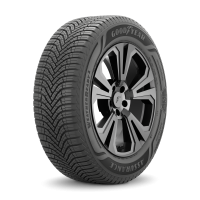
Finally, there was the new Goodyear, the easiest and most consistent to drive fast, and the closest to a summer tyre in terms of handling.
Speaking of a summer tyre, I did have one in the test as reference. Just a touring suv summer tyre but it felt like a race tyre in comparison, the steering felt heavier, the brakes were sharper, and the grip was a good step on, even in these cooler test conditions.
Wet Handling
Spread: 4.01 s (5.6%)|Avg: 74.35 s
Wet handling time in seconds [Average Temperature 9c] (Lower is better)
Reference Summer Ref
71.53 s
Goodyear Assurance WeatherReady 2
73.78 s
Pirelli Scorpion WeatherActive
74.48 s
Michelin CrossClimate 2 AW
74.65 s
Nokian Remedy WRG5
74.72 s
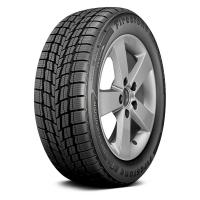
Bridgestone WeatherPeak
75.02 s
Firestone WeatherGrip
75.10 s
Toyo Celsius 2
75.54 s
Wet braking is one of those things where a tyre can really make a safety different in the real world the difference, and the wet braking results almost track wet handling perfectly, with the Goodyear once again having the best stopping distance and the Toyo the worse. The Pirelli and Michelin also perform well, but then the gap to 4th was over 10% worse, around 13ft, which is quite the difference and nearly the length of a car.
Wet Braking
Spread: 9.01 M (30.8%)|Avg: 34.96 M
Wet braking in meters (80 - 5 km/h) [Average Temperature 14.5c] (Lower is better)
Wet Braking: Safety Impact: Best vs Worst Tyre
The Goodyear didn't so as well in the deeper water of the aquaplaning tests, with the Nokian, Michelin and Bridgestone all performing well.
Straight Aqua
Spread: 5.80 Km/H (6.9%)|Avg: 80.33 Km/H
Float Speed in Km/H (Higher is better)
Michelin CrossClimate 2 AW
83.70 Km/H
Nokian Remedy WRG5
82.90 Km/H
Pirelli Scorpion WeatherActive
80.10 Km/H
Bridgestone WeatherPeak
79.60 Km/H
Goodyear Assurance WeatherReady 2
79.50 Km/H
Firestone WeatherGrip
78.60 Km/H
Toyo Celsius 2
77.90 Km/H
Curved Aquaplaning
Spread: 2.40 m/sec2 (25.3%)|Avg: 8.24 m/sec2
Remaining lateral acceleration (Higher is better)
Nokian Remedy WRG5
9.50 m/sec2
Bridgestone WeatherPeak
9.20 m/sec2
Michelin CrossClimate 2 AW
8.80 m/sec2
Firestone WeatherGrip
8.30 m/sec2
Toyo Celsius 2
7.50 m/sec2
Pirelli Scorpion WeatherActive
7.30 m/sec2
Goodyear Assurance WeatherReady 2
7.10 m/sec2
Dry
The differences between these tyres in the dry is small. It ended up as Bridgestone, Toyo and Firestone having too little front grip to post a fast time, Michelin, Nokian and Pirelli all doing great, and Goodyear again feeling the most summer like with the quickest most direct steering. Sub limit, doing lane changes, they were all fine, but again the Bridgestone and Firestone just seemed a little less controlled when doing aggressive lane changes.
Dry Handling
Spread: 2.30 s (3.2%)|Avg: 73.65 s
Dry handling time in seconds [Average Temperature 9c] (Lower is better)
Reference Summer Ref
72.46 s
Goodyear Assurance WeatherReady 2
73.12 s
Pirelli Scorpion WeatherActive
73.29 s
Nokian Remedy WRG5
73.63 s
Michelin CrossClimate 2 AW
73.85 s
Firestone WeatherGrip
74.04 s
Toyo Celsius 2
74.08 s
Bridgestone WeatherPeak
74.76 s
Dry braking did spread things out. The Michelin Crossclimate 2 pulled its usual party piece by being the best at stopping the car, with the Goodyear second, but not what I'd call a close second as it was 2 meters back. Then Pirelli and Nokian almost tied for third another meter back, it was almost another 2 meters to the toyo then ANOTHER 2 meters to the Bridgestone and Firestone. As an illustration, from 80 mph the Michelin would take 63 meters and the firestone 75 meters, Another way of looking at it, when you're stopped from 80 mph on the Michelin, you're still doing over 30 mph on the Firestone.
Dry Braking
Spread: 9.96 M (29%)|Avg: 40.49 M
Dry braking in meters (100 - 5 km/h) [Average Temperature 14.5c] (Lower is better)
Dry Braking: Safety Impact: Best vs Worst Tyre
Snow
The good news for tyre shoppers is that all these tyres are very good in the snow! The bad news is for the Bridgestone and Firestone, which i'd hoped had traded some wet grip for class leading snow grip, but sadly that's not the case. They were very good, but not the best.
The slowest tyres around the lap were the Toyo and Goodyear, and I say slowest, both under 3% off the fastest lap time. Subjectively they were noticeably the 'worst' too, in that the steering inputs took slightly longer to register, and they felt a tiny bit down on traction but honestly, still good tyres in the snow.
Then you have the Pirelli, Bridgestone and Firestone, all under 2% off the best. I liked how the Bridgestone and Firestone felt once you had them turning, they dug in nicely and held on well, and the Pirelli was probably the most fun with a playful rear, but the rear took slightly longer to recover when sliding which slowed it down.
Finally it was the Nokian and Michelin. The Nokian was a nicely balanced tyre, I don't think it had as much grip overall as the Michelin but as it was a really rounded grip circle and everything happened exactly as you would expect, I found it easy to do consistently fast laps on.
And then of course we have the Michelin CrossClimate 2. The European version of this tyre, which is slightly different, is always one of the best in the snow and once again the US version proves it is the king in winter by having the fastest lap. Like the European version it's balance was a little understeer heavy, nice and safe, but also slow so I'm sure it has even more grip than this tiny advantage shows.
And finally, instead of including a summer tyre, I included one of the best, if not the best, winter tyre, the Nokian Hakkapeliitta R5. While there was just 3% between the best and worst all weather tyres, the R5 was nearly 10% ahead and you could feel it. Just a delight to drive. Keep that in mind if you live in a heavy snow climate.
Snow Handling
Spread: 6.98 s (8.7%)|Avg: 84.76 s
Snow handling time in seconds [Average Temperature -5.5c] (Lower is better)
Nokian Hakkapeliitta R5 SUV Ref
79.80 s
Michelin CrossClimate 2 AW
84.26 s
Nokian Remedy WRG5
84.28 s
Firestone WeatherGrip
85.24 s
Bridgestone WeatherPeak
85.30 s
Pirelli Scorpion WeatherActive
85.81 s
Goodyear Assurance WeatherReady 2
86.62 s
Toyo Celsius 2
86.78 s
The traction and braking data backed up the handling, with the Michelin CrossClimate 2 being the best in snow traction, closely followed by the Firestone and Nokian. Bridgestone jumped to the front in snow braking, with the Michelin in second and Nokian third. In both tests, the full winter tyre had a significant advantage over the pack
Snow Braking
Spread: 1.67 M (11.1%)|Avg: 16.39 M
Snow braking in meters (40 - 5 km/h) [Average Temperature -8.5c] (Lower is better)
Snow Braking: Safety Impact: Best vs Worst Tyre
Snow Traction
Spread: 0.27 s (8.8%)|Avg: 3.23 s
Snow acceleration time (5 - 40 km/h) [Average Temperature -8.5c] (Lower is better)
Nokian Hakkapeliitta R5 SUV Ref
3.08 s
Michelin CrossClimate 2 AW
3.21 s
Firestone WeatherGrip
3.22 s
Nokian Remedy WRG5
3.24 s
Toyo Celsius 2
3.24 s
Pirelli Scorpion WeatherActive
3.25 s
Bridgestone WeatherPeak
3.26 s
Goodyear Assurance WeatherReady 2
3.35 s
As promised I got ice data on smooth ice, which is the hardest type of ice to get grip on, and where compound really does make the difference. The Pirelli proved to be best overall, having the best ice traction and the second best ice braking, but the Michelin was again also excellent. Nokian finished third with very good traction, but lost out a little in braking, and as we saw in snow, the Goodyear, Firestone and Toyo struggled. The full winter tyre had its biggest advantage yet, finishing in a totally different class to the all weathers.
Ice Braking
Spread: 2.77 M (31.1%)|Avg: 10.70 M
Ice braking in meters (20 - 5 km/h) [Average Temperature -10.5c] (Lower is better)
Ice Braking: Safety Impact: Best vs Worst Tyre
Ice Traction
Spread: 5.10 s (79.7%)|Avg: 9.79 s
Ice acceleration time (5 - 20 km/h) [Average Temperature -10.5c] (Lower is better)
Nokian Hakkapeliitta R5 SUV Ref
6.40 s
Pirelli Scorpion WeatherActive
9.39 s
Nokian Remedy WRG5
9.61 s
Michelin CrossClimate 2 AW
9.79 s
Bridgestone WeatherPeak
10.10 s
Goodyear Assurance WeatherReady 2
10.42 s
Firestone WeatherGrip
11.14 s
Toyo Celsius 2
11.50 s
Comfort
Comfort and noise is very intricate, I've been driving on all sorts of surfaces and don't have a single solution for those of you who want comfort beyond everything else.
The Firestone did have the best subjective comfort overall, but of all the tyres, it was the only one that had a bit of a tread pattern whine in the cabin, which could be really annoying if it got worse as it wore. Then you had the Toyo that was excellent in noise, but firm over all the bumps. Then you had the goodyear which was composed over the stones, it had reassuring control of what it was doing, but hit pretty hard over the big impacts. Every tyre had it's positives and negatives, however there was one tyre that had a small lead in terms of manners, and that was the Pirelli. Not only did it have the lowest external noise, I also rated it the best for subjective noise, and the second best overall on all the surfaces. So there's your answer, if you want the ultimate refinement, it's the Pirelli. But really, they were so close you'll be happy with any of them.
Subj. Comfort
Spread: 1.50 Points (15%)|Avg: 9.07 Points
Subjective Comfort Score (Higher is better)
Firestone WeatherGrip
10.00 Points
Pirelli Scorpion WeatherActive
9.50 Points
Goodyear Assurance WeatherReady 2
9.50 Points
Nokian Remedy WRG5
9.00 Points
Bridgestone WeatherPeak
8.50 Points
Toyo Celsius 2
8.50 Points
Michelin CrossClimate 2 AW
8.50 Points
Noise
Spread: 2.60 dB (3.7%)|Avg: 72.00 dB
External noise in dB (Lower is better)
Pirelli Scorpion WeatherActive
70.30 dB
Bridgestone WeatherPeak
71.70 dB
Toyo Celsius 2
71.80 dB
Michelin CrossClimate 2 AW
72.00 dB
Firestone WeatherGrip
72.50 dB
Nokian Remedy WRG5
72.80 dB
Goodyear Assurance WeatherReady 2
72.90 dB
Value
There is quite a spread in the rolling resistance levels of the tyres, in fact over 30%, with the Michelin the best and the Goodyear the worst. As a tyre uses around a fifth of the energy for a gas powered vehicle and around a quarter in an electric car, that means in theory, you could be using around 4-8% more gas / electricity. Not massive, but also significant.
Rolling Resistance
Spread: 2.19 kg / t (31.1%)|Avg: 7.82 kg / t
Rolling resistance in kg t (Lower is better)
Michelin CrossClimate 2 AW
7.05 kg / t
Bridgestone WeatherPeak
7.14 kg / t
Nokian Remedy WRG5
7.31 kg / t
Firestone WeatherGrip
7.65 kg / t
Pirelli Scorpion WeatherActive
7.78 kg / t
Toyo Celsius 2
8.55 kg / t
Goodyear Assurance WeatherReady 2
9.24 kg / t
19,000 km
£1.45/L
8.0 L/100km
--
Annual Difference
--
Lifetime Savings
--
Extra Fuel/Energy
--
Extra CO2
Estimates based on typical driving conditions. Rolling resistance accounts for approximately 20% of IC vehicle fuel consumption and 25% of EV energy consumption. Actual savings vary based on driving style, vehicle weight, road conditions, and tyre age. For comparative purposes only. Lifetime savings based on a 40,000km / 25,000 mile tread life.
Finally, I couldn't do a wear test this time to work out which tyre offers the best cost per mile in the real world, but as these all have treadwear warranties I CAN work out the warranted cost per mile, which I think is worth looking at. There's a 40% difference in cost per mile between the most expensive, the Michelin, and the cheapest, the toyo, however, if you take the time to compare that to the final results, you will see that more expensive generally means more better. Donut Media would be proud.
Best overall in the dry, best overall in the wet, Best overall in the snow, excellent on ice, lowest rolling resistance on test.
Expensive, slightly reduced comfort.
The Michelin CrossClimate 2 AW might be getting on in years, but it is still the category leading all weather tyre. It somehow manages to blend the best grip in nearly all conditions with the lowest rolling resistance, a hugely impressive blend of qualities.
Excellent in the dry, best wet braking and wet handling, good comfort levels.
Weaker hydroplaning performance, not the best on snow or ice (but way better than an all season or summer tyre), highest rolling resistance of the test.
The new Goodyear Assurance WeatherReady 2 is solid all weather tyre. It might not be the best in the snow, but it was only 4.6% off overall, and it excels in the dry and wet. This is the tyre to fit if you live in a region with milder winters, and you don't mind taking a small hit on economy thanks to the high rolling resistance.
Good in the dry, very good in the wet grip tests, best overall on ice, best overall comfort, reasonable rolling resistance.
Weak curved hydroplaning performance, not the best on snow (but way better than an all season or summer tyre).
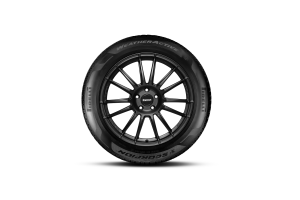
The Pirelli Scorpion WeatherActive is a very well balanced all weather tyre, with its only significant weakness found in curved hydroplaning. It's grip in the dry, wet and snow are all acceptable, and the combination of a low rolling resistance and the best ice performance highlights the strength of the compond.
Good in the dry, very good in the deeper water wet tests, excellent on snow, good on ice, good comfort, well priced, low rolling resistance.
Extended dry, wet and ice braking.
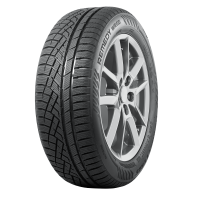
The Nokian Remedy WRG5 is a solid all weather tyre. While it struggles a little in braking compared to the best, the other qualities make up for is, notably an impressive lead in the deeper water of the hydroplaning tests which are so important in wet winters. It also has an excellent all round performance on snow, excellent traction on smooth ice, good levels of comfort, and a low rolling resistance.
Good aquaplaning resistance, excellent snow grip, very low noise, well priced, very low rolling resistance.
Reduced grip in the dry and wet, very long dry braking distances.
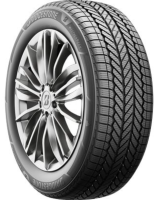
The Bridgestone WeatherPeak is the only tyre with a 70,000 mile treadwear warranty, and while it has a very low rolling resistance, low noise and great grip in the snow, it's performance in the dry and wet, in particular dry braking need to be improved.
Great snow grip, good comfort levels, low cost per mile, good rolling resistance.
Reduced grip in the dry and wet, very long dry braking distances, low grip on ice, poor tread pattern noise.
The Firestone WeatherGrip has a 65,000 mile treadwear warranty and a low purchase price making it one of the best value tyres of the test, a it also has excellent grip in the snow. Sadly it's dry, wet or ice grip could not match the snow performance, leaving the tyre with very long dry and wet braking distances.
Good subjective dry handling, good in the snow, lowest price per mile.
Long dry and wet braking distance, low hydroplaning resistance, very low grip on ice, high rolling resistance.
The Toyo Celsius AS2 is well priced and good in the snow but thanks to limited grip in the dry, wet and ice, and a high rolling resistance, it is difficult to recommend this tyre as a year round product.
These AW tires are quite close to the Hakka R5 reference tire in the winter tests. R5 is northern European friction tire? How much closer would the AW tires be to a central European winter tire? As a road rep in NW Colorado mountains and into Wyo and Montana, I've always gravitated toward performance winter tires vs studless just to get better wear and longer life, but with better winter characteristics than all seasons. Seems I could now go All Weathers year round now and not give up much except pure ice ability?
How much variation might tire size add to the equation? I'm currently running some Pirelli P7 AS Plus 3 in size 245/40-19, and may be needing some replacements in the not too distant future. Being in the southeast, snow/ice is not a significant concern, plus, if necessary, I have other vehicles that would be better suited to those conditions.
Hi. This are all weather tyres for USA. This tyres are avaible in Europe? Correctly in Poland? I search best of the best. You show us - all weather tyres are better than all season. In Europe we have all season, thats right. Can i buy all weather tyres in Europe, Poland? Searching at sites www give not satisfactionary results. Have a nice day, my English is poor.
No, you can't purchase these in Europe. They are similar performance to European all season tyres, so don't worry you're not missing out. Buy tyres from this category: https://www.tyrereviews.com...
I am looking into a new set of Tires. I am currently in the warranty process of getting rid of Pirelli Scorpion AS 3plus. They dry rotted at 50k miles. They are a 70k mile tire. I am currently looking at the Michelin CC2 and Goodyear Assurance Weather Ready 2. I live in the Northeast of the USA and we haven't had a ton of snow in my area in a while, plus I drive to the South often (I often drive very "spirited" so I need great handling as well). Would the CC2 be the better choice or should I give the Weather Ready 2 a chance?
This might be a dumb question but what's the difference of an all weather vs. an all season tyre given the fairly recent review of https://www.tyrereviews.com/Tyre-Tests/Best-All-Season-Tyres-2024-2025.htm ? At least in Germany, the terminology is mixed into one category basically whilst this review shows a focus on the AW part. E.g., the Michelin CrossClimate 2 appears to be available with and without the "AW" in its name. At the same time, Michelin apparently mixes it into one category on its German website as well? https://www.michelin.de/auto/tipps/leitfaden-winterreifen/winterreifen-oder-allwetterreifen Just looking at the Snow Braking distances of the Michelin CrossClimate 2 in the linked review compared to this one, it appears the "AW" variant has 1.69m shorter distance to brake in your testing.
Not a dumb question, tyres are very confusing. All weather is basically the same as the European all season tyre, except its designed for the american market so the CC2 AW is a different tyre (more tread depth, higher rolling resistance etc)
Comparing snow braking between tests is sadly not possible as snow can offer quite a varying amount of grip. Michelin say the two tyres should have comparable snow grip.
Hi, thanks for the response! Does the linked all season test refer to European variants then or is there a differentiation in the US regarding all season vs. All weather? Just trying to wrap my head around on which tests can be referred to for the all season / all weather tyres
I have not performed a US spec all season test before, all the all season articles on the site are EU region specific. All weather are US specific. I have made a few UHP all season tests, which are US specific.
I will work out a way of highlighting that in the article.
All Weather tires in North America carry the snowflake and mountain label similar to Snow/Winter tires. All Season Tires do not. In some designations (eg, Quebec, British Columbia, etc) tires must have that symbol to be legal for snow conditions.
I love this. Thank you so much - especially for the ice braking test! This is extremely informative. Thank you!
If you ever have a chance to repeat this test in the future, there is one particular tire I would love to see tested: Hankook WeatherFlex GT - successor to the Kinergy 4S2, which seems to get excellent reviews from European testers, so I'd love to see the American version tested against other all-weather tires.
It would also be nice to see a reference American all-season tire, rather than a summer tire. Most Americans are going to be comparing 4-season tires to 3-seasons. I'd like to see how much wet grip an all-weather sacrifices compared to a more relevant alternative.
And a few other budget tires too, if you can: General AltiMax 365AW Kumho Solus HA32 Falken Aklimate Nexen N Blue 4S 2 Nitto Motivo 365
It would be particularly interesting to see how a budget all-weather tire compares to a mid-tier all-season tire. Some people can only afford mid-tier all-season tires. To afford an all-weather tire, they have to go down a step. So it would be nice to know if something like the Nexen or Nitto can be recommended in good faith to less-affluent friends and family.
I agree, I should have included a US all season tire instead, that was a mistake on my part, but I do have videos comparing the categories (check the YT description)
Would have loved to include the General / Falken / Kumho etc but sadly it was out of budget.
Currently on my 3rd car using Cross Climate 2 (well, the first car was using Cross Climate 1).
I guess I am still going to stick to Cross Climate 2. In Ontario weather, I do wish it had slightly better grip on covered surfaces (I'm also used to X-Ice but stopped using them 8 years ago) but I guess I'm asking too much.
Great test and very useful results! You mentioned the reference winter tire but not the reference summer tire. Could you disclose the name of the reference summer tire?




These AW tires are quite close to the Hakka R5 reference tire in the winter tests. R5 is northern European friction tire? How much closer would the AW tires be to a central European winter tire? As a road rep in NW Colorado mountains and into Wyo and Montana, I've always gravitated toward performance winter tires vs studless just to get better wear and longer life, but with better winter characteristics than all seasons. Seems I could now go All Weathers year round now and not give up much except pure ice ability?
How much variation might tire size add to the equation? I'm currently running some Pirelli P7 AS Plus 3 in size 245/40-19, and may be needing some replacements in the not too distant future. Being in the southeast, snow/ice is not a significant concern, plus, if necessary, I have other vehicles that would be better suited to those conditions.
There can be some small variances based on test size, however we regularly see that a good tire is a good tire, so I wouldn't worry about it too much.
Hi. This are all weather tyres for USA. This tyres are avaible in Europe? Correctly in Poland? I search best of the best. You show us - all weather tyres are better than all season. In Europe we have all season, thats right. Can i buy all weather tyres in Europe, Poland? Searching at sites www give not satisfactionary results. Have a nice day, my English is poor.
No, you can't purchase these in Europe. They are similar performance to European all season tyres, so don't worry you're not missing out. Buy tyres from this category: https://www.tyrereviews.com...
PS your english is good.
I am looking into a new set of Tires. I am currently in the warranty process of getting rid of Pirelli Scorpion AS 3plus. They dry rotted at 50k miles. They are a 70k mile tire. I am currently looking at the Michelin CC2 and Goodyear Assurance Weather Ready 2. I live in the Northeast of the USA and we haven't had a ton of snow in my area in a while, plus I drive to the South often (I often drive very "spirited" so I need great handling as well). Would the CC2 be the better choice or should I give the Weather Ready 2 a chance?
This might be a dumb question but what's the difference of an all weather vs. an all season tyre given the fairly recent review of https://www.tyrereviews.com/Tyre-Tests/Best-All-Season-Tyres-2024-2025.htm ? At least in Germany, the terminology is mixed into one category basically whilst this review shows a focus on the AW part. E.g., the Michelin CrossClimate 2 appears to be available with and without the "AW" in its name. At the same time, Michelin apparently mixes it into one category on its German website as well? https://www.michelin.de/auto/tipps/leitfaden-winterreifen/winterreifen-oder-allwetterreifen
Just looking at the Snow Braking distances of the Michelin CrossClimate 2 in the linked review compared to this one, it appears the "AW" variant has 1.69m shorter distance to brake in your testing.
Not a dumb question, tyres are very confusing. All weather is basically the same as the European all season tyre, except its designed for the american market so the CC2 AW is a different tyre (more tread depth, higher rolling resistance etc)
Comparing snow braking between tests is sadly not possible as snow can offer quite a varying amount of grip. Michelin say the two tyres should have comparable snow grip.
Hi, thanks for the response!
Does the linked all season test refer to European variants then or is there a differentiation in the US regarding all season vs. All weather? Just trying to wrap my head around on which tests can be referred to for the all season / all weather tyres
I have not performed a US spec all season test before, all the all season articles on the site are EU region specific. All weather are US specific. I have made a few UHP all season tests, which are US specific.
I will work out a way of highlighting that in the article.
Thanks for clarifying and the in-depth reviews in general!
Sorry, I still don't get it.
I live in Denmark and I need a tire that will stay on my car all year. I have the money to spare and I just want the best tire available.
Do I go with the Pirelli Cinturato All Season SF3, as this article would indicate I should do? https://www.tyrereviews.com/Tyre-Tests/Best-All-Season-Tyres-2024-2025.htm
Or do I go with the Michelin CrossClimate 2, as this article would indicate I should do? https://www.tyrereviews.com/Tyre-Tests/The-7-BEST-All-Weather-Tyres-Tested.htm
Sorry if I'm just incredibly daft.
SF3 is better than CC2.
Straight to the point - I like it! Thank you very much :)
All Weather tires in North America carry the snowflake and mountain label similar to Snow/Winter tires. All Season Tires do not. In some designations (eg, Quebec, British Columbia, etc) tires must have that symbol to be legal for snow conditions.
Thanks for this very useful information.
Glad you found it useful!
I love this. Thank you so much - especially for the ice braking test! This is extremely informative. Thank you!
If you ever have a chance to repeat this test in the future, there is one particular tire I would love to see tested:
Hankook WeatherFlex GT - successor to the Kinergy 4S2, which seems to get excellent reviews from European testers, so I'd love to see the American version tested against other all-weather tires.
It would also be nice to see a reference American all-season tire, rather than a summer tire. Most Americans are going to be comparing 4-season tires to 3-seasons. I'd like to see how much wet grip an all-weather sacrifices compared to a more relevant alternative.
And a few other budget tires too, if you can:
General AltiMax 365AW
Kumho Solus HA32
Falken Aklimate
Nexen N Blue 4S 2
Nitto Motivo 365
It would be particularly interesting to see how a budget all-weather tire compares to a mid-tier all-season tire. Some people can only afford mid-tier all-season tires. To afford an all-weather tire, they have to go down a step. So it would be nice to know if something like the Nexen or Nitto can be recommended in good faith to less-affluent friends and family.
Regardless, thank you again, so very much!
I agree, I should have included a US all season tire instead, that was a mistake on my part, but I do have videos comparing the categories (check the YT description)
Would have loved to include the General / Falken / Kumho etc but sadly it was out of budget.
Currently on my 3rd car using Cross Climate 2 (well, the first car was using Cross Climate 1).
I guess I am still going to stick to Cross Climate 2. In Ontario weather, I do wish it had slightly better grip on covered surfaces (I'm also used to X-Ice but stopped using them 8 years ago) but I guess I'm asking too much.
Wait for Cross Climate 3?
There will always be a delta between X-Ice type tyres and all weather tyres, they have very different targets to meet!
Great test and very useful results! You mentioned the reference winter tire but not the reference summer tire. Could you disclose the name of the reference summer tire?
Sure, it was the Nokian Hakka Green 3.
We're looking forward for the european test to see if goodyear will launch Vector4season GEN-4
Currently I have no information about a gen-4 so sadly I don't think I will be testing it this season as all the tests have already started
When is European results expected?
The first EU all season test will be out at the end of April
Looking forward! I it will be time to replace Goodyear Vector4seaons GEN-2 SUV 215/55/18 and it help me choose!