
Do wider tyres give you more grip? The logical answer would be yes, the wider the tyre, the more rubber in contact with the surface, but it isn't that simple.
As a tyre gets wider, the footprint of the tyre changes. While the footprint does get wider, it also gets shorter, and how the tyre changes under camber and load is altered too.
Instead of worrying about the theory of wider tyres, I decided to actually do the test and let the results speak for themselves. It was a complicated test, and after nearly a years planning, and a large amount of help from Goodyear, the resulting video should tell you all you need to know about fitting wider tyres!
Below the video is all the technical data from the test. If you have any further questions once you've watched the video, please feel free to comment on YouTube and I will answer the best I can.
Wheel and Tyres Used
Tyre
Goodyear Eagle F1 Asymmetric 3
Sizes
225/40 R19 93Y - 9.1 kgs - EU label C rolling resistance A wet grip - 8J ET36 Wheel
255/35 R19 96Y - 9.9 kgs - EU label C rolling resistance A wet grip - 8.5J ET38/47 Wheel
285/30 R19 98Y - 11.5 kgs - EU label C rolling resistance A wet grip - 9.5J ET48 Wheel
Wheels
8Jx19 - 14.1 kgs
8.5x19 - 14.1 kgs
9.5x19 - 14.06 kgs
Pressures
225/40 R19 front @ 2.2 bar, 225/40 R19 rear @ 2.6 bar
225/40 R19 front @ 2.2 bar, 255/35 R19 rear @ 2.4 bar
255/35 R19 front @ 2.0 bar, 255/35 R19 rear @ 2.4 bar
255/35 R19 front @ 2.0 bar, 285/30 R19 rear @ 2.4 bar
225/40 R19 front @ 2.2 bar, 285/30 R19 rear @ 2.4 bar
Footprints
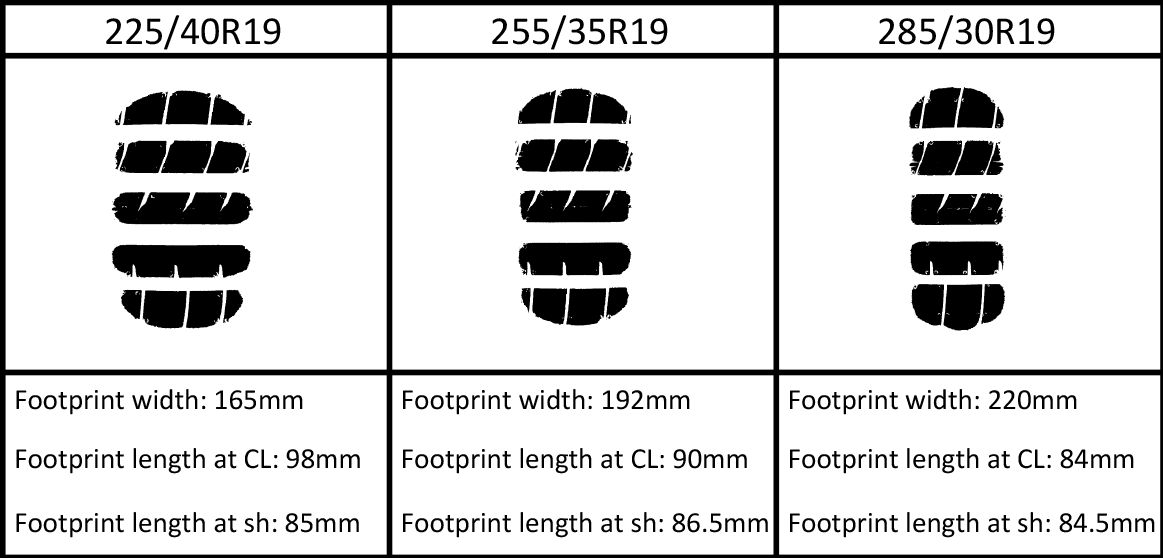
Hi!
Magical test! Everyone is just being theoretic in their articles. there are hundreds of the same articles...but you actually tested it! Love it!
What do you think about the weight vs width? My 2016 Mercedes CLS 220d came with a sport package, meaning 255&285 wide r18 wheels. The very basic OEM size is 245&245 r17 (but basically all the CLSs are equipped with 255&285 ) And I have no idea why. The biggest strongest sportcars have this huge tyres. And CLS is more about traveling... just generating noise, adding fual cons, and slowing the acceleration. I feel that the grip is good, but my winter tyre set, which is 245@245... well i feel the car still very agile, reacting very sharp to direction changes (actually even better then the wide summer, since the hankook s1evo3 has a soft sidewall).
Any guess why this car needs this huge size? I can only guess that the 1.8 tons just needs it...
I'm planning to move to 245 in the summer as well (but I love my current wheels, dunno how can i manage to keep them :D )
As people have said wider tyres don't actually mean more grip, they mean less wear. This means you can use a softer compound and it's the compound that produces the extra grip. A potential problem with this study is that you can't actually guarantee the tyres are the same compound because manufacturers may modify this when they widen the tyres?
I think we were safe on the compound point as this was done with goodyear :)
What do you suppose would happen to my wet performance if I went from 225/40/r18 to 235/35/r19. According to your previous article, going from 18 to 19 decreases wet performance by about 1.5%. However, according to this article, wider tires increase wet performance ( breaking and handling not aquaplaning )
I know you have not tested this, but what would you guess? My guess is if I use the same brand tire it's going to be a wash with no significant change.
I agree with your final conclusion, if you keep the same brand of tyre, it's not going to be a huge change.
What do you think about double wheels/tyres (like buses and trucks have) in terms of grip? Both of them are definitely much wider (in total), than a single-tyre wheel. However, should they produce 2x of grip? Well...not 2x grip of a single tire since the load per tire is 2x less, but maybe 40% more? https://uploads.disquscdn.c...
In theory they'd offer near double traction, even with half the load I'm sure there's enough weight.
I'm not sure how it would work laterally though!
?thanks
The double tyres will unlikely give double nor even 40%. In the real world it would probably be much less. Friction is the product of weight and coefficient of friction. So even though you double the contact area, you reduce the "pressure" of the larger contact area by half. In the real world by increasing the tyre width you increase "the chance" of the tyre making contact with the irregular road surface, but as you can imagine you don't really double the chance of contact (but you almost certainly decrease the loading of the contact area significantly). So in reality, doubling the width may only yield a single-digit percentage of traction (maybe only 2-3%). The most efficient way to gain traction is by SOFTENING the compound, and generally this is what wider tyres are. Softer compound tyres are required to be wider, so that they may last longer and the treads are strong enough to support the load. The appearance of wider tyres and slick in F1 is due to the understanding of the use of softer compounds.
The main purpose of double-tyres on large commercial vehicles is to last longer. Unladen these buses weigh 7 tons. Full of passengers they can approach 10 tons. With all that weight they're not concerned about grip all that much even with the hard compound they use. But, they are expected to last as long as possible (6-10 years or tread wears out, whichever comes first, but preferably the former). They don't make them a single ultra-wide tyre because it's cheaper to mass produce 1 standard size instead of having to produce 2 different sizes for a single vehicle to use. Plus, it's also easier for narrower tyres to remove water to prevent aquaplaning.
Definitely the topic is hard. Different experts have different thoughts on it. As tests show, common sense doesn't work with it. Wider doesn't mean grippier.
? I guess double wheels does not only serve longer, but provide more grip when the vehicle is loaded. As we know, tire grip vs load curve is similar to the sqrt(x). Thus overloaded single wheel is worse in terms of grip then double normal-loaded wheel.
Usually buses have weight distribution towards their rear axle. Just as a reference, LiAZ-677 bus has a mass from 8,38 t (empty) to 16,15 t (fully loaded). Weight distribution is 4,28/4,1 t when empty and 5,99/10,16 t when fully loaded with a driver and 110 passengers. As you can see total bus mass is doubled and the rear axle gained 150% of load.
The added weight alone contributes to the added traction. Doubling the weight onto a single tyre gives as much traction as doubling the weight onto dual tyres. The added contact area only serves to make the tyres last longer.
You have it right. However, there is 'tyre load sensitivity'.
If you increase the weight on a car by 50% you increase the amount of momentum dragging the car off line in the corner by 50% percent, and you also increase the amount of download on the tyres by 50% so the two should cancel out. However, with tyre load sensitivity the increase in grip is always a diminishing return, so adding 50% more weight would be 50% more momentum dragging you off line, but only, say, 30% more grip on the road, leading to an actual decrease in grip.
Vehicle dynamics is a different subject entirely. We are strictly on the subject of friction as a function of traction. When you throw it into a corner and the car slides that's not a result of decreased grip/traction, that is simply inertia overcoming traction.
Using your hypothetical scenario, rather than gaining 50% more momentum with weight let's get the car back to baseline and increase VELOCITY by 50% instead. But, with a 0% increase in grip how could it gain 50% more velocity through the corner? The heavier car had at least 30% more traction so theoretically could go 30% faster than the lighter car through the same corner. Therefore, the weight gain results in an increase in grip.
This idea has been used in the real world. The most famous example would probably be the Nissan GT-R. As with any car the design starts with the tyres. What sort of traction they can do and what loading to get it. Nissan's chief engineer opted for the car's weight to get traction. Or rather, he was free to design the car to be as practical (read heavy) as he wants, and the car could still perform as it should. Many say it is one of the easiest cars to drive fast even in less than favourable conditions.
Hi There . First of all thanks for the good review . Im driving a Nissan 350z year 06 . My stack setup is 225 45 18 and 245 45 18 , I was thinking for a wider tyres , 245 40 18 and 275 40 18 . Is it a good idea to go wider tire set or stick with my stock ? My rim size is 18x9jj ET22 . Please advice . Thanks
hi you have an M3 e92 which wheel and tire size you recommend to put with the OEM car for track use ... the most common is 275/35R18 in 10 "but I am afraid that rub in some place in the front ...perhaps the 9,5' is better ??
I've not got that far in the M3 journey yet. I'm still currently running stock sizes. My road M3 ran 255/275 for a while but the fronts rubbed.
like this, I do auto X in my GTR (2015 Black edition) and was thinking of + sizing for added grip, stock is 255-285 and was think of 275-305 set up, tenths count
also did a aggressive alignment suspension yet still within factory spec
If you do change let me know how you find it :)
Do you think the extra grip is due the wider tyres stay cooler on the track? You mentioned correctly the contact patch stays the same so what is it causing the better lap times? With the RGB style racing series in the UK they run on 195/50R15 front and 205/50R15 rear and they really do stick and don't overheat because I suppose they are light. I wounder if it weight over power that plays a factor.
I think I mention heat control in the video at some point, the wider tyres definitely stay a little cooler, but there is contact patch differences as shown in the graphics.
What confused me about the contract patch was in theory from years ago was the contract patch shape changes but not the total area size. Clearly and I missed this, the wider tyres in your test had larger contact patch area by some margin rulling out the possibility that the 225 was running over inflated tyre pressures?
Hi. If you do some rough contact area sums you will find that the 285/30R19 has 220 mm x 84 mm = 18,480 sq. mm touching the road. The 255/35R19 has 192 x 87 mm= 16,704 sq. mm touching the road. The 225/40R19 has 165 mm x 92mm = 15,180 sq mm touching the road. The lengths are very similar but the wdiths have large differences. This shows that the wider tyre does have a larger contact patch, more rubber touching the road.
I am happy to see this type of tests.
When it comes to 3 series with X-DRIVE, which set suits better?
eg.front/rear
225-255 or maybe
235-235 ?
I've not done the test so I'd be guessing, sorry! I'd stick with whatever is OE on an x drive system as the front and rear will be sensitive to different rotational speeds.
I'was interested to see the braking distances on different width tires.
Glad you found it useful :)
Really happy to see you matching wheel weights, great video, keep up the good work!
Thanks :)
Excellent comparison video!
Near the end you touch on tire width vs quality, which is something I can use help on for my next set.
I'm considering 235/40-17 vs 225/45-17.
I have Continental Extreme Contact Sports, and quite like them. However, I was told that 235/40 is a good size for my setup (2104 Civic Si with 17x8 wheels, and suspension mods that neutralize the handling; springs, dampers, larger RSB).
In the 235/40-17 size I find few brands I really know: Yokohama S.drive, Falken Azenis FK453, and possibly Sumitomo HTR ZII. Older tech, and/or middling tier tires, to be sure.
Wondering how the the lesser/wider tires would measure up against the better/narrower tire.
What about acceleration? Some people say taller is better, some say wider. I’m currently trying to decide bn a 295/35 or 295/30.
My understanding is that shorter tires are easier to accelerate (better). Also, if they're on the same wheel diameter, the shorter tire is likely lighter in weight; which is always a good thing. Possibly not noticeable, but a pound or three saved can add up.
Just keep your overall diameter within a few % of the OE tires for the sake of speedo error, and the electronic nannies.
But, I’ve heard taller tires give you more front to rear contact patch which helps with forward acceleration. Obviously wider tires help with lateral grip.
For acceleration you want the lightest, smallest diameter setup possible, as the smaller the wheel and tyre, the shorter the overall gearing.
Those are my thoughts too, but some race engineers I know say taller is better for acceleration assuming there's enough width to get the power down. It'd be awesome if you could update this test this to find out who's right and wrong. Great article, btw.
225/45 and 235/40 have the same sidewall height (give or take a mm or so). 40 or 45 is the proportion of the tyre width.
Yup. I’m purely talking diameter.
Towards the end of the video you comment on Tire quality as well.
I’m considering either P225/45-17 (a common size) and P235/40-17 (not so common) for my next set.
I’ve noticed that in 235/40-17 only older/middle tier tires are available: Yokohama S.drive, Falken Azenis FK453, Sumitomo HTR ZII for example.
Whereas, in 225/45-17 I can get the likes of Michelin Pilot Sport 4S, Pirelli P Zero (PZ4), and other top tier tires.
I’m curious if the combination of slightly smaller diameter, and slightly wider footprint of the 235/40-17 would allow the older tech tires to accelerate and handle on par, or better than the narrower, slightly taller new tech 225/45s.
As an educated guess, I would say the newer technology 225 would have the edge, especially in the wet.
I’d think that unless you’re always breaking traction under acceleration, the longer footprint wouldn’t help as much as the shorter gearing from the smaller tire. Road conditions and vehicle torque would play a big part.
This is an excellent test! At the end of your review, you mention "width vs quality", which is something I've been researching for my next set of tires.
I'm torn between 225/45-17, and 235/40-17 for my next set. 235/40 was recommended, to provide more rubber on the road; but I've found that most tires in this size (excluding extreme performance/too soft) are middle/lower tier brands, or older models from reputable brands.
How would a 235/40-17 Yokohama S.drive, Sumitomo HTR ZII, or Falken Azenis FK453 rate against a 225/45-17 Continental ExtremeContact Sport?
Are you sure that the wet braking figures are all far shorter than the dry?
We were braking down from 80 kph in the wet and 100 kph in the dry