

The most criticsied aspect of runflat tyres is comfort, which is why Bridgestone have taken a fresh approach to the runflat tyre with the new Bridgestone DriveGuard. The new tyre promises improved comfort, noise, wet grip and reduced tramlining. Have Bridgestone solved the runflat problem with a fresh approach to the only type of tyre which can keep you mobile regardless of the type of puncture? We've driven on them to find out!

Runflat tyres allow you to drive for up to 50 miles at 50 mph once your tyre has been deflated, and unlike seal tyres which only protect small punctures in the main tread, they can keep you mobile in almost any type of deflation situation. In order to achieve this, runflat tyres have a strengthened sidewall which adds weight and stiffness to the structure, and is the cause of many of the negative qualities associated with runflat tyres.
The new Bridgestone DriveGuard has a completely re-imagined and re-engineered sidewall structure, which now has a far more "traditional tyre" level of compliance in the material, but is still sturdy enough to drive safely on in the event of a puncture.
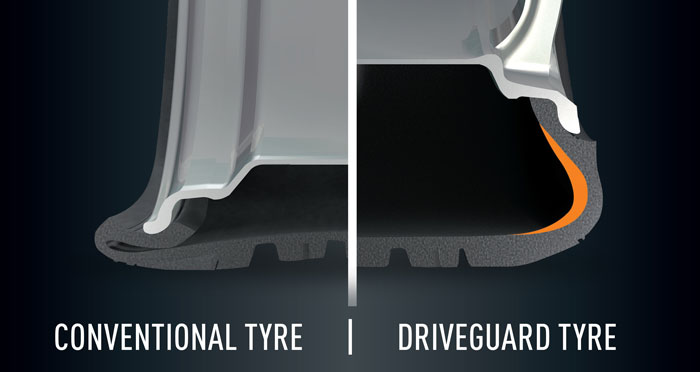
The new DriveGuard has achieve an A for wet grip and C for fuel economy, bettering Bridgestone's current non-runflat offering and equalling some of the best touring tyres available.
Other benefits of the DriveGuard are availability and pricing. Unlike current runflats, which are all OE marked, the DriveGuard can be fitted to any car with a TPMS system, which just so happens to have been an EU mandatory requirement for all new cars since 2014. The DriveGuard is also priced under a traditional runflat, with the recommended pricing sitting between a normal tyre and a runflat.
The Driving
In order to test the DriveGuard we were provided with two identical Peugeot 308's, one vehicle fitted with the new DriveGuard, and the other fitted with the traditional Bridgestone Turanza T001.
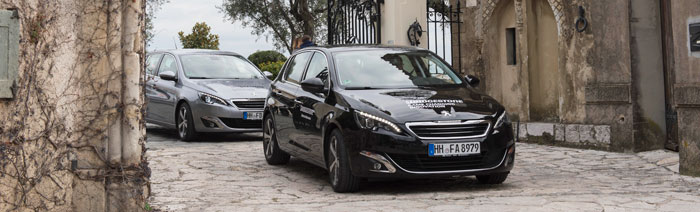
The route consisted of 10 km each way of mixed driving, over extremely varied road surfaces. In order to test the DriveGuard in isolation, we spent the first part of the journey on the new tyre.
In isolation, it would be easy to mistake the DriveGuard for a normal tyre. The ride was compliant, the steering feel good, grip impressive and noise low. In the 205/55 R16 size fitted to the 308, there was no notable tramlining and the only hint of the DriveGuard being a non-standard tyre was the way the tyre transmitted big road imperfections such as potholes into the suspension of the car.
For the second part of the journey we changed to the regular Turanza T001. The difference in general driving was extremely small, arguably unnoticable to untrained drivers, and only offering a small amount of improvement over the DriveGuard in the high impact pothole type hits. If anything, the car had lost a little steering feel, without a noticeable improvement in comfort.
To further demonstrate the DriveGuard advantage, for the third section of driving we purposively punctured the apex area between the tread and the shoulder, and let the tyre deflate. We chose to damage the apex area as it is the area a "seal" technology tyre can't protect against.

Driving on the deflated tyre was immediately noticeable due to slower steering input on the deflated side, and an increased noise, but the car was no way uncontrollable, and still offered excellent braking and steering control at sub 50 mph speeds. It performed flawlessly as a runflat tyre.
TUV Test
While our own experiences on the new tyres were all too brief, Bridgestone commissioned the world's leading independent test body TÜV SÜD to benchmark the new DriveGuard against three of the leading non-runflat competitors. Selected for the testing was the multi test winning Goodyear EfficientGrip Performance, Michelin Primacy 3 and Pirelli Cinturato P7, a brave selection given the performance of these tyres in magazine tests.
Fortunately, the new DriveGuard performed incredibly. When averaging the results of the three competing tyres, the DriveGuard scored 104% of the group in straight aquaplaning, 118% in curved, 106% in lateral wet grip, equalled the group in wet braking and scored 102% in dry braking. Even more surprising was the comfort and drive by scores, with the runflat DriveGuard scoring 99% during comfort testing and 101% under drive by noise when compared to three of the best non-runflat tyres on the market!
The only drawback of the new tyre is rolling resistance, where the DriveGuard scored 95% of the groups average. This is a natural drawback of a runflat tyre sidewall construction, but is an improvement over existing tyres.
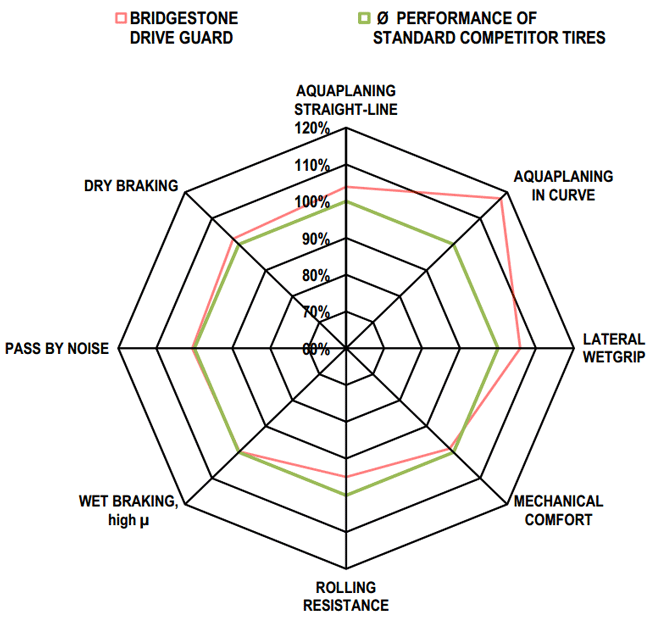
*Test performed in November 2015 by TÜV SÜD Product Service GmbH (Report No. 713073923-3 – Tyre size 225/45 R17).
Conclusion
Now the runflat can be fitted to any vehicle with TPMS, should you consider it?
If your car doesn't have a spare tyre, and you're worried about being stranded, the DriveGuard is an excellent solution. The new technology runflat offers a near identical blend of performance to traditional non-runflat tyres, with none of the traditional drawbacks of the early runflat models.
The DriveGuard is a huge step forward for Bridgestone.

i am thinking about putting those "DriveGuard" on my Mini Cooper Countryman D (205/60 R16 ) i am driving mostly in summer conditions (dry roads) as i live in Greece... any suggestions ?
The Bridgestone DriveGuard is an excellent runflat tyre and should suit your climate well.
Had ordered 4 of these for my cooper and after 1 month i'm returning them only had 2 installed and drove them about less than 4k and one blew out while driving smooth roads at 70 mph was super stable and no issues with the RF but went to get it fixed and it had blown at the bead and they said the other one i had on the front had busted side wall also the handling on these was amazing the sound amazing the grip was amazing the ability to live thru a pot hole leaves a lot to be desired my Conti tires had over 30k miles of spirited driving and over the same pot holes and well they lived 3 years These will be nice tires someday i hope atm i would stick with normal RFs for Minis (mnni) and BMWs i guess maybe with soft non racing shocks and suspension of your moms car they work great, according to the Bridgestone rep Ken (thanks a million again you are a man with a soul your parents should be proud of you) who was super helpful in getting my tired refunded at tirerack.com which wasn't going to help me, and instead would have rather i just RMAed them monthly for the next 2 years as roadhazzards. the design of the tires has them stick out past where normal RFs do on my rims it might have added to the issues i will miss the smooth ride and the quite but as minis have no extra room to haul tires around just to be able to enjoy comfort i will return to standard RFs for now since my daily commute is 40 miles each way and i need to be able to trust my tires will not just die from a bump in the road.
Different tyre...you're talking about the US DriveGuard which is TOTALLY different. You may as well have reviewed a Ling Long Ditchfinder, it'd be as relevant...oh and your grammar and punctuation suck.
One thing I'm confused about with these is that Bridgestone is marketing them as suitable for any car with TPMS. Now, I get the reason why you shouldn't fit them to a non-TPMS equipped car, but I also thought there was a wheel design element required too?
When I did my three day training up at Michelin in Stoke, we were told that BMW and Mini wheels are all of an EH2 design - i.e. they have two Extended Humps. I thought these were also a requirement for run flat tyres as otherwise in a zero pressure situation the tyre won't stay on the rim. It's essentially the extended hump that holds the bead wire in place.
It would be good for Bridgestone to clarify this as some wheel designs today still only have one hump and it would be a real shame for people to fit Driveguard tyres thinking they'll be safe, only to find that when they get a puncture they're no better off than if they were on a conventional tyre.
Perhaps you guys at Tyre Reviews could ask the question?
Bridgestone were very clear in their launch and marketing material that the tyre is suitable for all vehicles with TPMS. There is no specific runflat wheel requirement like there was with the early BMW runflats :)
Hi There,
I found two versions of BS DriveGuard. The old one is from USA and is allyear designed tire and second one focused on EU marked and specifically mentioned as summer tire and also not for every market in EU. I am not able to order it from Slovakia or Czech Republic. So I am owner of BMW, I hate my tires, suspension is hard and custom tires are also really really stiff. I am trying to solve it and only one solution seems to be BS DG. But how can be sure that I will order EU version and not allyear from US, when even guys from BS have not difference model type for totally different products ..
thx
Brano
Hi Brano,
We don't have direct experience about buying tyre in Europe, however if you speak to one of the multinational retailers such as mytyres (owned by Delticom) I'm sure they will be able to deliver you a set.
The US version of the Driveguard shouldn't be in Europe at all, so that shouldn't be a concern.
There are two versions in EU of this tire: summer and winter. So far I don't see difference between Michelin Primacy 3 which I have replaced with Bridgestone DriveGuard (225/50 R 17 98 Y). Only few weeks of experience though.
That's interesting. I'll be intrigued to try a set to see how they compare to 'old' RFT tyres and also standard tyres. I can think of a number of our clients that will benefit from these!
If you do try, please let us know how you get on! :)
Here's a technical confirmation from Bridgestone:
Early RF Technology tyres were indeed requiring the EH2 wheel design (ref: extended hump).
However, with 3G RF Technology in DriveGuard, there is no need to utilise an EH2 wheel.
DriveGuard utilises a unique tyre stiffness carcass design, which prevents bead dislodgement during low pressure running. This is achieved without the need of a EH2 wheel.