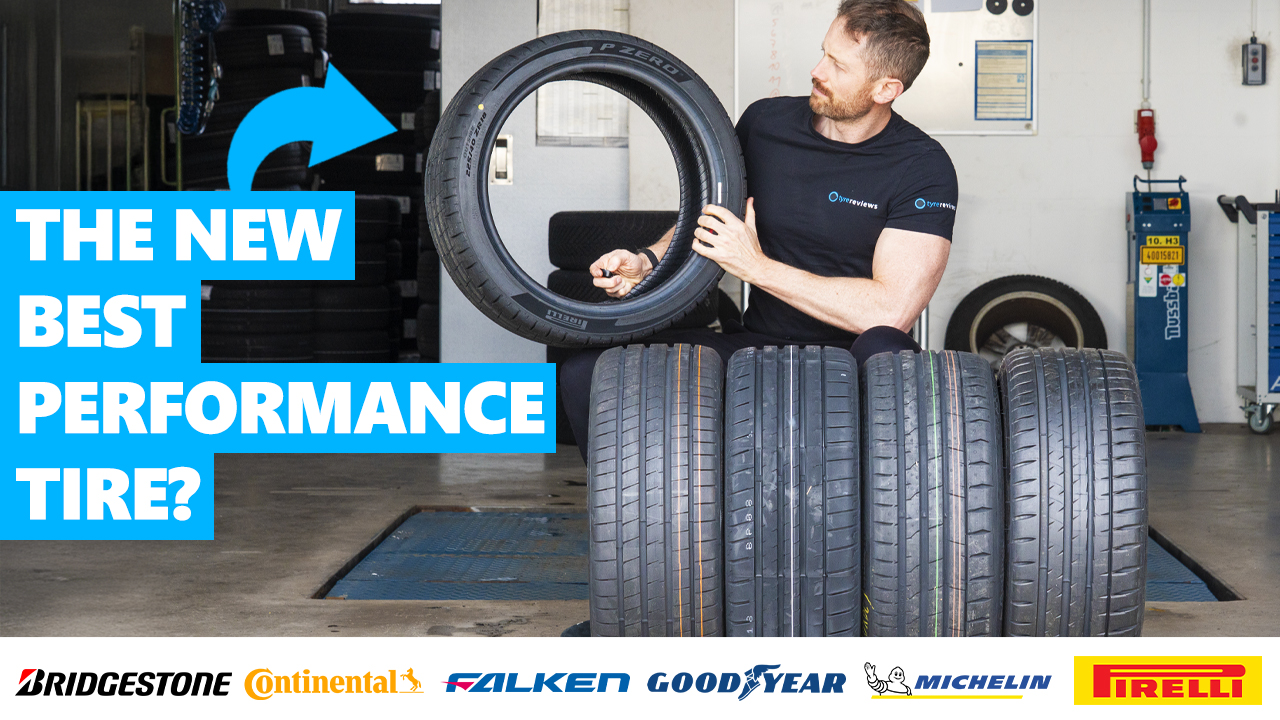
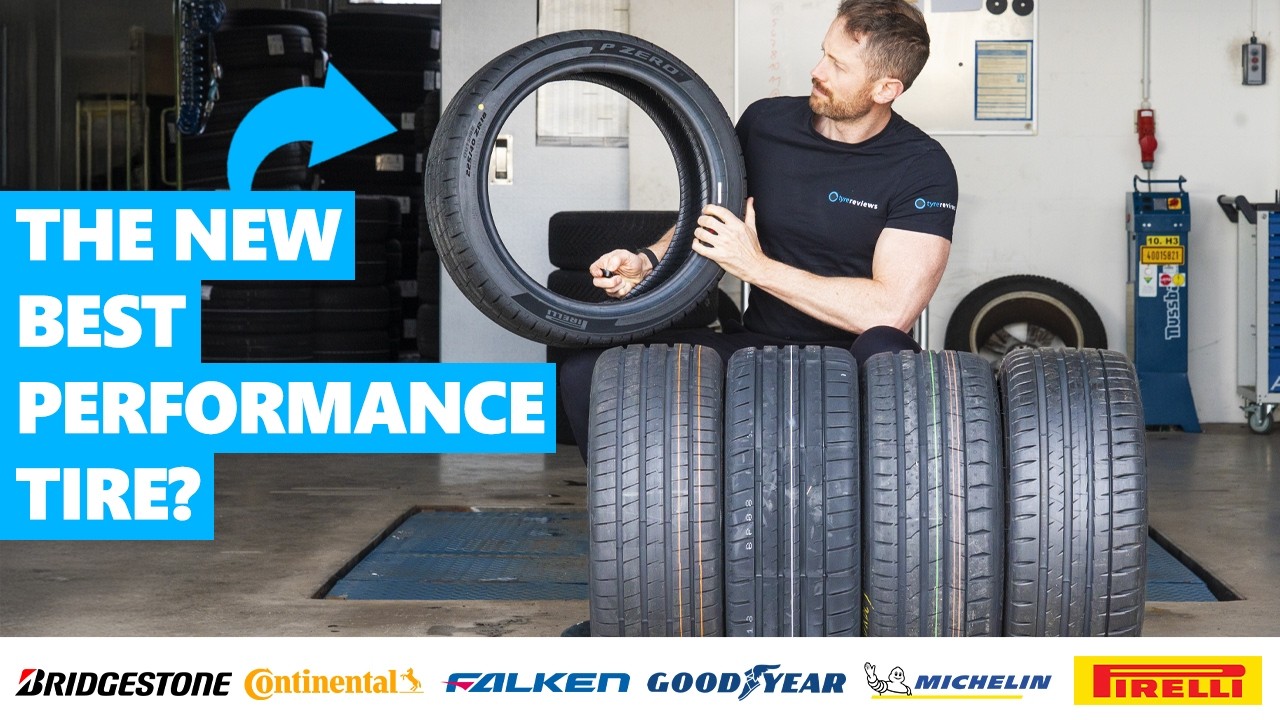
There's a new tyre on the market aiming to be the best of the best performance summer tyres. The Pirelli P Zero PZ5 is designed to take on the Michelin Pilot Sport 4S, Continental SportContact 7, Bridgestone Potenza Sport, Goodyear Eagle F1 Asymmetric 6 and more, but can the latest UUHP summer tyre on the market really move the game on in both handling AND grip? There's only one way to find out - testing!
To find out if the new PZ5 is as good as Pirelli claim, I have tested it against all the tyres mentioned above, and the Falken Azenis FK520 and a budget tyre. I've put all seven sets of tyres through dry and wet testing, and I've looked into the noise, comfort and rolling resistance levels of each set of tyres to ensure you have all the information needed to make the correct purchase decision.
Have a read of the data, and any questions please let me know in the comments at the end of the page.
Testing Methodology
Test Driver
Jonathan Benson
Tyre Size
225/40 R18
Test Location
Professional Proving Ground
Test Year
2025
Tyres Tested
7
Show full testing methodologyHide methodology
Every tyre is tested using calibrated instrumented measurement and structured subjective assessment. Reference tyres are retested throughout each session to correct for changing conditions, ensuring fair, repeatable comparisons. Multiple reference sets are used where needed so that control tyre wear does not affect accuracy.
We use professional-grade testing equipment including GPS data loggers, accelerometers, and calibrated microphones. All tyres are broken in and conditioned before testing begins. For full details on our equipment, preparation process, and calibration procedures, see our complete testing methodology.
Categories Tested
Dry Braking
For dry braking, I drive the test vehicle at an entry speed of 110 km/h and apply full braking effort to a standstill with ABS active on clean, dry asphalt. I typically use an 100–5 km/h measurement window. My standard programme is five runs per tyre set where possible, although the sequence can extend to as many as fifteen runs if conditions and tyre category justify it. I analyse the full set of runs and discard statistical outliers before averaging. Reference tyres are run repeatedly throughout the session to correct for changing conditions.
Dry Handling
For dry handling, I drive at the limit of adhesion around a dedicated handling circuit with ESC disabled where possible so I can assess the tyre's natural balance, transient response, and limit behaviour without electronic intervention masking the result. I usually complete between two and five timed laps per tyre set, depending on the circuit, tyre type, and consistency of conditions. I exclude laps affected by clear driver error or obvious environmental inconsistency. Control runs are carried out frequently throughout the session, and I often use multiple sets of control tyres so that wear on the references does not become a meaningful variable. For more track-focused products, I also do endurance testing, which is a set number of laps at race pace to determine tire wear patterns and heat resistance over longer driving.
Subj. Dry Handling
Objective data is only part of the picture, so I also carry out a structured subjective handling assessment at the limit of adhesion on a dedicated dry handling circuit. I score steering precision, steering response, turn-in behaviour, mid-corner balance, corner-exit traction, breakaway characteristics, and overall confidence using a standardised 1–10 scale used consistently across my testing. The final assessment combines numeric scoring with written technical commentary. I complete familiarisation laps on the control tyre before evaluating each candidate.
Wet Braking
For wet braking, I drive the test vehicle at an entry speed of 88 km/h and apply full braking effort to a standstill with ABS active on an asphalt surface with a controlled water film. I typically use an 80–5 km/h measurement window to isolate tyre performance from variability in the initial brake application. My standard programme is eight runs per tyre set where possible, although the sequence can extend to as many as fifteen runs if conditions and tyre category justify it. I analyse the full set of runs and discard statistical outliers before averaging. To correct for changing conditions, I run reference tyres repeatedly throughout the session — in wet testing, typically every three candidate test sets.
Wet Handling
For wet handling, I drive at the limit of adhesion around a dedicated handling circuit. I generally use specialist wet circuits with kerb-watering systems designed to maintain a consistent surface condition. ESC is disabled where possible so I can assess the tyre's natural balance, transient response, and limit behaviour without electronic intervention masking the result. I usually complete between two and five timed laps per tyre set, depending on the circuit, tyre type, and consistency of conditions. I exclude laps affected by clear driver error or obvious environmental inconsistency. Control runs are carried out frequently throughout the session, and I often use multiple sets of control tyres so that wear on the references does not become a meaningful variable.
Subj. Wet Handling
Objective data is only part of the picture, so I also carry out a structured subjective handling assessment at the limit of adhesion on a dedicated wet handling circuit. I score steering precision, steering response, turn-in behaviour, mid-corner balance, aquaplaning resistance, breakaway characteristics, and overall confidence using a standardised 1–10 scale used consistently across my testing. The final assessment combines numeric scoring with written technical commentary. I complete familiarisation laps on the control tyre before evaluating each candidate.
Straight Aqua
To measure straight-line aquaplaning resistance, I drive one side of the vehicle through a water trough of controlled depth, typically around 7 mm, while the opposite side remains on dry pavement. I enter at a fixed speed and then accelerate progressively. I define aquaplaning onset as the point at which the wheel travelling through the water exceeds a specified slip threshold relative to the dry-side reference wheel. I usually perform four runs per tyre set and average the valid results.
Curved Aquaplaning
For curved aquaplaning, I use a circular track, typically around 100 metres in diameter, with a flooded arc of controlled water depth, usually about 7 mm. The vehicle is instrumented with GPS telemetry and a tri-axial accelerometer. I drive through the flooded section at progressively increasing speed, typically in 5 km/h increments, and record the minimum sustained lateral acceleration at each step. The test continues until lateral acceleration collapses, indicating complete aquaplaning. The result is expressed as remaining lateral acceleration in m/s² as speed rises.
Subj. Comfort
To assess comfort, I drive on a wide range of road surfaces (often dedicated comfort tracks at test facilities) at speeds from 50 to 120 km/h, including smooth motorway, coarse surfaces, expansion joints, broken pavement, and sharp-edged obstacles. I evaluate primary ride quality, secondary ride quality, impact harshness, seat-transmitted vibration, and the tyre's ability to absorb sharp inputs. Ratings are assigned on a 1–10 scale relative to the reference tyre.
Noise
I measure external pass-by noise in accordance with UNECE Regulation 117 and ISO 13325 using the coast-by method on a compliant test surface. Calibrated microphones are positioned beside the test lane, and the vehicle coasts through the measurement zone under controlled conditions. I record the maximum A-weighted sound pressure level in dB(A), complete multiple runs over the relevant speed range, and normalise the result to the reference speed required by the procedure.
Rolling Resistance
Rolling resistance is measured under controlled laboratory conditions in accordance with ISO 28580 and UNECE Regulation 117 Annex 6. The tyre is mounted on a test wheel and loaded against a large-diameter steel drum. After thermal stabilisation at the prescribed test speed, rolling resistance force is measured at the spindle and corrected according to the relevant procedure. The result is expressed as rolling resistance coefficient, typically in kg/tonne.
How each category is weighted in the overall score:
Dry35%
Dry Braking50%
Dry Handling40%
Subj. Dry Handling10%
Wet40%
Wet Braking40%
Wet Handling30%
Subj. Wet Handling10%
Straight Aqua10%
Curved Aquaplaning10%
Comfort10%
Subj. Comfort50%
Noise50%
Value15%
Rolling Resistance100%
Wet
While you might not personally think wet grip is your highest priority, that's why you can go to the tyre reviews website to change the final score weighting to get the best tyre for you, wet performance is key to both safety, and winning tests, which is why tyre manufacturers focus a lot of their effort on it.
Well, at least most tyre manufacturers, The budget brand in this test named itself sunny, and I can only assume it's because they only care about sunny days, because you don't have any grip when it's raining. The sunny was in no way sporty, the only tyre to give me scare myself levels of oversteer in this mk8 gti, which generally never wants to oversteer anymore (sad face) and the steering was rubbish and elasticity.
The rest of the tyres, given the group, you should know were good. In fact, I'd argue the rest of the tyres were great, but some more great than others.
Michelin and goodyear were paired up, just half a second apart. The Michelin, as usual, didn't feel overly sporty and you could watch your delta time bleed away in the long corners due to the understeer in the tyre, but otherwise it was stable and safe. This is now the oldest of the group, and it shows, I'm excited to get the next version to aftermarket, whenever that will be, as I know they're improving it greatly.
The Goodyear once again worked very well with the GTI, but surprisingly, like the Michelin, you could feel the step down in grip compared to the best of the test. Also like the Michelin it is one of the older tyres in the test, so while the goodyear was still fun, it's no longer the very best.
Then you had what I'm calling a double surprise, the Falken and Continental. Since driving, I've looked at other tests of the FK520 it's not been this good in the wet, but today it very much was, verified by a second driver who I asked to run the field. The Falken wasn't the most sporty but it was incredibly grippy, incredibly stable and very easy to drive fast. Excellent job on the 520, a big step up from the 510 it replaces.
The Continental was great as usual, fast, but I found a little bit too much understeer to really attack compared to the best. A very nice tyre as always, but there's some new boys in town.
The newest tyre in this test, the Pirelli P Zero PZ5 was fantastic. It felt like the big brother of the Goodyear, which is a tyre I always loved the handling ok. Great steering, lovely balance, noticeably more grip than all the tyres behind it, where I was bleeding time to reference with the Michelin I was gaining it with the Pirelli, honestly it felt like no tyre could be faster or better suited to the car, it was a fantastic experience.
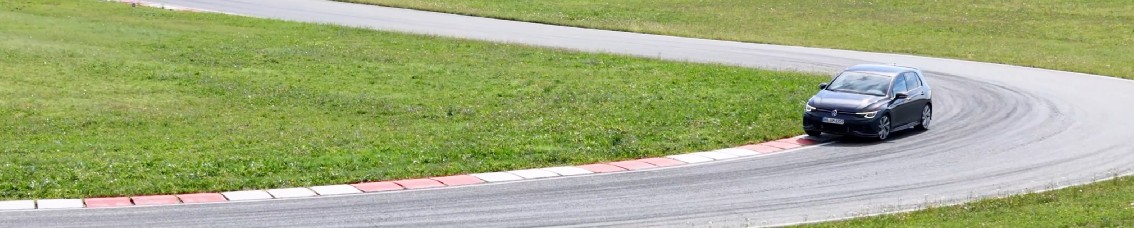
That was, until I drove the Potenza Sport. In all my years of tyre testing I have never had an experience like that. It felt like I was playing a computer game, suddenly everything was digital and the fact the track was wet meant nothing, I could take massive liberties I could only dream of before. If a tyre company ever put a full wet race compound into a road tyre, this is what I imagine it would feel like.
Wet Handling
Spread: 22.89 s (23%)|Avg: 105.42 s
Wet handling time in seconds (Lower is better)
Bridgestone Potenza Sport
99.34 s
Pirelli P Zero PZ5
101.91 s
Continental SportContact 7
102.51 s
Falken Azenis FK520
102.90 s
Goodyear Eagle F1 Asymmetric 6
104.29 s
Michelin Pilot Sport 4 S
104.77 s
Sunny NA305
122.23 s
You'd be happy with any of them in wet braking, apart from of course, the sunny. The Pirelli jumped up to best, but there was only 3.8% covering the top six which is a very close result. In the deeper water of aquaplaning, the Goodyear was the best overall, and the Pirelli again did a great job.
Wet Braking
Spread: 8.94 M (39.8%)|Avg: 24.11 M
Wet braking in meters (80 - 5 km/h) (Lower is better)
Wet Braking: Safety Impact: Best vs Worst Tyre
On average the Goodyear and Pirelli were the best in the deeper water of the aquaplaning tests, with the budget tyre performing surprisingly badly in what is usually an easy test.
Straight Aqua
Spread: 3.10 Km/H (4.1%)|Avg: 73.89 Km/H
Float Speed in Km/H (Higher is better)
Falken Azenis FK520
75.50 Km/H
Goodyear Eagle F1 Asymmetric 6
75.20 Km/H
Pirelli P Zero PZ5
74.00 Km/H
Michelin Pilot Sport 4 S
73.50 Km/H
Bridgestone Potenza Sport
73.30 Km/H
Continental SportContact 7
73.30 Km/H
Sunny NA305
72.40 Km/H
Curved Aquaplaning
Spread: 0.62 m/sec2 (19.7%)|Avg: 2.92 m/sec2
Remaining lateral acceleration (Higher is better)
Goodyear Eagle F1 Asymmetric 6
3.15 m/sec2
Pirelli P Zero PZ5
3.14 m/sec2
Bridgestone Potenza Sport
3.00 m/sec2
Michelin Pilot Sport 4 S
2.96 m/sec2
Falken Azenis FK520
2.95 m/sec2
Continental SportContact 7
2.69 m/sec2
Sunny NA305
2.53 m/sec2
Dry
For the budget Sunny tyre, I can be brief - it wasn't good. With significant understeer, poor rear stability, and slow lap times, let's move on to tyres you might actually consider.
The Falken FK520 felt solid in sublimit situations like lane changes, making it predictable and safe but not particularly exciting. It delivered good grip with a nice safe balance, just without the sporty character some drivers might want.
The Michelin Pilot Sport 4S and Goodyear Eagle F1 Asymmetric 6 were both excellent. The Michelin featured slightly lighter steering than the Goodyear, especially in sublimit handling, with everything happening predictably. In this size, it performed very well with only a small desire for more front axle bite. The Goodyear, one of my favorites, did everything well. While perhaps slightly behind the Michelin in sublimit scenarios, at the limit it felt connected - you were truly one with the vehicle, with every expected behavior materializing exactly as anticipated.
The final three tyres - Continental SportContact 7, Bridgestone Potenza Sport, and Pirelli P Zero PZ5 - were the best of the test, all wonderful but with subtle differences. The Continental offered monumental grip and precise steering in sublimit driving, but lacked a touch of stability when really pushing in corners. The Bridgestone had incredible grip and steering response, but its drawback was slightly reduced feedback at corner entry and mid-corner when modulating throttle to tuck the nose. The Pirelli felt a bit light in the steering sublimit, but once into the corner, it dug in beautifully with predictable, lovely handling characteristics.
The lap times between these top three were virtually identical - the first laps of the Pirelli and Bridgestone were identical, though the Bridgestone lost slightly more time on the second lap. The gap is so small that subjective preference becomes more important than timing differences. All three were amazing in their own ways, with slightly different personalities but equivalent overall performance.
The quality of modern performance tyres is simply outstanding - there's never been a better time to be a tyre enthusiast with such high performance across the board.
Dry Handling
Spread: 4.53 s (5.5%)|Avg: 82.94 s
Dry handling time in seconds (Lower is better)
Pirelli P Zero PZ5
81.83 s
Bridgestone Potenza Sport
81.84 s
Continental SportContact 7
81.96 s
Goodyear Eagle F1 Asymmetric 6
82.47 s
Michelin Pilot Sport 4 S
82.82 s
Falken Azenis FK520
83.33 s
Sunny NA305
86.36 s
The Continental edged out the Pirelli in dry braking by just 0.4%, in another incredibly close braking test, in fact there once again less than 4% covering the top 6, highlighting just how close this test is.
Dry Braking
Spread: 5.71 M (17.2%)|Avg: 34.44 M
Dry braking in meters (100 - 5 km/h) (Lower is better)
Dry Braking: Safety Impact: Best vs Worst Tyre
Comfort
The quietest tyre on test was the Goodyear, very closely followed by the Falken. Then Pirelli and Continental did well, Bridgestone was fine and the Michelin and Sunny finished just over 2db louder than the Goodyear. Not insignificant, but also not huge considering this is an external noise measurement. I didn't notice anything in the car.
For comfort, Pirelli, Conti and Michelin had a small lead over Falken and Goodyear, with the Bridgestone, as usual, just a little firmer than the rest.
Subj. Comfort
Spread: 1.50 Points (15%)|Avg: 9.57 Points
Subjective Comfort Score (Higher is better)
Michelin Pilot Sport 4 S
10.00 Points
Continental SportContact 7
10.00 Points
Pirelli P Zero PZ5
10.00 Points
Sunny NA305
9.50 Points
Goodyear Eagle F1 Asymmetric 6
9.50 Points
Falken Azenis FK520
9.50 Points
Bridgestone Potenza Sport
8.50 Points
Noise
Spread: 2.50 dB (3.5%)|Avg: 72.67 dB
External noise in dB (Lower is better)
Goodyear Eagle F1 Asymmetric 6
71.20 dB
Falken Azenis FK520
71.70 dB
Pirelli P Zero PZ5
72.20 dB
Continental SportContact 7
73.10 dB
Bridgestone Potenza Sport
73.30 dB
Michelin Pilot Sport 4 S
73.50 dB
Sunny NA305
73.70 dB
Value
The budget Sunny had the lowest rolling resistance which is neat. Anyway. Of the tyres that actually had grip the Goodyear and Michelin had the lowest energy use, however the Continental, Pirelli and Falken were so close I would in NO WAY base my purchase decision on energy use. Apart from the Bridgestone, it was 30% worse than the best in a shockingly high result.
Rolling Resistance
Spread: 2.50 kg / t (30.5%)|Avg: 8.99 kg / t
Rolling resistance in kg t (Lower is better)
Sunny NA305
8.20 kg / t
Michelin Pilot Sport 4 S
8.70 kg / t
Goodyear Eagle F1 Asymmetric 6
8.70 kg / t
Continental SportContact 7
8.80 kg / t
Falken Azenis FK520
8.90 kg / t
Pirelli P Zero PZ5
8.90 kg / t
Bridgestone Potenza Sport
10.70 kg / t
19,000 km
£1.45/L
8.0 L/100km
--
Annual Difference
--
Lifetime Savings
--
Extra Fuel/Energy
--
Extra CO2
Estimates based on typical driving conditions. Rolling resistance accounts for approximately 20% of IC vehicle fuel consumption and 25% of EV energy consumption. Actual savings vary based on driving style, vehicle weight, road conditions, and tyre age. For comparative purposes only. Lifetime savings based on a 40,000km / 25,000 mile tread life.
Best in the dry overall, blended wet braking, handling and deeper water aquaplaning tests extremely well, excellent comfort, good rolling resistance.
Steering a little light in the 18" size.
The newest tyre in the test has turned out to be the best tyre in this test!
The new Pirelli P Zero PZ5 was the best overall in the dry, even if the steering was a touch lighter at the very limit, joint best in the wet, scoring well in both the shallow and deep water tests, and had excellent comfort, though the margins were small. Its rolling resistance was higher than the Goodyear, Michelin and Continental, but it would be an insignificant amount in the real world. Great job Pirelli, the new PZ5 is now leading the UUHP / max performance segment.
Excellent in the dry with the shortest dry braking, good in wet braking and handling, excellent noise and comfort, good rolling resistance.
Average aquaplaning performance, front / rear balance not as ideal in the 18" size.
The Continental SportContact 7 was once again right at the front of yet another test, having huge amounts of grip in the dry, excellent comfort, and nice quick steering. In this 18" size on the Golf it wasn't quite as well balanced around the limit as I remember the 19" fitment, but even with average aquaplaning performance it's still right at the front in the overall results, so another fantastic option.
Well rounded tyre in the dry and wet, excellent comfort, safe handling balance, low rolling resistance.
Understeer at the limit.
The Michelin Pilot Sport 4S is another really well rounded tyre, super safe and dynamic, especially sub limit where the steering is really nice. At the limit it still isn't quite the sportiest of the bunch, but if you're not going on track a lot, it's a really difficult tyre to not recommend.
Excellent in the dry with best balance, good in the wet with excellent aquaplaning resistance, lowest noise, low rolling resistance.
A tiny bit behind in braking.
The Goodyear, as always, is a super nice tyre to drive, it didn't quite match the best in braking, but in handling, comfort, noise and rolling resistance, it was there. I really like this tyre, and of all the top four it's usually the cheapest. It's really fantastic.
Good grip in the dry and wet, good aquaplaning resistance, low noise, safe handling balance.
Felt more like a sports touring tyre than an ultra high performance product.
The Falken Azenis FK520 performed well in the grip tests, was low noise, and the best in straight aquaplaning. It did struggle a little more in curved aquaplaning and wasn't at the very top in comfort, but I'd definitely call it a solid, safe tyre. The main drawback for me is that it's not a very dynamic tyre, so while you have good grip it's not much fun using it, so if you consider yourself a driver, keep that in mind, but for an everyday application it offers good value.
Rolling resistance so high it can no longer be produced in the EU, lower levels of comfort than the best in test, high wear on track.
The Bridgestone potenza sport might have been amazing in the wet, and as always a nice handling tyre, but the rolling resistance level of this tyre was not just awkwardly high, but it is now being legislated out of production in the EU thanks to new label targets, making this test of it a little redundant.
Also as we've seen plenty before, the outer shoulder of this tyre did not hold up well to track work, so I hope any update they make to improve the rolling resistance will address this issue too.
I really like the Potenza Sport as a fast road tyre as it steers so nicely. If they can fix the rolling resistance and track wear without changing the sporty nature of the tyre it could easily end up as one of my favourite tyres.
It will be no surprise that the budget Sunny NA305 finished in last place, and was the worst in everything bar NVH and rolling resistance, and it wasn't just a little bit worse, 40% off in wet braking is tragic. When braking from motorway speeds, where you'd be stopped on the Pirelli, you'd still be doing 70 km/h on the sunny. That's bad. Think about hitting a stationary car at 70 km/h!.
Can you guys help me out? All opinions are welcome!
I’m currently really doubting between the Continental SportContact 7 and the Pirelli P Zero PZ5.
I drive an Alfa Romeo Giulietta QV, which has been modified to make it more sporty and engaging to drive. I’m looking for the most sporty tyres in size 225/40 R18, where fun on normal public roads is the main priority. Think of pushing hard through roundabouts, sharp turn-in on highway exits and entries, that kind of driving.
I live in the Netherlands, so wet performance does matter, but dry performance and overall driving feel are more important to me.
I’m currently deciding between the Pirelli P Zero 5 and the Michelin Pilot Sport 5 for my Golf 8 GTE (Netherlands, typical mild summer climate). I have the stock bridgestone potenza S0005 now (225 40 R18 )
There is a new review coming out. Not much has changed. - The PZ5 is excellent - The Goodyear is excellent - The Sport Contact 7 is excellent - The Potenza Sport Evo is excellent All good.
Thanks for the continuing great content on Tyre Reviews. Such a good source of impartial advice. Any news on when the Michelin Pilot Sport 4S tyre will be replaced? The Pilot Sport 5 S has very limited tyre sizes (none in my car's tyre dimensions) and the 4S has been out ages now.... Seems strange the 5 S didn't get rolled out to more sizes and strange that a proper replacement for all 4S tyre sizes has taken so long.. Any views on why that is? Maybe now the 4S isn't topping every group test Michelin will hurry up!
I am running a 2022 Crorolla Touring Sport Hybrid - GR Sport spec with 18" rims fitted with this exact tyre size. What would be in your opinion the best tyre to choose if I wanted improved handling and reduced in cabin noise? Currently running fk520 on the front and t005 on the back. Not particularly happy with either...
I’d like to propose that you consider adding RIM PROTECTION as a highlighted feature in your tire reviews. While it doesn’t necessarily need to be tested exhaustively, it’s a feature that I, along with many other customers, truly value. Not all tire manufacturers provide rim protection, but it makes a significant difference to those of us who care about preserving our rims from damage caused by curbs.
Personally, I would not consider purchasing a tire that doesn’t offer rim protection, and I believe many others share this sentiment. Including it in your reviews could help guide us in making more informed decisions.
Thank you for considering this suggestion, and I look forward to seeing this feature in future reviews!
"Given that I experience significant wear on the outer sidewalls of the tire during road use, which of these tires performs better in this regard? Does it feature a stiffer sidewall, and would that help reduce this type of wear?"
It's fun to read the articles and find all the puns, like here the one at the "value" section : "The budget Sunny had the lowest rolling resistance which is neat. Anyway. Of the tyres that actually had grip [...]". Also, the rim protection note on the Potenza : "Rim Protection: Damn boi". Keep the fun, Johnathan!
For an xdrive BMW i went to square 19x9J setup 255/35r19 all around. But I can't decide SC7 or PZ5 or 4S* I care about only performance. Summer there is between 15C-42C
This weekend bought and mounted the new Pirelli P Zero PZ5 (245 45 R19). I went on the highway, the ride was pretty smooth overall, but I noticed at speeds in excess of 180 Km/h, the steering felt a bit wobbly. It was not the case with the old Conti Sport 6, or the winter GoodYear Ultragrip. They are a bit overinflated and they say they have a mould-release layer that it takes 300-500 km to wear off. Now I'm a bit unsure if I chose right over the ContiSport7.
Reset the pressures and let them bed in a little and report back. Generally new tyres always feel a little less precise than worn tyres as tread depth is a huge factor, but they certainly shouldn't feel worse than a winter (unless the winter tyre is very worn)
Hi John, Great site and reviews, all the info you could possibly need on your site is there. And amazing to see how well Pirelli is performing. I find it difficult to choose between the Asym6 and the Cinturato C3 in 245/45 R19. Currently I run the Premiumcontact 6, love the steering feel but a little less noise, a bit more comfort and better rolling make it perfect. Would I loose much steering precision with the Pirelli C3 compared to the Conti's or Goodyears? Thanks!
Hey Mate. The Asy6 is the best tire you can get if you want a magically perfect tire which has very good feedback, feeling as well. I would put Asy6 on everything except for weekend cars (SC7 for that minor extra feedback...but of course its worse a bit in every other aspect)
Hi John. How do you think these tyres, asym6 in particular, would cope with slightly mildly snowy conditions that one might encounter in South east England I.e not much below freezing? This would be on an AWD car. I just made it through one winter fairly easily with bridgestone Potenza s001’s and have been wondering if I really need an all season.
Awesome review as always! Weird that how different the PS4s, SC7, Potenza Sport results are from year to year, and size to size(and of course the source of the test). Sometimes the SC7 kills everything, and sometimes its barely make it to a top3 result (dry lap time for example) I totally agree, that nowadays UUHP tires are just awesome, and its just a taste question, what you choose. IMO the best thing is the Asy6. its like a comfi tourer tire which somehow grips and handles like magic :D But for a pure weekend car, i would still go with the SC7 (or supersport2 or PS5s if they ever released...) But to be honest never a Pirelli.... my experience, and every close carenthusiast friend of mine have horrible experience with them. Basically they are only good for 1 or maybe 2 seasons and then the classleading grip, etc is gone.... :(
Experience. I had an Asy5. It was meh, okay, compromise to be okay in everything, but nothing exceptional. I bought the Asy6 as still.. maybe the best compromise. But gosh this tire is crazygood. It feels like the best possible equipment in every situation, except snow :D (I have a review here, on a merc CLS)
Great review as always! I was wondering if there are any comparison tests out there between the Continental ExtremeContact Sport 02 and the SportContact 7? I'm curious to know how they stack up against each other. Would it be safe to assume they'd rank similarly in a direct comparison? Also, if you have any insights into the key differences between the two, I'd love to hear them! Thanks!
Hi John, amazing review, as always! I have been going back and forth between fitting summers or all seasons to my car in the UK. I have narrowed it down to the GYF1ASM6 and all season Bridgestone T6AS. I understand the trade offs in performance due to your great reviews. One key question I have - out of the two, which has better noise and comfort? I want a quiet tyre and comfortable ride (size 235/40/18 on a golf r estate) and it might swing the decision for me. Your reviews compare these characteristics for each tyre within their segment but really curious how the compare to each other.
Many thanks, and looking forward to the latest all season test coming out soon!
A good question. The supersport while fun, is a very old tire, and the asymmetric 6 is better and offered in a much wider range of sizes so relevant to more people. I'm waiting for the supersport 2, whenever that might be.






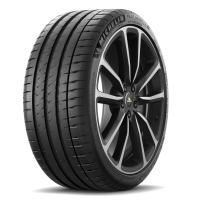
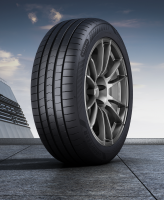
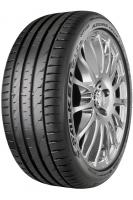
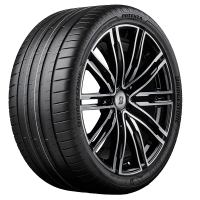
Can you guys help me out? All opinions are welcome!
I’m currently really doubting between the Continental SportContact 7 and the Pirelli P Zero PZ5.
I drive an Alfa Romeo Giulietta QV, which has been modified to make it more sporty and engaging to drive.
I’m looking for the most sporty tyres in size 225/40 R18, where fun on normal public roads is the main priority. Think of pushing hard through roundabouts, sharp turn-in on highway exits and entries, that kind of driving.
I live in the Netherlands, so wet performance does matter, but dry performance and overall driving feel are more important to me.
Which tyres would you choose?
Tricky choice. If steering is your thing, get the Bridgestone Potenza Sport EVO.
Unfortunately I can't get the Bridgestone where I live, so I'm kinda 'stuck' with the choice between the PZ5 and the SC7.
I prefer the PZ5
I’m currently deciding between the Pirelli P Zero 5 and the Michelin Pilot Sport 5 for my Golf 8 GTE (Netherlands, typical mild summer climate). I have the stock bridgestone potenza S0005 now (225 40 R18 )
Maybe someone could help me choose :D
Pirelli for handling, Michelin for Comfort
Missed this review last year, maybe because I don´t want to buy some summer tyres ;)
I need to replace my BMW OE CSC6, my favorite at the moment is the Pirelli, but still thinking also about Goodyear.
Maybe you have a review with new models somewhere in the pipeline ;) ?
There is a new review coming out. Not much has changed.
- The PZ5 is excellent
- The Goodyear is excellent
- The Sport Contact 7 is excellent
- The Potenza Sport Evo is excellent
All good.
The PS5 not?
Bridgestone LM005 and Conti OE CSC7 disappointed me, so no tyre from these 2 brands.
Have also to take a look at winter tyres 225/45R17 at end of year, but maybe new models will be announced before next winter.
Hi Jonathan. Do you have a rough ETA for the next summer test? Will you have the new Hankook Ventus Evo in test also?
Marchish, and no, I have the Evo Z.
Thanks for the continuing great content on Tyre Reviews. Such a good source of impartial advice. Any news on when the Michelin Pilot Sport 4S tyre will be replaced? The Pilot Sport 5 S has very limited tyre sizes (none in my car's tyre dimensions) and the 4S has been out ages now.... Seems strange the 5 S didn't get rolled out to more sizes and strange that a proper replacement for all 4S tyre sizes has taken so long.. Any views on why that is? Maybe now the 4S isn't topping every group test Michelin will hurry up!
I've not heard anything, so no time soon is my assumption.
Hi Tyre Reviews team!
I am running a 2022 Crorolla Touring Sport Hybrid - GR Sport spec with 18" rims fitted with this exact tyre size. What would be in your opinion the best tyre to choose if I wanted improved handling and reduced in cabin noise? Currently running fk520 on the front and t005 on the back. Not particularly happy with either...
Many thanks!!
PZ5 is always a good answer, Pilot Sport 4S or even Pilot Sport 5 if you prefer more comfort over handling.
Thank you very much!
Dear Tyre Reviews Team,
I’d like to propose that you consider adding RIM PROTECTION as a highlighted feature in your tire reviews. While it doesn’t necessarily need to be tested exhaustively, it’s a feature that I, along with many other customers, truly value. Not all tire manufacturers provide rim protection, but it makes a significant difference to those of us who care about preserving our rims from damage caused by curbs.
Personally, I would not consider purchasing a tire that doesn’t offer rim protection, and I believe many others share this sentiment. Including it in your reviews could help guide us in making more informed decisions.
Thank you for considering this suggestion, and I look forward to seeing this feature in future reviews!
Best regards,
Mauro
Rim protection level is actually in this test, it is below the photo of the tyre in the overall results.
Thanks, I love it that it is back again in your tests.
Just a question, the PZ5 here have a "good" protection, the R have a "medium", is there a big difference?
https://www.tyrereviews.com/Tyre-Tests/The-BEST-Performance-Summer-Tyres-for-2026-Tested.htm
"Given that I experience significant wear on the outer sidewalls of the tire during road use, which of these tires performs better in this regard? Does it feature a stiffer sidewall, and would that help reduce this type of wear?"
It's fun to read the articles and find all the puns, like here the one at the "value" section : "The budget Sunny had the lowest rolling resistance which is neat. Anyway. Of the tyres that actually had grip [...]". Also, the rim protection note on the Potenza : "Rim Protection: Damn boi".
Keep the fun, Johnathan!
Kumho Ecsta Sport (S) PS72 missing - this Tyre got really good reviews / tests already
For an xdrive BMW i went to square 19x9J setup 255/35r19 all around. But I can't decide SC7 or PZ5 or 4S* I care about only performance. Summer there is between 15C-42C
sc7
This weekend bought and mounted the new Pirelli P Zero PZ5 (245 45 R19). I went on the highway, the ride was pretty smooth overall, but I noticed at speeds in excess of 180 Km/h, the steering felt a bit wobbly. It was not the case with the old Conti Sport 6, or the winter GoodYear Ultragrip. They are a bit overinflated and they say they have a mould-release layer that it takes 300-500 km to wear off. Now I'm a bit unsure if I chose right over the ContiSport7.
Reset the pressures and let them bed in a little and report back. Generally new tyres always feel a little less precise than worn tyres as tread depth is a huge factor, but they certainly shouldn't feel worse than a winter (unless the winter tyre is very worn)
You shouldnt be in that high speed after fresh sets of tyres.. rubber compartment needs time to settle to your car.
Hi John, Great site and reviews, all the info you could possibly need on your site is there. And amazing to see how well Pirelli is performing. I find it difficult to choose between the Asym6 and the Cinturato C3 in 245/45 R19. Currently I run the Premiumcontact 6, love the steering feel but a little less noise, a bit more comfort and better rolling make it perfect. Would I loose much steering precision with the Pirelli C3 compared to the Conti's or Goodyears? Thanks!
Hey Mate. The Asy6 is the best tire you can get if you want a magically perfect tire which has very good feedback, feeling as well. I would put Asy6 on everything except for weekend cars (SC7 for that minor extra feedback...but of course its worse a bit in every other aspect)
Thanks, fittet Asym6 last week and youre right. Exactly what I was looking for. More comfort, very quiet and still very response and capable. Cheers
Hi John. How do you think these tyres, asym6 in particular, would cope with slightly mildly snowy conditions that one might encounter in South east England I.e not much below freezing? This would be on an AWD car. I just made it through one winter fairly easily with bridgestone Potenza s001’s and have been wondering if I really need an all season.
Awesome review as always!
Weird that how different the PS4s, SC7, Potenza Sport results are from year to year, and size to size(and of course the source of the test). Sometimes the SC7 kills everything, and sometimes its barely make it to a top3 result (dry lap time for example)
I totally agree, that nowadays UUHP tires are just awesome, and its just a taste question, what you choose. IMO the best thing is the Asy6. its like a comfi tourer tire which somehow grips and handles like magic :D But for a pure weekend car, i would still go with the SC7 (or supersport2 or PS5s if they ever released...) But to be honest never a Pirelli.... my experience, and every close carenthusiast friend of mine have horrible experience with them. Basically they are only good for 1 or maybe 2 seasons and then the classleading grip, etc is gone.... :(
Hi Robert - your description of the Asym6, is that based your reading of the reviews or your personal experience?
Experience. I had an Asy5. It was meh, okay, compromise to be okay in everything, but nothing exceptional. I bought the Asy6 as still.. maybe the best compromise. But gosh this tire is crazygood. It feels like the best possible equipment in every situation, except snow :D (I have a review here, on a merc CLS)
Great review as always! I was wondering if there are any comparison tests out there between the Continental ExtremeContact Sport 02 and the SportContact 7? I'm curious to know how they stack up against each other. Would it be safe to assume they'd rank similarly in a direct comparison? Also, if you have any insights into the key differences between the two, I'd love to hear them! Thanks!
Generally better wet grip, lower rolling resistance and higher levels of wear for the european tyre.
Are any other test/news/tyres coming out this spring? Or is this for the season, can I buy new summer tyres already?
No, i believe they're all on the site now.
Hi John, amazing review, as always! I have been going back and forth between fitting summers or all seasons to my car in the UK. I have narrowed it down to the GYF1ASM6 and all season Bridgestone T6AS. I understand the trade offs in performance due to your great reviews. One key question I have - out of the two, which has better noise and comfort? I want a quiet tyre and comfortable ride (size 235/40/18 on a golf r estate) and it might swing the decision for me. Your reviews compare these characteristics for each tyre within their segment but really curious how the compare to each other.
Many thanks, and looking forward to the latest all season test coming out soon!
My assumption would be the Bridgestone would have the edge though I expect it would be very close.
Hi John, thank you for the quick reply, really appreciate it!
When can we expect the European all season test to be published? Really looking forward to it!
My first is out in a few weeks, then the big one at the end of September (ish)
Why the Goodyear Asymmetric 6 and not the Supersport?
A good question. The supersport while fun, is a very old tire, and the asymmetric 6 is better and offered in a much wider range of sizes so relevant to more people. I'm waiting for the supersport 2, whenever that might be.
Hi John, amazing review!
How's the Pirelli on track? Does it wear a lot or can it bear light track days?
I think I did 6 laps on all of them and it looked the same as the Michelin and Conti, which were both way better than the Bridgestone
Why are you not mentioning Goodyear F1 Asym6 for the track?
Is it just my feeling or is most people avoiding Asym6 for the track?
Goodyear looked the same as the michelin and conti if I recall. People do use them on track.