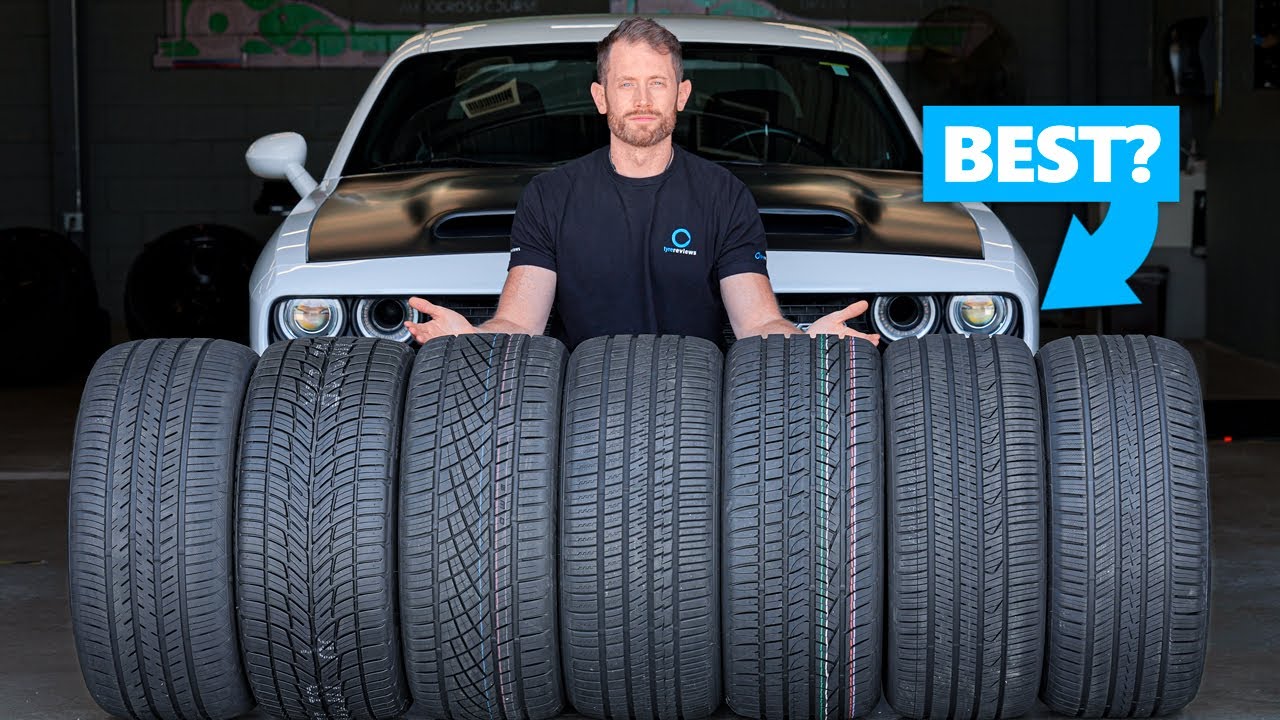
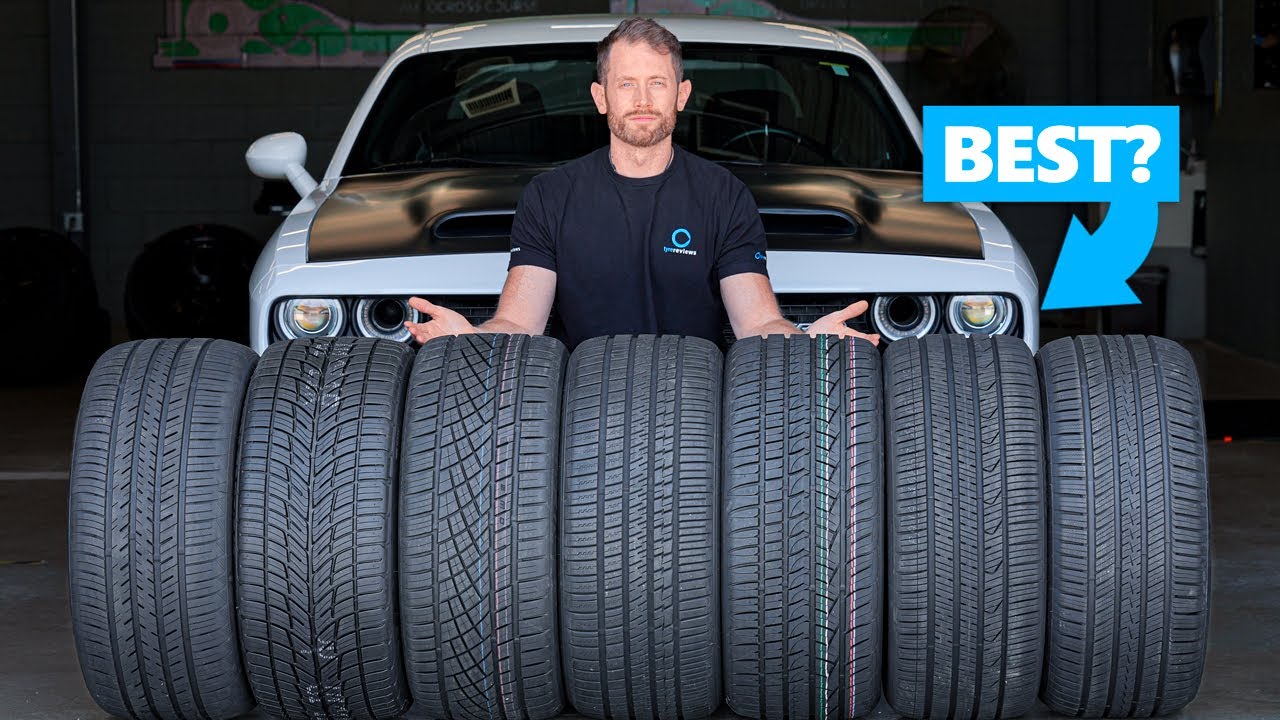
In this test I'll be comparing 7 of the most popular ultra high performance all season tyres to find out which tyre is best for you.
If you've read any of my previous all season tests, you'll be happy to know that six of the tyres in this test I've never tested before, and they include the brand new Pirelli P Zero AS 3 Plus and the brand new Falken Azenis FK460AS. The tyre I have tested before is one of the benchmarks of the segment, the Continental ExtremeContact DWS06+, so if you want to, you'll have a cross reference points to compare the tyres in this test to the tyres in the previous tests.
As always I'll be digging into the dry, wet, comfort and noise performance of the tyres, then in a later test I'll be looking at the snow performance, to give you a really complete overview of the tyres performances.
Testing Methodology
Test Driver
Jonathan Benson
Tyre Size
275/40 R20
Test Location
Professional Proving Ground
Test Year
2023
Tyres Tested
7
Show full testing methodologyHide methodology
Every tyre is tested using calibrated instrumented measurement and structured subjective assessment. Reference tyres are retested throughout each session to correct for changing conditions, ensuring fair, repeatable comparisons. Multiple reference sets are used where needed so that control tyre wear does not affect accuracy.
We use professional-grade testing equipment including GPS data loggers, accelerometers, and calibrated microphones. All tyres are broken in and conditioned before testing begins. For full details on our equipment, preparation process, and calibration procedures, see our complete testing methodology.
Categories Tested
Dry Braking
For dry braking, I drive the test vehicle at an entry speed of 110 km/h and apply full braking effort to a standstill with ABS active on clean, dry asphalt. I typically use an 100–5 km/h measurement window. My standard programme is five runs per tyre set where possible, although the sequence can extend to as many as fifteen runs if conditions and tyre category justify it. I analyse the full set of runs and discard statistical outliers before averaging. Reference tyres are run repeatedly throughout the session to correct for changing conditions.
Dry Handling
For dry handling, I drive at the limit of adhesion around a dedicated handling circuit with ESC disabled where possible so I can assess the tyre's natural balance, transient response, and limit behaviour without electronic intervention masking the result. I usually complete between two and five timed laps per tyre set, depending on the circuit, tyre type, and consistency of conditions. I exclude laps affected by clear driver error or obvious environmental inconsistency. Control runs are carried out frequently throughout the session, and I often use multiple sets of control tyres so that wear on the references does not become a meaningful variable. For more track-focused products, I also do endurance testing, which is a set number of laps at race pace to determine tire wear patterns and heat resistance over longer driving.
Subj. Dry Handling
Objective data is only part of the picture, so I also carry out a structured subjective handling assessment at the limit of adhesion on a dedicated dry handling circuit. I score steering precision, steering response, turn-in behaviour, mid-corner balance, corner-exit traction, breakaway characteristics, and overall confidence using a standardised 1–10 scale used consistently across my testing. The final assessment combines numeric scoring with written technical commentary. I complete familiarisation laps on the control tyre before evaluating each candidate.
Wet Braking
For wet braking, I drive the test vehicle at an entry speed of 88 km/h and apply full braking effort to a standstill with ABS active on an asphalt surface with a controlled water film. I typically use an 80–5 km/h measurement window to isolate tyre performance from variability in the initial brake application. My standard programme is eight runs per tyre set where possible, although the sequence can extend to as many as fifteen runs if conditions and tyre category justify it. I analyse the full set of runs and discard statistical outliers before averaging. To correct for changing conditions, I run reference tyres repeatedly throughout the session — in wet testing, typically every three candidate test sets.
Wet Handling
For wet handling, I drive at the limit of adhesion around a dedicated handling circuit. I generally use specialist wet circuits with kerb-watering systems designed to maintain a consistent surface condition. ESC is disabled where possible so I can assess the tyre's natural balance, transient response, and limit behaviour without electronic intervention masking the result. I usually complete between two and five timed laps per tyre set, depending on the circuit, tyre type, and consistency of conditions. I exclude laps affected by clear driver error or obvious environmental inconsistency. Control runs are carried out frequently throughout the session, and I often use multiple sets of control tyres so that wear on the references does not become a meaningful variable.
Subj. Wet Handling
Objective data is only part of the picture, so I also carry out a structured subjective handling assessment at the limit of adhesion on a dedicated wet handling circuit. I score steering precision, steering response, turn-in behaviour, mid-corner balance, aquaplaning resistance, breakaway characteristics, and overall confidence using a standardised 1–10 scale used consistently across my testing. The final assessment combines numeric scoring with written technical commentary. I complete familiarisation laps on the control tyre before evaluating each candidate.
Subj. Comfort
To assess comfort, I drive on a wide range of road surfaces (often dedicated comfort tracks at test facilities) at speeds from 50 to 120 km/h, including smooth motorway, coarse surfaces, expansion joints, broken pavement, and sharp-edged obstacles. I evaluate primary ride quality, secondary ride quality, impact harshness, seat-transmitted vibration, and the tyre's ability to absorb sharp inputs. Ratings are assigned on a 1–10 scale relative to the reference tyre.
Subj. Noise
For subjective noise assessment, I drive at constant speeds across multiple surface types with the windows closed, ventilation off, and audio system off. I assess overall noise level, tonal quality, cavity boom, pattern noise, broadband roar, and sensitivity to both speed and road texture. Each tyre is rated on a 1–10 scale and supported by written observations on noise character and annoyance.
Wear
I do not conduct tread wear testing myself; where wear is included in a programme, it is carried out by a contracted specialist test provider using either an on-road convoy method or an accelerated machine-based method. In convoy wear testing, multiple vehicles run a defined public-road route over an extended distance, with tread depth measured at intervals and tyres rotated methodically to reduce positional and vehicle-specific effects. In accelerated machine wear testing, the tyre is run on a specialised roadwheel or rough-surfaced drum system designed to simulate real-world wear under controlled load, speed, alignment, and force inputs. I then use the contracted provider's measured wear rate relative to the reference tyre to estimate projected tread life.
How each category is weighted in the overall score:
Dry40%
Dry Braking50%
Dry Handling45%
Subj. Dry Handling5%
Wet45%
Wet Braking50%
Wet Handling45%
Subj. Wet Handling5%
Comfort10%
Subj. Comfort50%
Subj. Noise50%
Value5%
Value100%
Wet
Starting with the wet performance of the tyres, this is arguably the most important aspect of the tyres they're meant for year round use in areas get mild to moderate winters. In short, they'll see a lot of wet running, and wet is where the good tyres separate themselves from the bad.
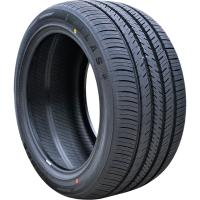
In last place was the Atlas Force UHP, which I believe is made by Linglong, a chinese company. This tyre is the cheapest tyre here, and might be sold as an all season tyre, but it looks like a very summer bias tread pattern, so we will have to see how it does in the snow testing, but in the wet, it was both the slowest and my least favourite subjectively. It wasn't a total disaster, even on this 717bhp hellcat with all the driver aids turned off, however it did have noticably less grip laterally, even without seeing the lap times, and once it started sliding it took longer to recover.
Next up was the group of BFGoodrich, General and Vredestein, all in the 49 second bracket and while their lap times were close, they did feel fairly different to each other.
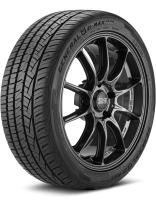
The BFGoodrich felt good when turning, but it didn't seem to stop or accelerate very easily, and was one of the tyres more upset by the deeper pockets of water on track, and the General was a similar story, feeling slightly more sporty, but these are tiny differences, and again seemed to get upset by the deeper water.
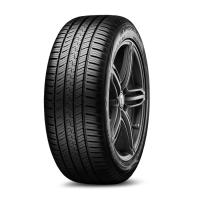
The Vredestein on the other hand was a different feeling tyre, it felt softer, more sluggish to turn, and offered less feedback than the previous two tyres, but had zero issues with standing water. It was incredibly easy to be consistent driving it, two of the three laps I drove were identical and the last was two one hundredths of a second slower. Quite a result, but of the 7 tyres, in the wet, it felt the least like a UHP tyre and more like a touring tyre.
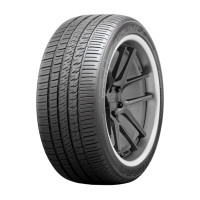
Next up nearly a second ahead, which is a lot of time on this short lap was the new Falken. This tyre felt good to steer, but it could have given me a little more detail at the limit through the steering wheel. Lots of grip, good quick steering but lacking the final few percent of detail at the limit. Good tyre though and had good traction out of the corners. For an all season tyre in the wet with a 717bhp RWD vehicle.
The second fastest lap time was posted by new Pirelli, feeling pretty similar to the new Falken. Perhaps not quite as direct to steer, but excellent grip and very good traction and brakes. As good as everything was with the Pirelli, I did find myself prone to making small mistakes when driving it, but I couldn't really tell you why, I think possibly a little detail missing on the front axle, and a slightly longer than ideal time for it to recover. But I'm really moaning over tiny details, you'll be happy with this tyre.
And finally, the Continental, it's not a new tyre, but it's still the best around wet handling. There were small amounts of hydroplaning, but the grip was immense, it turned really nicely, and was just an enjoyable all round experience.
Wet Handling
Spread: 2.86 s (6%)|Avg: 48.84 s
Wet handling time in seconds (Lower is better)
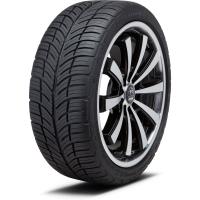
Continental ExtremeContact DWS 06
47.38 s
Pirelli P Zero AS Plus 3
47.83 s
Falken Azenis FK460 AS
48.24 s
Vredestein Hypertrac All Season
49.14 s
BFGoodrich g Force COMP 2 AS Plus
49.41 s
General G Max AS 05
49.66 s
Atlas Force UHP
50.24 s
As for the wet braking test, I was happy to find out there was a pretty decent correlation between wet braking and wet handling, which is always nice as it's not always the way. In percentage terms, the falken edged even closer to the Pirelli and Continental, with the rest of the pack slipping slightly further back, so we're seeing a bit of a separation between the top 3 and the rest.
Wet Braking
Spread: 5.60 M (12%)|Avg: 49.20 M
Wet braking in meters (Lower is better)
Pirelli P Zero AS Plus 3
46.70 M
Continental ExtremeContact DWS 06
46.90 M
Falken Azenis FK460 AS
47.30 M
Vredestein Hypertrac All Season
49.40 M
General G Max AS 05
50.60 M
Atlas Force UHP
51.20 M
BFGoodrich g Force COMP 2 AS Plus
52.30 M
Dry
The soft handling of the Vredestein in the wet was magnified in the dry, the tyre just didn't appreciate going quickly and had lots of noisy understeer. It was also the worst in dry braking.
The General posted exactly the same time, and while it felt a little tighter than the Vredestein, it also felt a little imprecise on this Challenger.
Then came the BFGoodrich and the Atlas. Both felt more sporty, with the BFG just having a little more understeer, but as we know understeer is safe. The Atlas was a surprise, punching well above its weight in dry handling, but given it looks like a summer pattern, perhaps this all makes sense.
The final trio of tyres were once again the Falken, Continental and Pirelli, in that order. Like in the wet, the Falken just needed a little more detail at the limit through the steering, the Continental felt great, and the Pirelli remained as fun as it's predecessor in the dry, and posted the best time overall.
Dry Handling
Spread: 1.03 s (2.4%)|Avg: 42.68 s
Dry handling time in seconds (Lower is better)
Pirelli P Zero AS Plus 3
42.14 s
Continental ExtremeContact DWS 06
42.27 s
Falken Azenis FK460 AS
42.52 s
BFGoodrich g Force COMP 2 AS Plus
42.75 s
Atlas Force UHP
42.76 s
General G Max AS 05
43.17 s
Vredestein Hypertrac All Season
43.17 s
The Continental proved to be the best at stopping the car, with the Falken a close second and the new Pirelli third.
Dry Braking
Spread: 3.70 M (10.7%)|Avg: 35.84 M
Dry braking in meters (Lower is better)
Continental ExtremeContact DWS 06
34.50 M
Falken Azenis FK460 AS
34.70 M
Pirelli P Zero AS Plus 3
35.20 M
Atlas Force UHP
35.30 M
BFGoodrich g Force COMP 2 AS Plus
36.10 M
General G Max AS 05
36.90 M
Vredestein Hypertrac All Season
38.20 M
Environment
Subj. Comfort
Spread: 5.00 Points (5%)|Avg: 97.00 Points
Subjective Comfort Score (Higher is better)
Vredestein Hypertrac All Season
100.00 Points
General G Max AS 05
98.00 Points
Atlas Force UHP
98.00 Points
Pirelli P Zero AS Plus 3
98.00 Points
Continental ExtremeContact DWS 06
95.00 Points
BFGoodrich g Force COMP 2 AS Plus
95.00 Points
Falken Azenis FK460 AS
95.00 Points
Subj. Noise
Spread: 5.00 Points (5%)|Avg: 97.86 Points
Subjective in car noise levels (Higher is better)
Vredestein Hypertrac All Season
100.00 Points
General G Max AS 05
98.00 Points
Atlas Force UHP
98.00 Points
BFGoodrich g Force COMP 2 AS Plus
98.00 Points
Falken Azenis FK460 AS
98.00 Points
Pirelli P Zero AS Plus 3
98.00 Points
Continental ExtremeContact DWS 06
95.00 Points
Price / Warranty
The Continental was the most expensive tyre on test, with the Atlas being the cheapest.
Price
Spread: 136.00 (90.1%)|Avg: 248.67
Price in local currency (Lower is better)
Atlas Force UHP
150.99
General G Max AS 05
249.99
Falken Azenis FK460 AS
252.00
Vredestein Hypertrac All Season
253.13
BFGoodrich g Force COMP 2 AS Plus
269.99
Pirelli P Zero AS Plus 3
277.60
Continental ExtremeContact DWS 06
286.99
The tyres broadly offered a similar tread life warranty.
Wear
Spread: 10000.00 KM (20%)|Avg: 47857.14 KM
Predicted tread life in KM (Higher is better)
General G Max AS 05
50000.00 KM
Continental ExtremeContact DWS 06
50000.00 KM
Vredestein Hypertrac All Season
50000.00 KM
Falken Azenis FK460 AS
50000.00 KM
Pirelli P Zero AS Plus 3
50000.00 KM
BFGoodrich g Force COMP 2 AS Plus
45000.00 KM
Atlas Force UHP
40000.00 KM
Using the purchase price and warranty, we can work out a cost per 1,000 miles driven.
Dollars/1000 miles based on mileage warranty (Lower is better)
Atlas Force UHP
3.77 Price/1000
General G Max AS 05
5.00 Price/1000
Falken Azenis FK460 AS
5.04 Price/1000
Vredestein Hypertrac All Season
5.06 Price/1000
Pirelli P Zero AS Plus 3
5.55 Price/1000
Continental ExtremeContact DWS 06
5.74 Price/1000
BFGoodrich g Force COMP 2 AS Plus
6.00 Price/1000
Results
For the overall results I've been debating whether to include the treadwear warranty against the price to factor in a price per mile value figure, as while a tread wear warranty isn't a true wear test, in theory the tyres should get there.
For these results I have, but there's a link below to the results page so you can play with it yourself and see what results you get.
It's so much work and data. On the one hand we are thankful you did something.
But, not really. I know you maintain that you cannot control the weather. But, it's not applicable. And, IMO the ambient temperature of the wet road test was not even measured or disclosed. Also, based on your short-sleeve shirt, it was too high to be of any real-world use, since it's still a very safe situation to be driving on warm roads. Given that you are testing all-season tires, IMO this research was not useful. You should have done the test at 5am or something, or gone to a different location, waited until it was closer to January, etc.
Legit question. This test is wackasaurus without the Michelins. They won YOUR previous ’22-’23 UHP all season tire test. Giving attitude to someone pointing out the obvious flaw in your test is weak sauce.
So, when does a premium All Season tyre become a UHP All Season Tyre? Who defines whether a tyre is Premium, UHP or is it defined by the characteristics of the tyre by the testers rather than the manufacturers :-) Given this new generation of All season tyres, and the fact that you can't buy the Michelin Pilot Sport all Season in Europe :-( , are any of these new all season tyres UHP ? Would be great to have the Premium/UHP/UUHP classification of each tyre included in the next test Sorry Jonathan that may mean more work for you !
It's actually quite simple, UHP all season tires are an american product which aren't three peak marked, so can't be sold in europe mostly because europeans expect anything called all season to be 3peak marked.
No one has really released anything like a US uhp all season, falken and dunlop both have sporty all seasons which are three peak marked, but what is needed to make a tyre three peak means they are no where near as performance as a UHP all season.
I am south UK based where we rarely get snow but am looking for an all season tyre that I could use to go up into the Alps where I would need the 3PMSF potentially in bad weather or chains. I am still debating which All Season tyre is best for on my Audi S4 Avant. All the tests suggest that the Michelin Crossclimate 2 is still the best all round tyre even when you reduce snow percentage. I had been debating the Continental AllSeasonContact 2 (due out in my sizes later this year allegedly). The state of the roads here in the UK is so bad now that I am actually dropping down rim size from 19" 245/35 R19 to 18" 245/40 R18 as the potholes are dreadful and the extra 1/2" tyre wall should help the ride quality and protect the rims. The debate is, is the MCC2 the best all Season tyre for UK incremental weather or do I just wait on the Michelin Pilot Sport S 5 and pop all season tyres on my 19" wheels for when I do into the Alps :-) Thoughts and opinions greatly appreciated.
You'll be waiting a while for the S5! My next all season test with the new conti, bridgestone, pirelli etc will be out in a few weeks, that might help.
Thank you so much Jonathan, I am eagerly awaiting your review as all your tests are excellent and I love your passion for tyres. Looking at the reviews and extrapolating it would look like the Continental SportContact 7 is still going to outperform the MPS S5 anyway. Following on from your earlier reviews I have put the SportContact 7s on my wife's Audi S3 and it is absolutely superb. The Audi S4 is going to be used for long distance touring over the next 3 to 4 years so I am sorely tempted just to stick the SportContact 7s on that as well and if/when we go into the Alps address that problem when I come to it as it will only be for 1-2 months max. Having said that the new Bridgestone Turanza allseason 6 does look like it could be the perfect tire for UK wet weather where Snow is a rarity :-) Trust me when I say that I will not be buying new tires until I have read your next All Season tire review :-D


It's so much work and data. On the one hand we are thankful you did something.
But, not really. I know you maintain that you cannot control the weather. But, it's not applicable. And, IMO the ambient temperature of the wet road test was not even measured or disclosed. Also, based on your short-sleeve shirt, it was too high to be of any real-world use, since it's still a very safe situation to be driving on warm roads. Given that you are testing all-season tires, IMO this research was not useful. You should have done the test at 5am or something, or gone to a different location, waited until it was closer to January, etc.
Why did you leave out the Michelin Pilot Sport All Season 4 to compare to Pirelli pZero AS Plus 3 and Continental ExtremeContact DWS 06 PLUS ???
This is a while back but I think it was explained in the comments of the video?
Legit question. This test is wackasaurus without the Michelins. They won YOUR previous ’22-’23 UHP all season tire test. Giving attitude to someone pointing out the obvious flaw in your test is weak sauce.
It was not meant as attitude, I couldn't remember if I'd explained it in the video, hence the question mark.
Roger that. I mentioned the Michelin cuz you’re the top G for tire comparisons and I depend on your reviews.
So, when does a premium All Season tyre become a UHP All Season Tyre? Who defines whether a tyre is Premium, UHP or is it defined by the characteristics of the tyre by the testers rather than the manufacturers :-)
Given this new generation of All season tyres, and the fact that you can't buy the Michelin Pilot Sport all Season in Europe :-( , are any of these new all season tyres UHP ? Would be great to have the Premium/UHP/UUHP classification of each tyre included in the next test
Sorry Jonathan that may mean more work for you !
It's actually quite simple, UHP all season tires are an american product which aren't three peak marked, so can't be sold in europe mostly because europeans expect anything called all season to be 3peak marked.
No one has really released anything like a US uhp all season, falken and dunlop both have sporty all seasons which are three peak marked, but what is needed to make a tyre three peak means they are no where near as performance as a UHP all season.
Great to know, Thank you
I am south UK based where we rarely get snow but am looking for an all season tyre that I could use to go up into the Alps where I would need the 3PMSF potentially in bad weather or chains. I am still debating which All Season tyre is best for on my Audi S4 Avant. All the tests suggest that the Michelin Crossclimate 2 is still the best all round tyre even when you reduce snow percentage. I had been debating the Continental AllSeasonContact 2 (due out in my sizes later this year allegedly). The state of the roads here in the UK is so bad now that I am actually dropping down rim size from 19" 245/35 R19 to 18" 245/40 R18 as the potholes are dreadful and the extra 1/2" tyre wall should help the ride quality and protect the rims. The debate is, is the MCC2 the best all Season tyre for UK incremental weather or do I just wait on the Michelin Pilot Sport S 5 and pop all season tyres on my 19" wheels for when I do into the Alps :-) Thoughts and opinions greatly appreciated.
You'll be waiting a while for the S5! My next all season test with the new conti, bridgestone, pirelli etc will be out in a few weeks, that might help.
Thank you so much Jonathan, I am eagerly awaiting your review as all your tests are excellent and I love your passion for tyres. Looking at the reviews and extrapolating it would look like the Continental SportContact 7 is still going to outperform the MPS S5 anyway. Following on from your earlier reviews I have put the SportContact 7s on my wife's Audi S3 and it is absolutely superb. The Audi S4 is going to be used for long distance touring over the next 3 to 4 years so I am sorely tempted just to stick the SportContact 7s on that as well and if/when we go into the Alps address that problem when I come to it as it will only be for 1-2 months max. Having said that the new Bridgestone Turanza allseason 6 does look like it could be the perfect tire for UK wet weather where Snow is a rarity :-) Trust me when I say that I will not be buying new tires until I have read your next All Season tire review :-D